Subscribe for our latest news, straight to your inbox:
Thank you! Your submission has been received!
Oops! Something went wrong while submitting the form.
Share this post
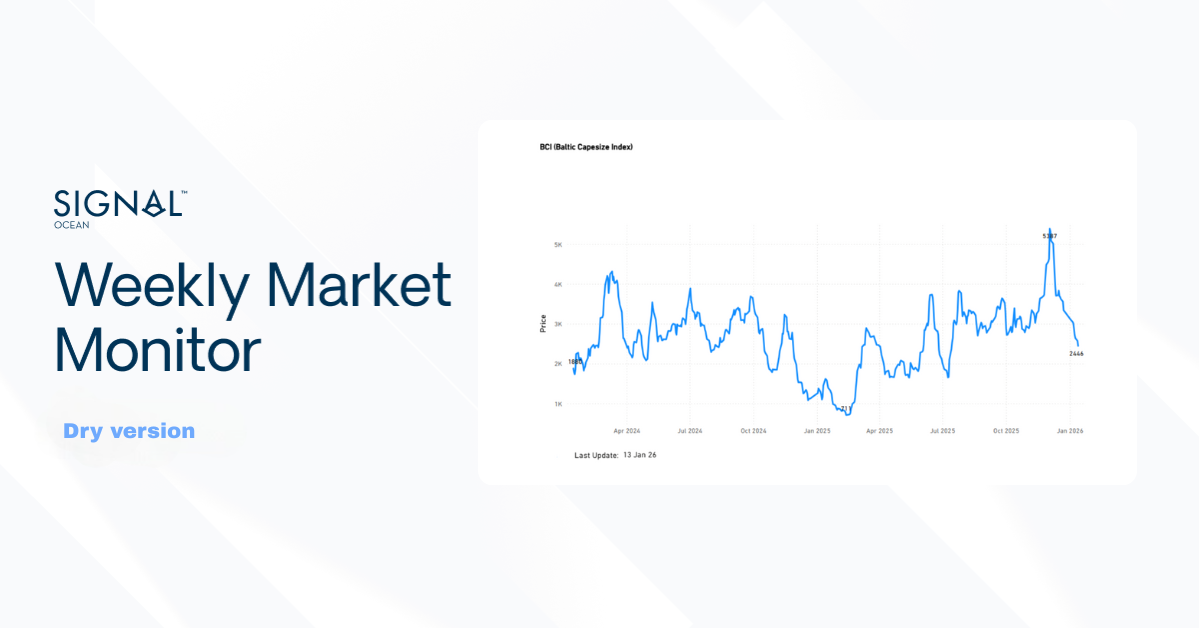
Chart of the Week| Daily Freight Assessments: BCI
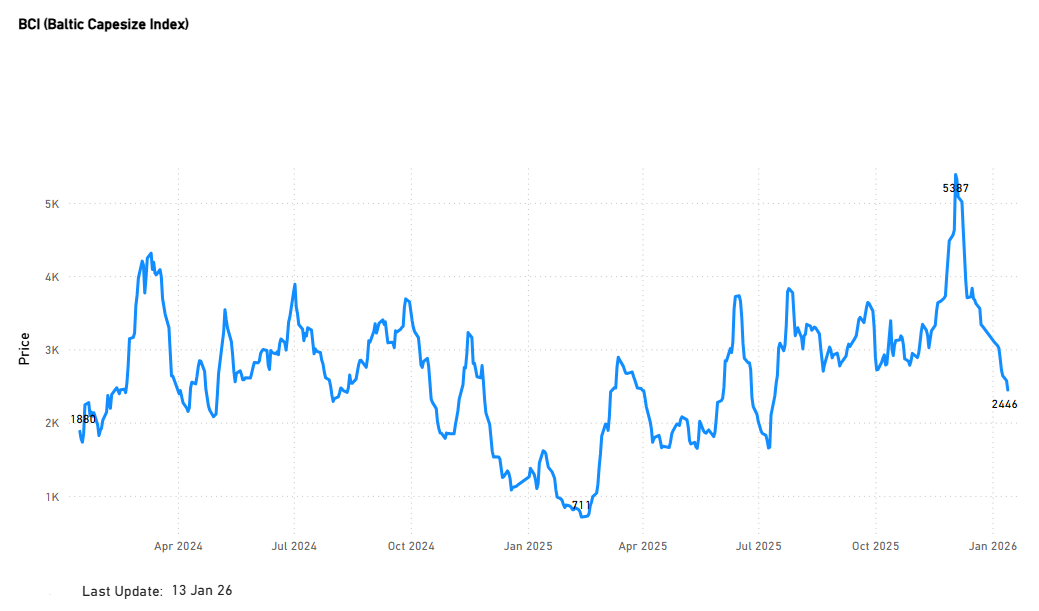
Sharp correction since the December peak highlights near-term pressure, though levels remain above last year (+51%)
Key Takeaways
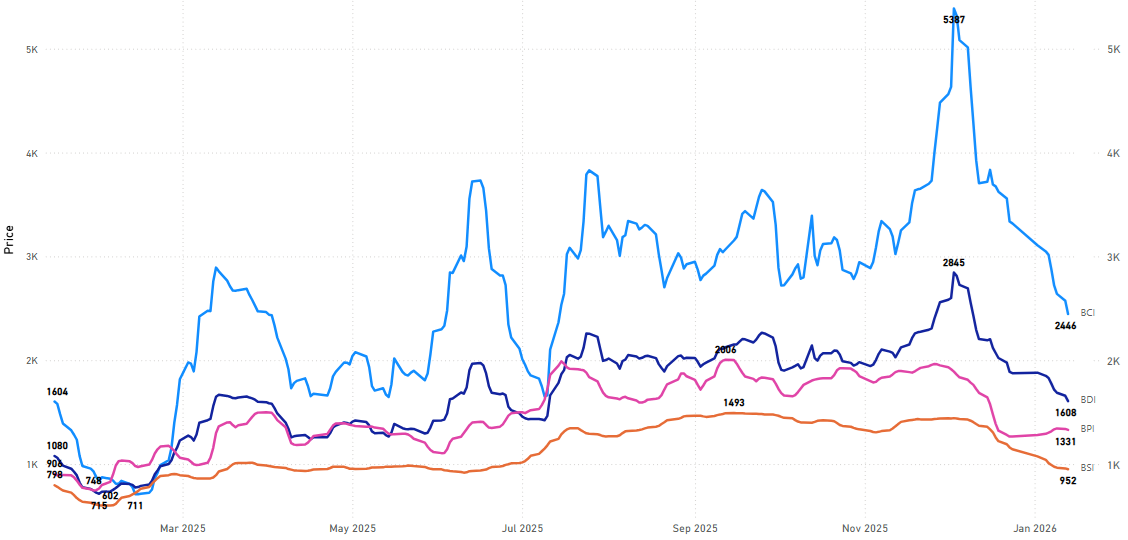
The Baltic Dry Index opens the year on weaker momentum, driven primarily by sustained pressure in the Capesize freight market.
A pronounced correction has unfolded since the early-December peak, although losses remain contained on a year-on-year basis.
Market sentiment is turning more supportive as expectations of Chinese policy support lift iron ore prices and improve forward demand signals.
Market Overview
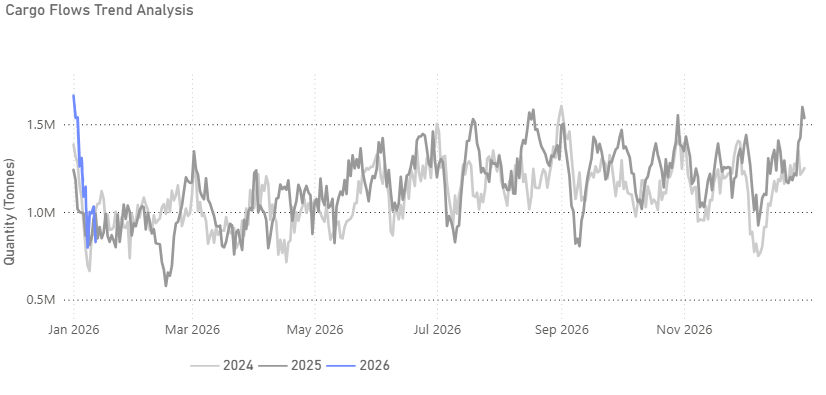
The start of the year has seen the BDI come under renewed pressure, with Capesize rates continuing to lead the downside. Following a strong rally into early December, the segment has experienced a noticeable downward correction, reflecting softer spot-fixing activity, seasonal demand headwinds, and a temporary slowdown in iron ore cargo flows.
Despite the recent weakness, the market pulse remains stronger than it was a year ago. Looking ahead, sentiment is expected to improve gradually. Iron ore prices have strengthened in recent sessions amid growing expectations that the Chinese cabinet will announce a new package of stimulus measures aimed at supporting economic growth and infrastructure activity. If confirmed, such policy support could help strengthen Capesize earnings and provide a near-term floor for the BDI as the quarter progresses.
Brazilian Iron Ore Shipments | Early-Year Flows Turning Lower
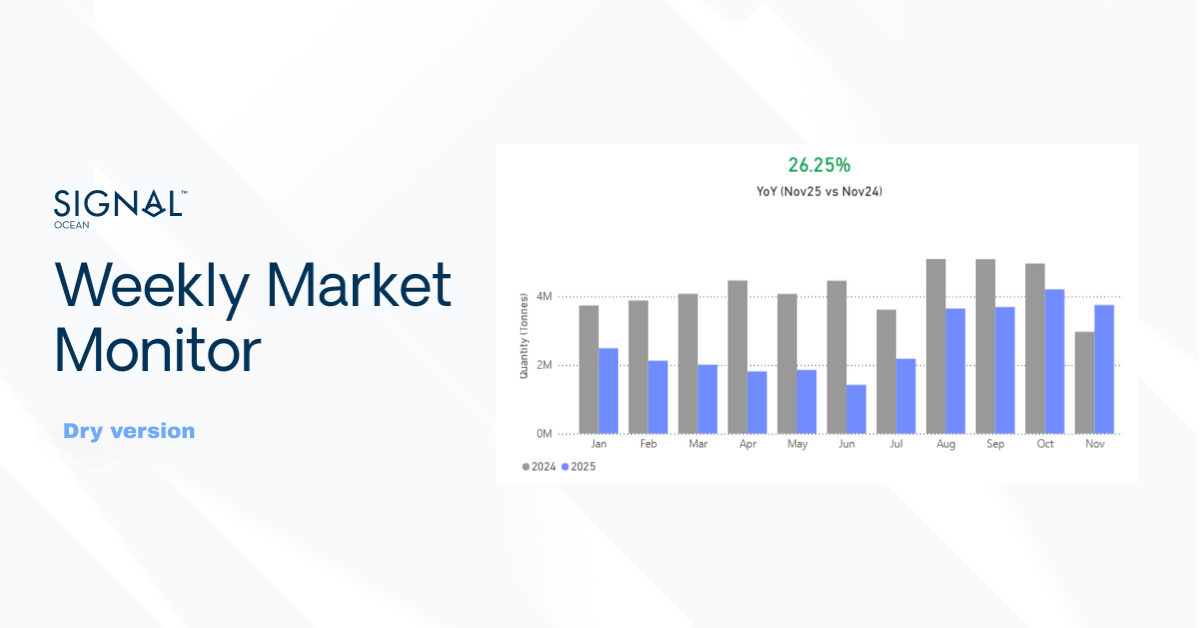
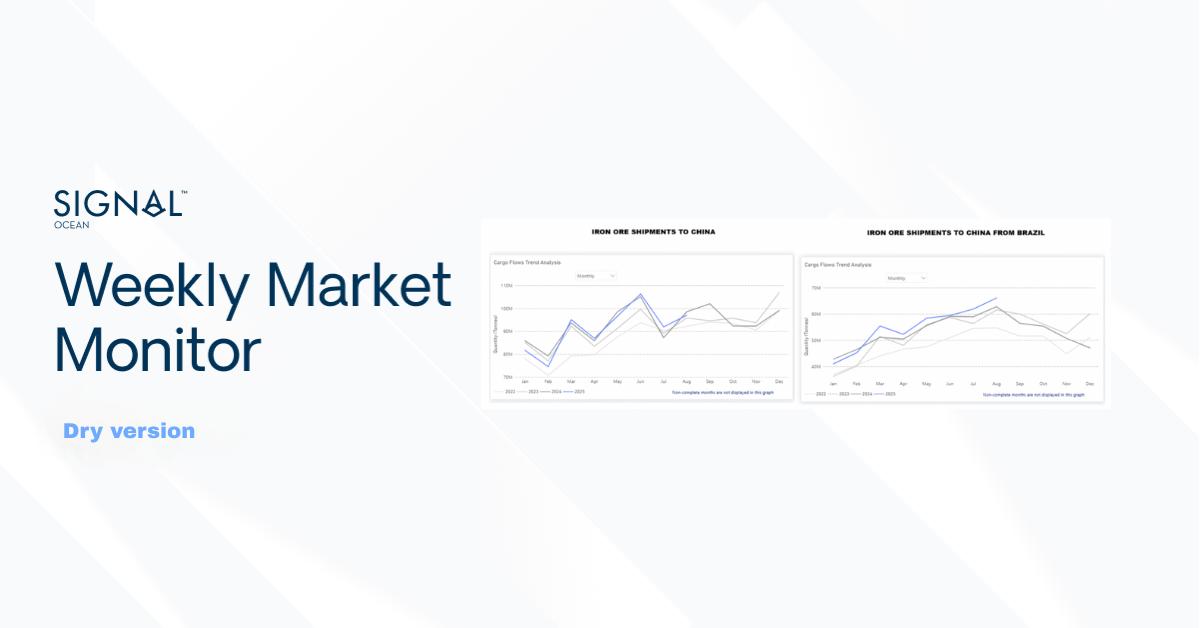
As of 12 January, Brazilian iron ore shipments on a 7-day moving-average basis are estimated to be ~2.6% lower year-on-year versus the same early-January period in 2024. The latest 7-day average also suggests early-2026 shipments are running ~16% below early-2025 levels and ~18% below early-2024, based on Signal Ocean data.
FREIGHT MARKET Weaker
Market price trends depicted are based on Signal Ocean Assessments. For real-time updates and historical comparisons, access our Freight Market Analytics dashboard here: Signal Ocean Freight Market Analytics.
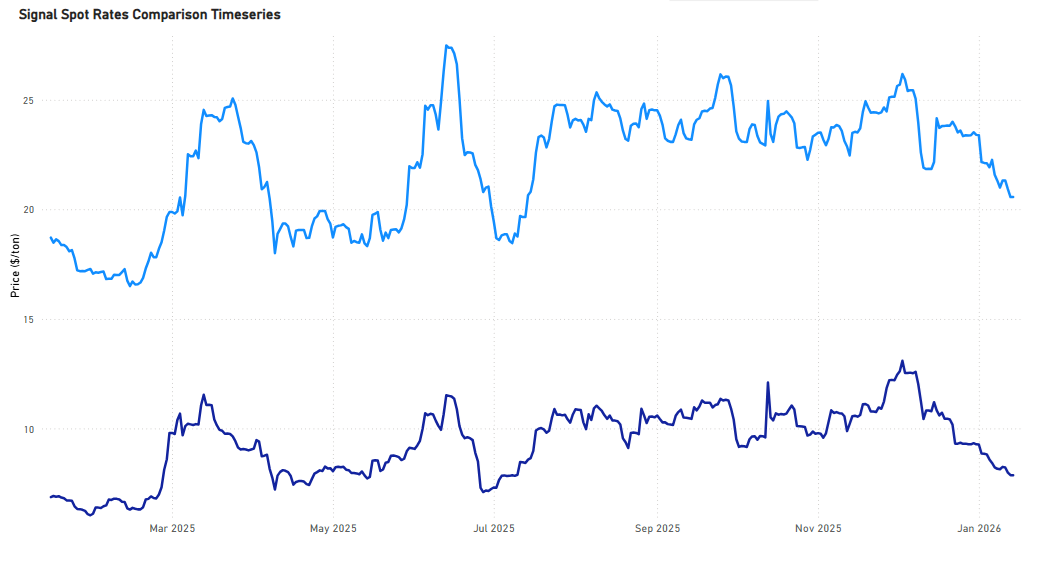
The recent drop in the BDI is led by a sharp correction in Capesize (BCI), whereas Panamax, Supramax, and Handysize markets have shown comparatively milder declines.
Capesize | Weaker
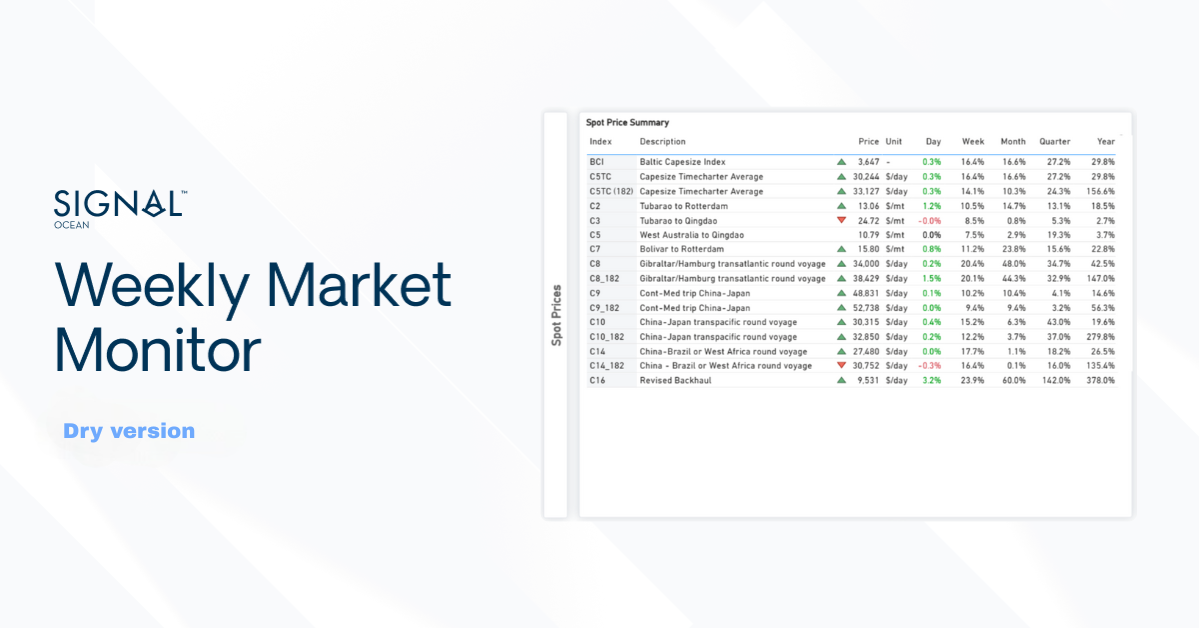
Cape freight rates on the Brazil–China and WAus–China routes have trended lower since early December, following a clear summer peak reached mid-year. The continued easing into mid-January signals a soft start to the year, with rates losing momentum during the first month of 2026.
This early-year weakness is not unexpected. Seasonal demand typically remains subdued ahead of the Lunar New Year, with stronger freight signals more likely to emerge toward the end of the holiday period and into late Q1. At the same time, Brazilian iron ore supply is already scheduled to ramp up, supporting expectations of firmer cargo volumes later in the quarter.
Latest estimates for Brazilian iron ore production in Q1 also point to solid output levels, This soft start to the year occurs against a backdrop of record Brazilian iron ore exports in 2025, which grew about 7.1% y/y and surpassed 400 million tonnes for the first time, and production guidance for 2026 that remains robust, with leading miners projecting similar output bands to 2025. Vale expects iron ore production in 2026 to be in the range of 335–345 million tons, reflecting output continuity and industry capacity, even as some forecasts were revised downward.
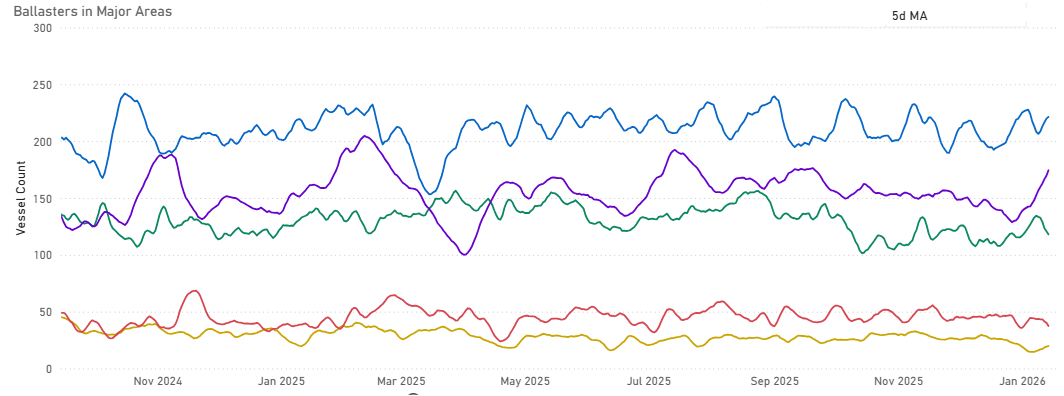
Ballast counts are building most notably in IO/SA, which remains the largest accumulation area at 183 vessels (+12% WoW). The Pacific is also showing increased availability, led by Australasia at 231 vessels (+14% WoW). In the Atlantic, NATL rose sharply in percentage terms (+29% WoW), while SATL declined to 36 vessels (-14% WoW). FEAST/NOPAC eased slightly to 126 vessels (-3% WoW).
Iron Ore Macro & Supply-Demand Update
China – Demand-Side Signals
Chinese steel mills increased short-term procurement, but buying behavior remains largely hand-to-mouth, reflecting weak confidence in underlying steel demand.
Blast furnace utilisation has improved marginally, though construction activity remains subdued, limiting upside to steel demand.
Port iron ore inventories have declined modestly but remain at historically comfortable levels.
Miners & Supply News
Rio Tinto: Pilbara iron ore shipments have continued steadily, with no material supply disruptions reported.
BHP: Australian iron ore exports have continued normally, supported by early-year Chinese buying interest.
India
NMDC announced January pricing adjustments reflecting domestic market conditions rather than changes in seaborne trade.
In India’s Goa region, iron ore auction delays have again been reported, constraining local supply but with no material impact on the global market.
For subscription to our FREE weekly market trends email, please contact us: research@thesignalgroup.com
-Republishing is allowed with an active link to the source
Creating a sustainable world requires us to embark on a journey towards a zero emission future, where every step is a commitment to preserve our planet for future generations.
Albert Greenway
Environmental Scientist, Sustainability Expert
No items found.
Increased Use of Renewable Energy:
Shipping companies are embracing renewable energy sources to power onboard systems and reduce emissions during port operations. Solar panels and wind turbines are being installed on vessels to generate clean energy, reducing reliance on auxiliary engines, and cutting down emissions. Shore power facilities in ports allow ships to connect to the electrical grid, eliminating the need for onboard generators while docked.
Collaboration and Industry Partnerships:
Recognizing that addressing emissions requires collective action, shipping companies, governments, and organizations have formed partnerships and collaborations. These initiatives focus on research and development, sharing best practices, and promoting knowledge transfer. Joint projects aim to develop and deploy innovative technologies, improve infrastructure, and create a supportive regulatory framework to accelerate the industry's transition towards a greener future. The Zero Emission Shipping - Mission Innovation.
To pave the way for a greener future in shipping, the availability of alternative fuels plays a vital role in their widespread adoption. However, this availability is influenced by factors such as port infrastructure, local regulations, and government policies. As the demand for cleaner fuels in shipping rises and environmental regulations become more stringent, efforts are underway to improve the accessibility of these fuels through infrastructure development, collaborations, and investments in production facilities.
Liquefied Natural Gas (LNG) infrastructure has seen significant growth in recent years, resulting in more LNG bunkering facilities and LNG-powered vessels. Nonetheless, the availability of LNG as a marine fuel can still vary depending on the region. To ensure consistent availability worldwide, there is a need for further development of LNG supply chains and infrastructure. For biofuels, their availability hinges on production capacity and the availability of feedstock. Although biofuels are being produced and utilized in various sectors, their availability as a marine fuel remains limited. Scaling up biofuel production and establishing robust supply chains are imperative to ensure wider availability within the shipping industry.Hydrogen, as a fuel for maritime applications, is still in the early stages of infrastructure development. While some hydrogen vessels have been tested or introduced in the first quarter of last year, the infrastructure required for hydrogen production and distribution needs further advancement.
Ammonia, as a marine fuel, currently faces limitations in availability. The production, storage, and handling infrastructure for ammonia need further development to support its widespread use in the shipping industry.Methanol, on the other hand, is already a commercially available fuel and has been used as a blend with conventional fuels in some ships. However, its availability as a standalone marine fuel can still be limited in certain regions. Bureau Veritas in October 2022 published a White Paper for the Alternative Fuels Outlook. This white paper provides a comprehensive overview of alternative fuels for the shipping industry, taking into account key factors such as technological maturity, availability, safety, emissions, and regulations.
Creating a sustainable world requires us to embark on a journey towards a zero emission future, where every step is a commitment to preserve our planet for future generations.
Albert Greenway
Environmental Scientist, Sustainability Expert
Increased Use of Renewable Energy:
Shipping companies are embracing renewable energy sources to power onboard systems and reduce emissions during port operations. Solar panels and wind turbines are being installed on vessels to generate clean energy, reducing reliance on auxiliary engines, and cutting down emissions. Shore power facilities in ports allow ships to connect to the electrical grid, eliminating the need for onboard generators while docked.
Collaboration and Industry Partnerships:
Recognizing that addressing emissions requires collective action, shipping companies, governments, and organizations have formed partnerships and collaborations. These initiatives focus on research and development, sharing best practices, and promoting knowledge transfer. Joint projects aim to develop and deploy innovative technologies, improve infrastructure, and create a supportive regulatory framework to accelerate the industry's transition towards a greener future. The Zero Emission Shipping - Mission Innovation.
To pave the way for a greener future in shipping, the availability of alternative fuels plays a vital role in their widespread adoption. However, this availability is influenced by factors such as port infrastructure, local regulations, and government policies. As the demand for cleaner fuels in shipping rises and environmental regulations become more stringent, efforts are underway to improve the accessibility of these fuels through infrastructure development, collaborations, and investments in production facilities.
Liquefied Natural Gas (LNG) infrastructure has seen significant growth in recent years, resulting in more LNG bunkering facilities and LNG-powered vessels. Nonetheless, the availability of LNG as a marine fuel can still vary depending on the region. To ensure consistent availability worldwide, there is a need for further development of LNG supply chains and infrastructure. For biofuels, their availability hinges on production capacity and the availability of feedstock. Although biofuels are being produced and utilized in various sectors, their availability as a marine fuel remains limited. Scaling up biofuel production and establishing robust supply chains are imperative to ensure wider availability within the shipping industry.Hydrogen, as a fuel for maritime applications, is still in the early stages of infrastructure development. While some hydrogen vessels have been tested or introduced in the first quarter of last year, the infrastructure required for hydrogen production and distribution needs further advancement.
Ammonia, as a marine fuel, currently faces limitations in availability. The production, storage, and handling infrastructure for ammonia need further development to support its widespread use in the shipping industry.Methanol, on the other hand, is already a commercially available fuel and has been used as a blend with conventional fuels in some ships. However, its availability as a standalone marine fuel can still be limited in certain regions. Bureau Veritas in October 2022 published a White Paper for the Alternative Fuels Outlook. This white paper provides a comprehensive overview of alternative fuels for the shipping industry, taking into account key factors such as technological maturity, availability, safety, emissions, and regulations.

.webp)












.png)
.png)


.png)
.png)
.png)

.png)
.png)
.png)
.png)
.png)
.png)
.png)
.png)
.png)
.png)
.png)
.png)


.avif)
.avif)
.avif)
.avif)
.avif)
.avif)
.avif)


.avif)
.avif)
.avif)

.avif)


.avif)
.avif)


.avif)
.avif)
.avif)
.avif)
.avif)
.avif)
.avif)
.png)


.avif)
.avif)
.avif)
.avif)
.png)

.avif)
