Subscribe for our latest news, straight to your inbox:
Thank you! Your submission has been received!
Oops! Something went wrong while submitting the form.
Share this post
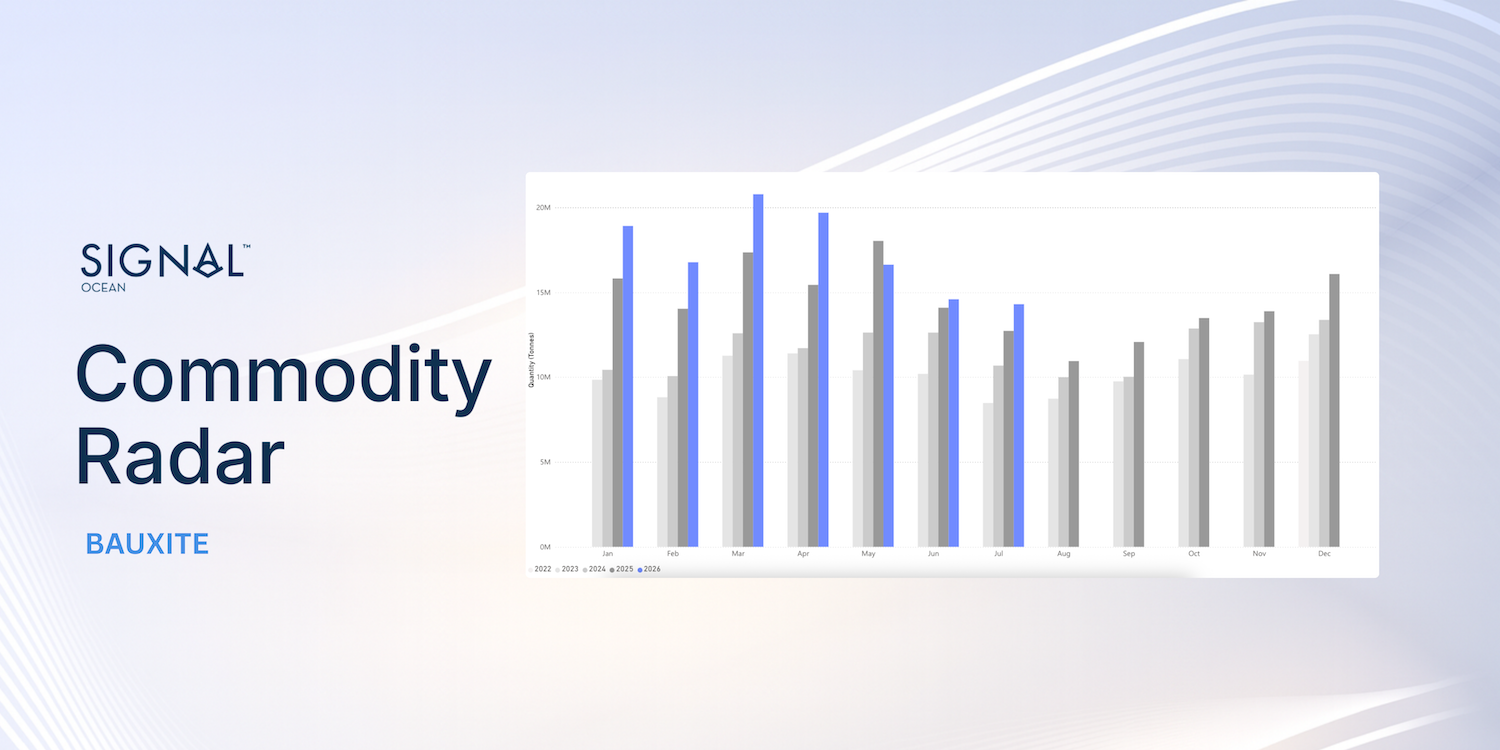
COMMODITY RADAR | Spotlight: BAUXITE
Bauxite offers real positivity for capesizes
Bauxite continues to climb, with a positive downstream outlook, capesize demand could feel the benefit.
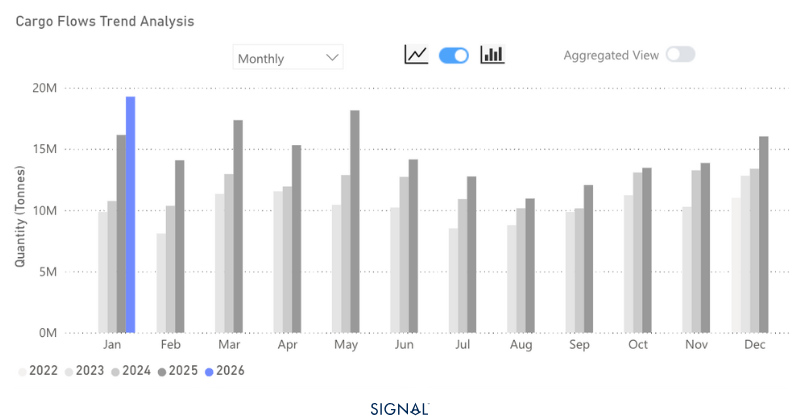
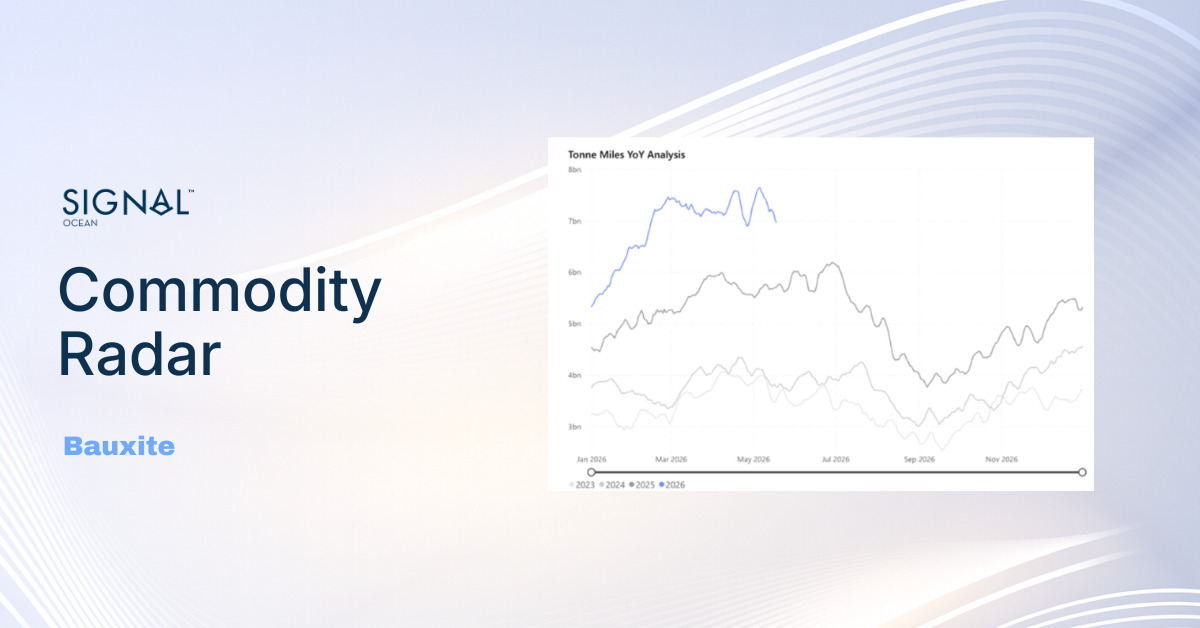
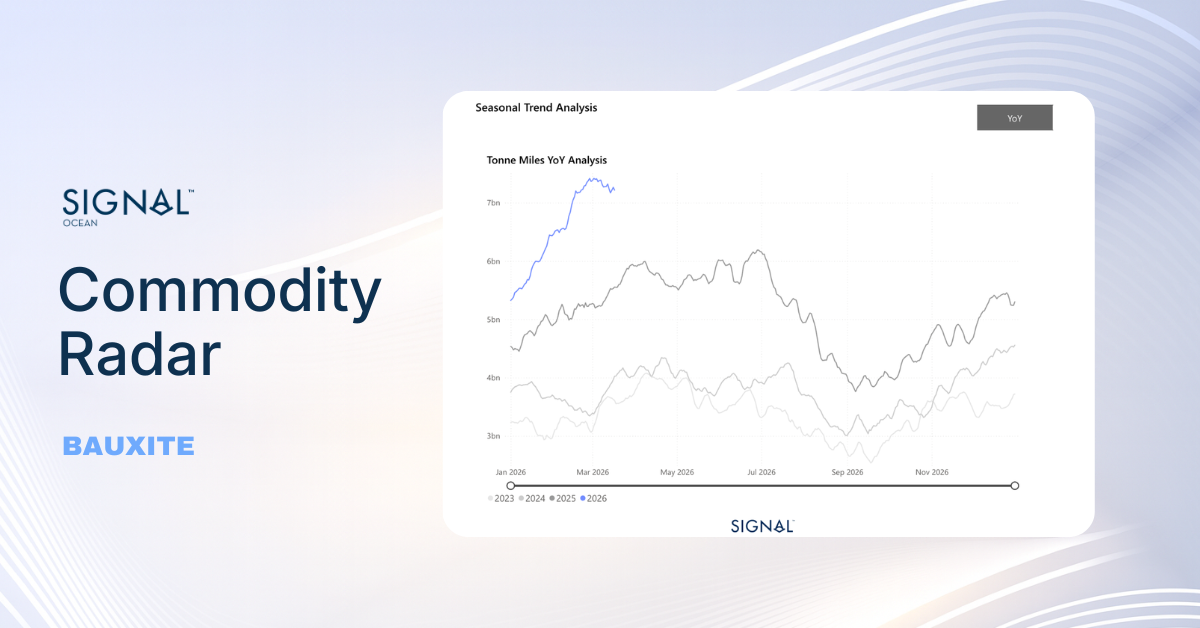
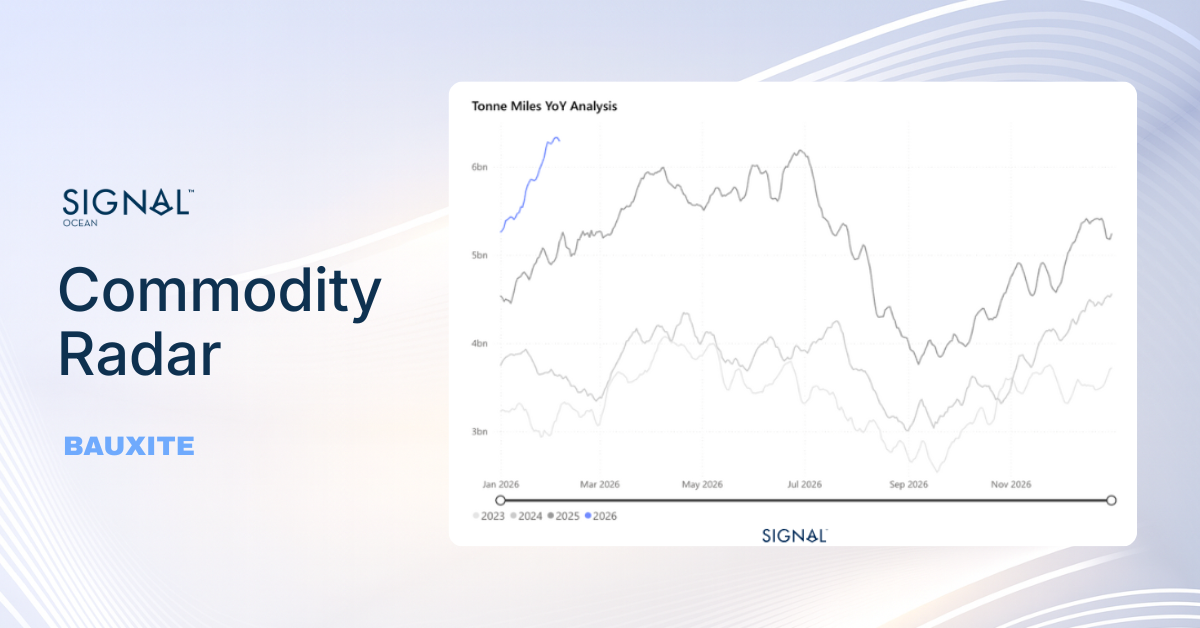
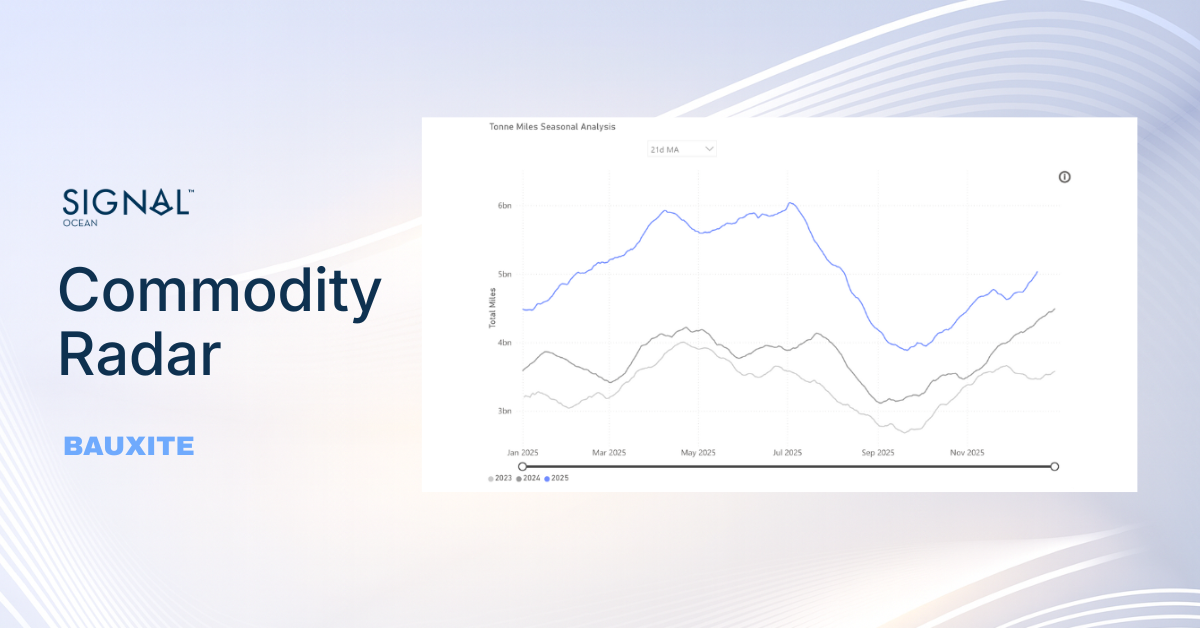
Bauxite flows increased by 18% in 2025.
Flows have increased outside of China by 1% y/y.
Flows to China have increased by 22%.
2026 has seen further expansion so far, as January flows up 12% y/y. Deteriorating domestic bauxite quality in China and a rise in alumina production for export could help to continue the increase.
Source: Bauxite carrying Capesize tonne-miles from Signal Ocean
Bauxite was the best performing of the three capesize demand-driving commodities in 2025, outpacing iron ore and coal in terms of tonne-mile growth. Bauxite flows reached 258mt, up 18% from 2024. The market is dominated on the supply side by Guinea, the origin for 68% of all the bauxite flows, and on the demand side by China, the destination for 85% of all seaborne bauxite flows on TSOP.
This trend has continued in 2026, with the full January figures showing 25mt of bauxite flows, up 12% y/y. So far, 77% of bauxite flows have originated in Guinea, with China being the destination for 86% of the tonnage.
The first month of 2026 has seen 25mt of bauxite flows, up 14% y/y. Unsurprisingly, Guinea and China dominate in terms of origin and destination, respectively, with 77% originating from the former and 86% of global flows heading to the latter. Flows from Guinea are up 19% y/y in January 2026, equating to 19mt. This increase is matched by China’s increased imports, which are also up 19% over the same period.
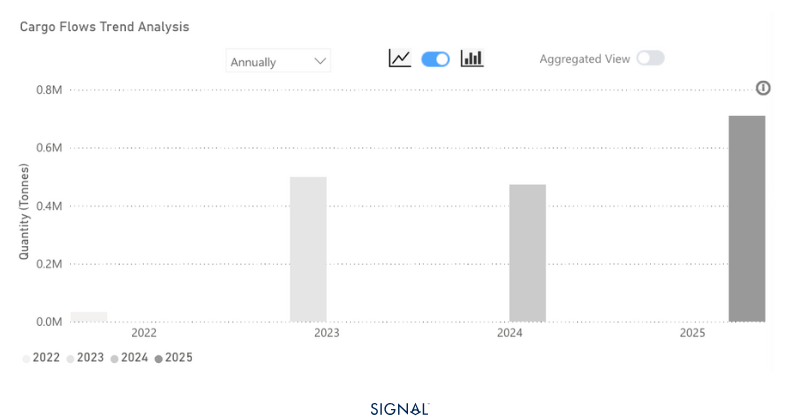
China’s increased demand in 2026 is likely to continue. While the 45mt annual cap on aluminium production in China remains, domestic alumina capacity is set to expand to 119mt, 9mt higher than in 2025. This alumina is likely to find its way to Indonesia as the country rapidly expands its own aluminium production capacity.
Indonesia banned bauxite exports in 2023, in order to secure material for its own processing and then export higher-value products. The issue is that, despite such large bauxite reserves and production, alumina production capacity is too low, leading to large bauxite stockpiles that cannot be processed or exported. Indonesia reportedly relies on imports for around half of its alumina needs.
Source: China's alumina flows to Indonesia from Signal Ocean
Bauxite and Simandou keep West Africa a key growth area for Capesize demand
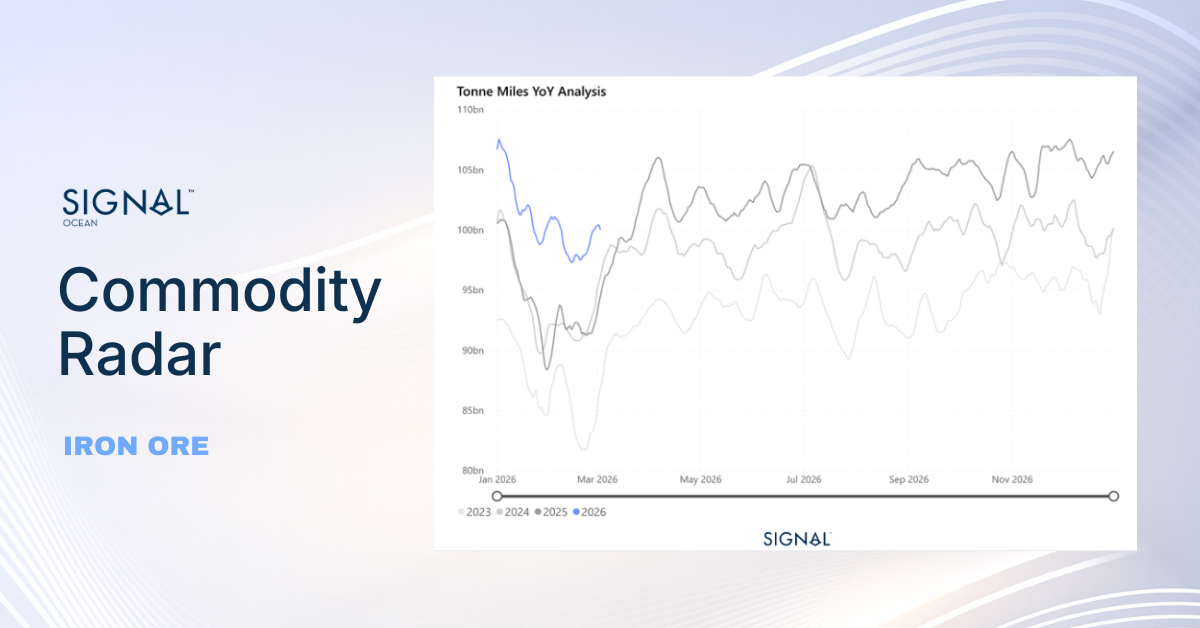
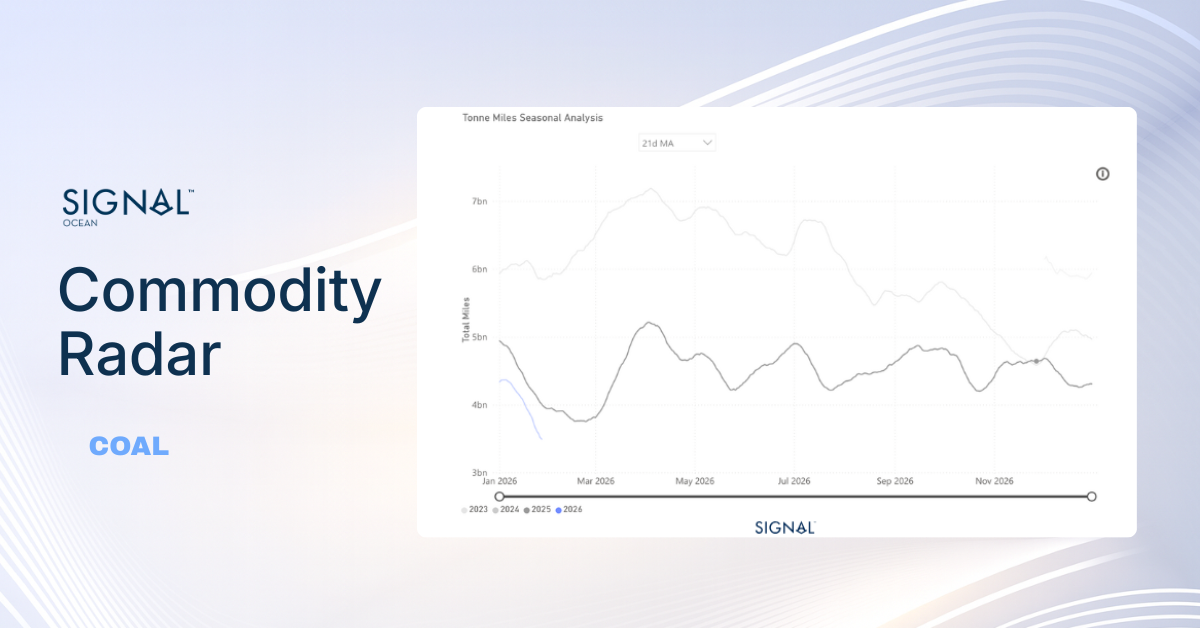
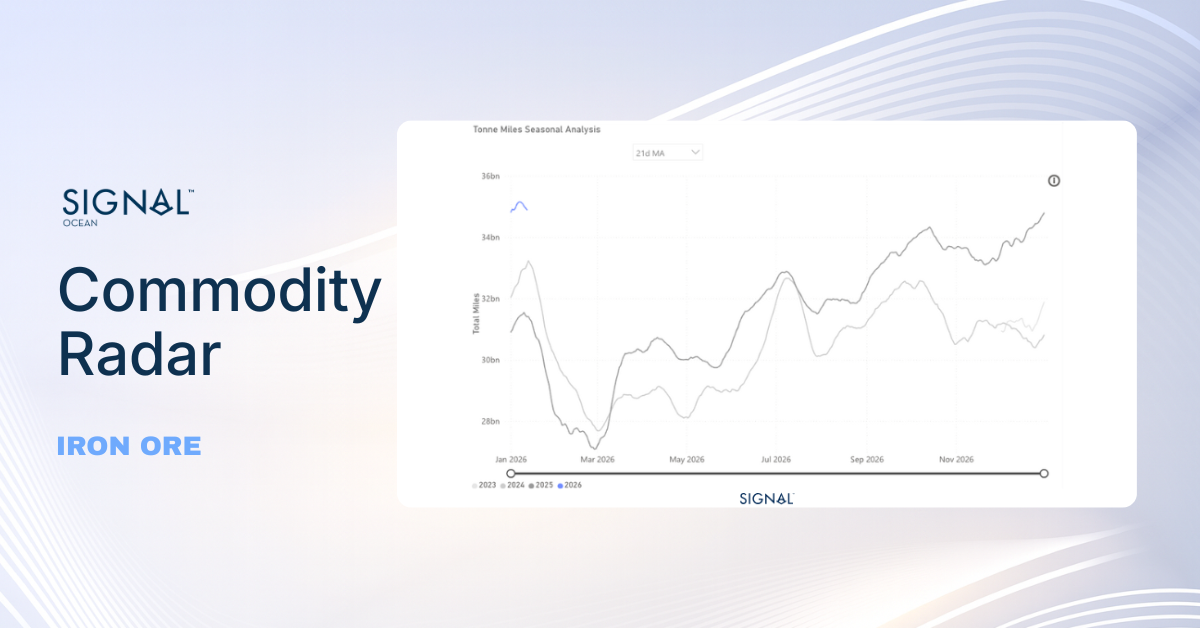
Our view of strong bauxite demand will be a positive light for capesize demand at a time when both iron ore and coal are showing signs of structural decline. What’s more is that with the opening of the Simandou iron ore mine in Guinea, West Africa has further solidified itself as a key origination area for cape demand.
For subscription to our FREE weekly market trends email, please click here, or contact us at: research@thesignalgroup.com
- Republishing is allowed with an active link to the source
Luke has over 8-years of experience analysing and forecasting commodity markets, with particular expertise in stainless steel raw materials and the wider metals markets.
Creating a sustainable world requires us to embark on a journey towards a zero emission future, where every step is a commitment to preserve our planet for future generations.
Albert Greenway
Environmental Scientist, Sustainability Expert
No items found.
Increased Use of Renewable Energy:
Shipping companies are embracing renewable energy sources to power onboard systems and reduce emissions during port operations. Solar panels and wind turbines are being installed on vessels to generate clean energy, reducing reliance on auxiliary engines, and cutting down emissions. Shore power facilities in ports allow ships to connect to the electrical grid, eliminating the need for onboard generators while docked.
Collaboration and Industry Partnerships:
Recognizing that addressing emissions requires collective action, shipping companies, governments, and organizations have formed partnerships and collaborations. These initiatives focus on research and development, sharing best practices, and promoting knowledge transfer. Joint projects aim to develop and deploy innovative technologies, improve infrastructure, and create a supportive regulatory framework to accelerate the industry's transition towards a greener future. The Zero Emission Shipping - Mission Innovation.
To pave the way for a greener future in shipping, the availability of alternative fuels plays a vital role in their widespread adoption. However, this availability is influenced by factors such as port infrastructure, local regulations, and government policies. As the demand for cleaner fuels in shipping rises and environmental regulations become more stringent, efforts are underway to improve the accessibility of these fuels through infrastructure development, collaborations, and investments in production facilities.
Liquefied Natural Gas (LNG) infrastructure has seen significant growth in recent years, resulting in more LNG bunkering facilities and LNG-powered vessels. Nonetheless, the availability of LNG as a marine fuel can still vary depending on the region. To ensure consistent availability worldwide, there is a need for further development of LNG supply chains and infrastructure. For biofuels, their availability hinges on production capacity and the availability of feedstock. Although biofuels are being produced and utilized in various sectors, their availability as a marine fuel remains limited. Scaling up biofuel production and establishing robust supply chains are imperative to ensure wider availability within the shipping industry.Hydrogen, as a fuel for maritime applications, is still in the early stages of infrastructure development. While some hydrogen vessels have been tested or introduced in the first quarter of last year, the infrastructure required for hydrogen production and distribution needs further advancement.
Ammonia, as a marine fuel, currently faces limitations in availability. The production, storage, and handling infrastructure for ammonia need further development to support its widespread use in the shipping industry.Methanol, on the other hand, is already a commercially available fuel and has been used as a blend with conventional fuels in some ships. However, its availability as a standalone marine fuel can still be limited in certain regions. Bureau Veritas in October 2022 published a White Paper for the Alternative Fuels Outlook. This white paper provides a comprehensive overview of alternative fuels for the shipping industry, taking into account key factors such as technological maturity, availability, safety, emissions, and regulations.
Creating a sustainable world requires us to embark on a journey towards a zero emission future, where every step is a commitment to preserve our planet for future generations.
Albert Greenway
Environmental Scientist, Sustainability Expert
Increased Use of Renewable Energy:
Shipping companies are embracing renewable energy sources to power onboard systems and reduce emissions during port operations. Solar panels and wind turbines are being installed on vessels to generate clean energy, reducing reliance on auxiliary engines, and cutting down emissions. Shore power facilities in ports allow ships to connect to the electrical grid, eliminating the need for onboard generators while docked.
Collaboration and Industry Partnerships:
Recognizing that addressing emissions requires collective action, shipping companies, governments, and organizations have formed partnerships and collaborations. These initiatives focus on research and development, sharing best practices, and promoting knowledge transfer. Joint projects aim to develop and deploy innovative technologies, improve infrastructure, and create a supportive regulatory framework to accelerate the industry's transition towards a greener future. The Zero Emission Shipping - Mission Innovation.
To pave the way for a greener future in shipping, the availability of alternative fuels plays a vital role in their widespread adoption. However, this availability is influenced by factors such as port infrastructure, local regulations, and government policies. As the demand for cleaner fuels in shipping rises and environmental regulations become more stringent, efforts are underway to improve the accessibility of these fuels through infrastructure development, collaborations, and investments in production facilities.
Liquefied Natural Gas (LNG) infrastructure has seen significant growth in recent years, resulting in more LNG bunkering facilities and LNG-powered vessels. Nonetheless, the availability of LNG as a marine fuel can still vary depending on the region. To ensure consistent availability worldwide, there is a need for further development of LNG supply chains and infrastructure. For biofuels, their availability hinges on production capacity and the availability of feedstock. Although biofuels are being produced and utilized in various sectors, their availability as a marine fuel remains limited. Scaling up biofuel production and establishing robust supply chains are imperative to ensure wider availability within the shipping industry.Hydrogen, as a fuel for maritime applications, is still in the early stages of infrastructure development. While some hydrogen vessels have been tested or introduced in the first quarter of last year, the infrastructure required for hydrogen production and distribution needs further advancement.
Ammonia, as a marine fuel, currently faces limitations in availability. The production, storage, and handling infrastructure for ammonia need further development to support its widespread use in the shipping industry.Methanol, on the other hand, is already a commercially available fuel and has been used as a blend with conventional fuels in some ships. However, its availability as a standalone marine fuel can still be limited in certain regions. Bureau Veritas in October 2022 published a White Paper for the Alternative Fuels Outlook. This white paper provides a comprehensive overview of alternative fuels for the shipping industry, taking into account key factors such as technological maturity, availability, safety, emissions, and regulations.

.webp)





.png)










.png)






.png)
.png)


.png)
.png)
.png)

.png)