Subscribe for our latest news, straight to your inbox:
Thank you! Your submission has been received!
Oops! Something went wrong while submitting the form.
Share this post
Spotlight | Vessel Crossings Strait of Hormuz
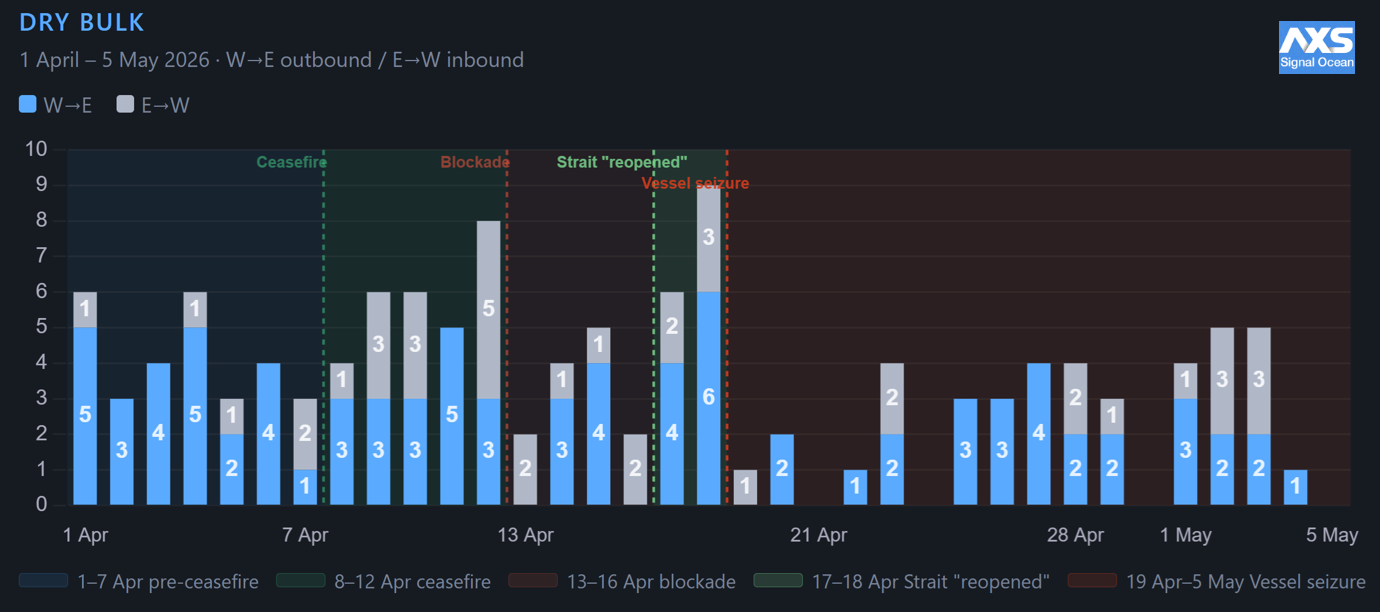
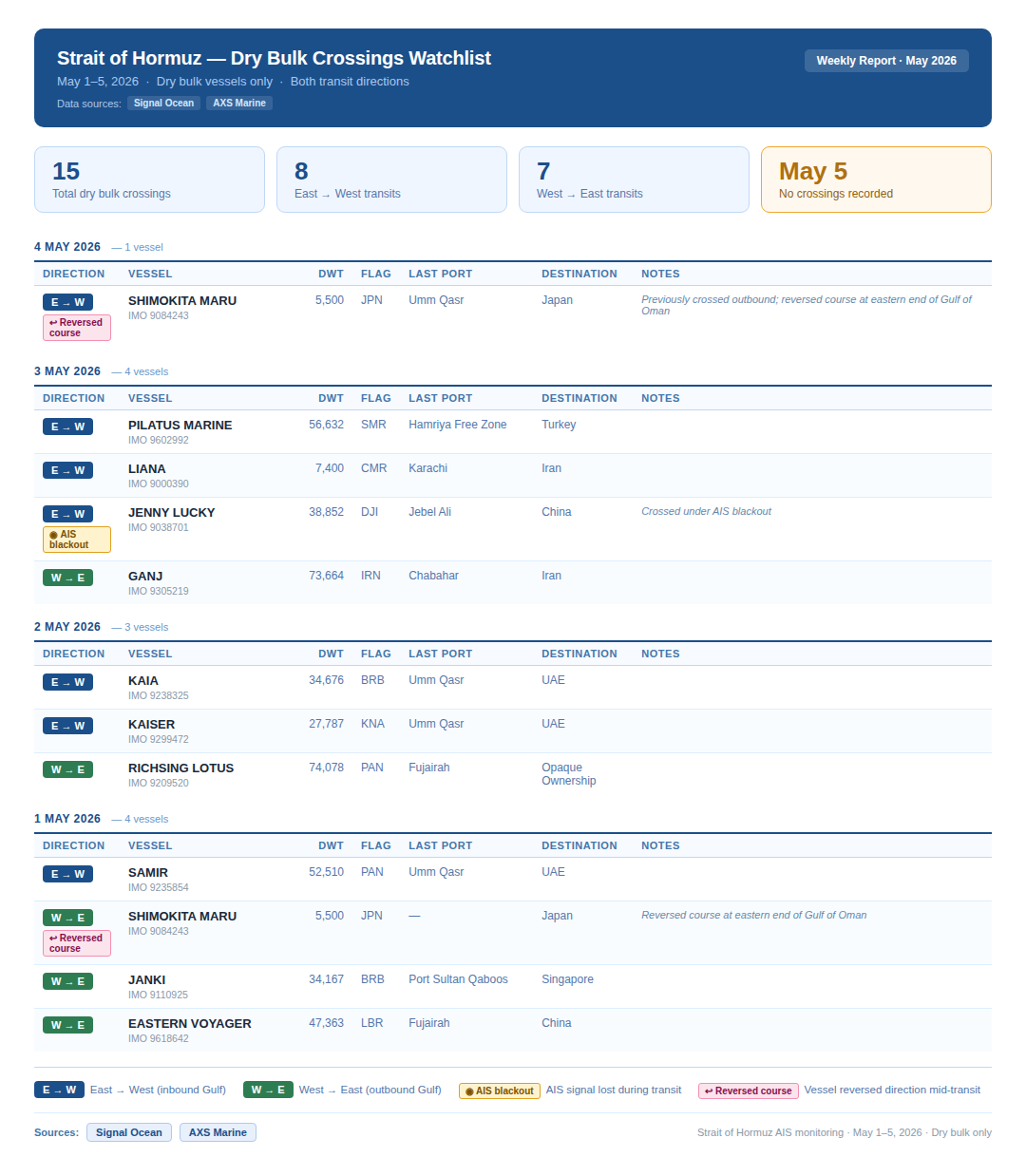
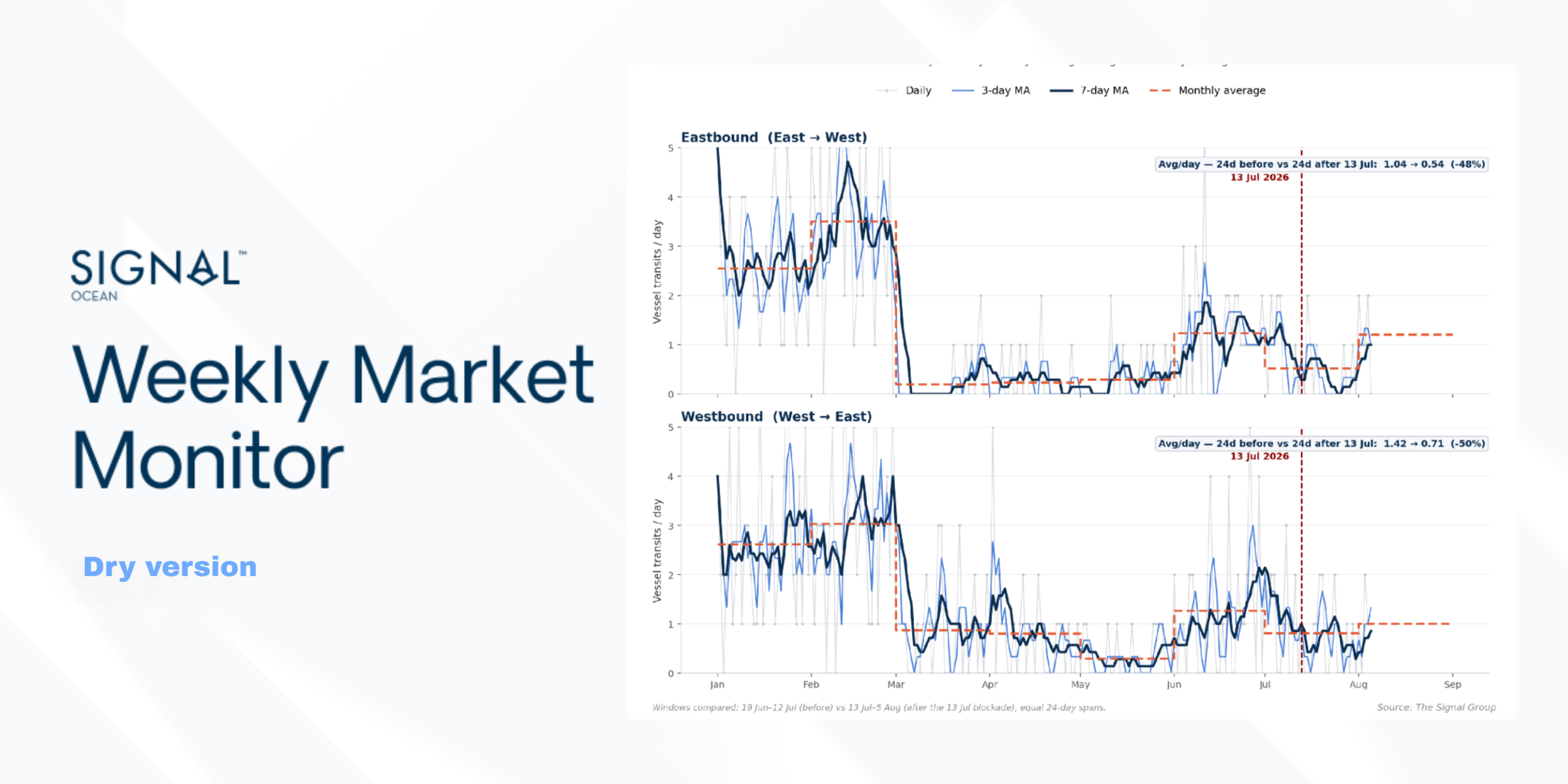
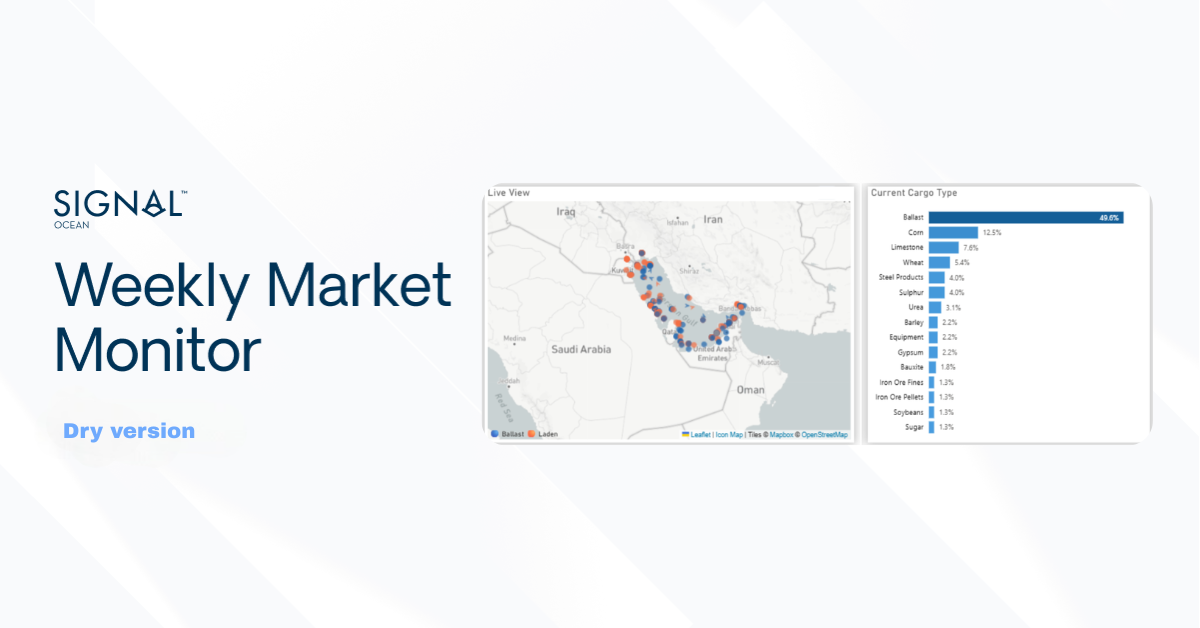
1-5 May: 15 Total dry bulk crossings, 8 E-W, 7 W-E, No crossings recorded from May 5th
FREIGHT MARKET OVERVIEW
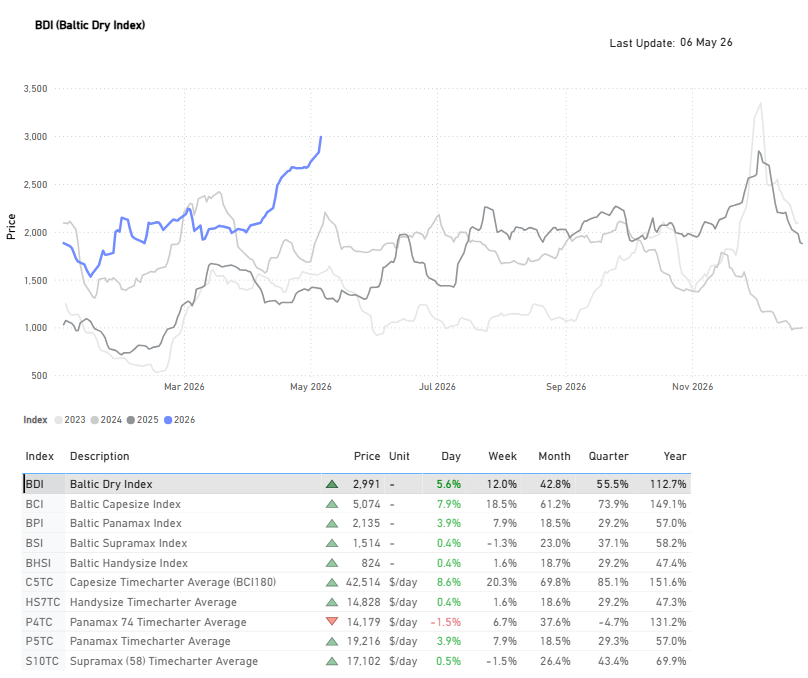
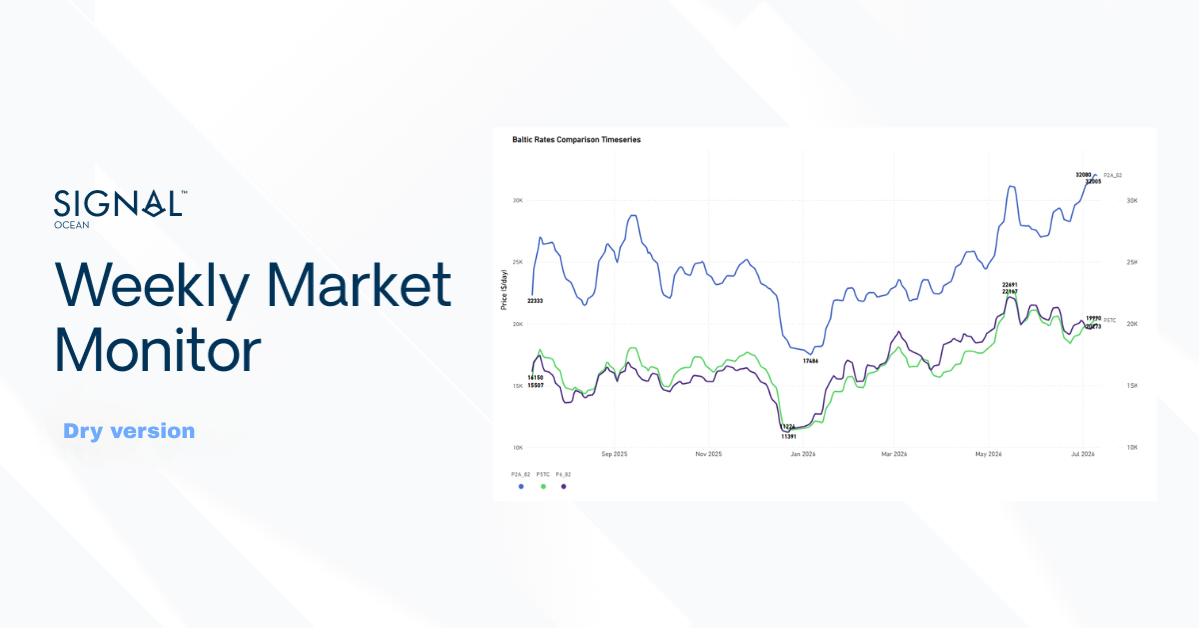
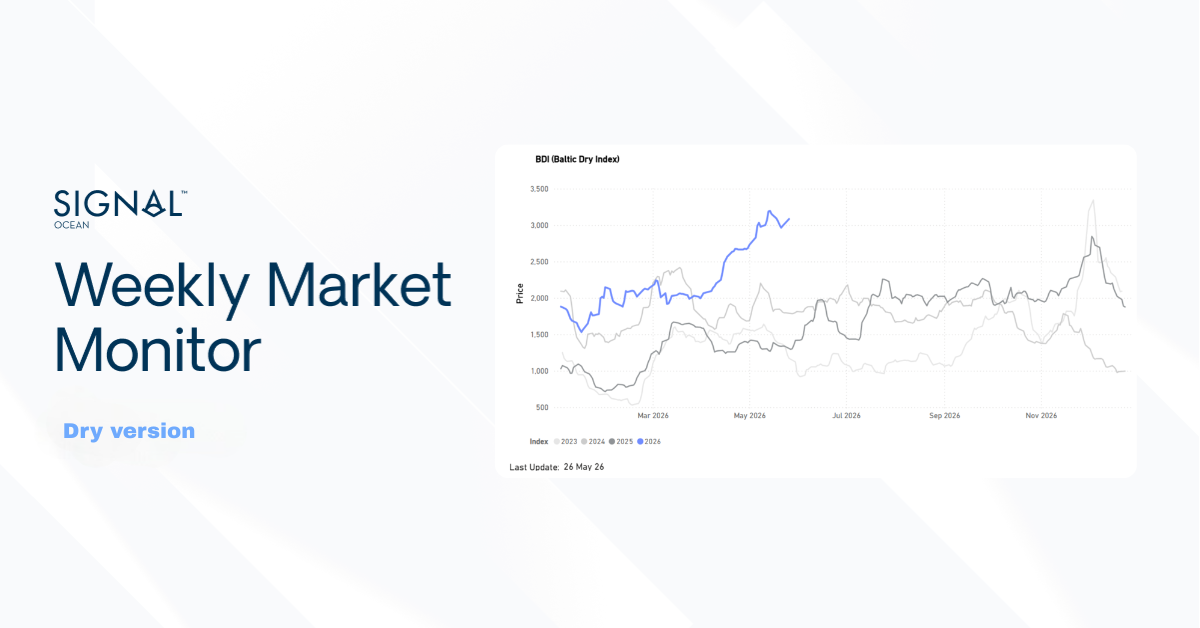
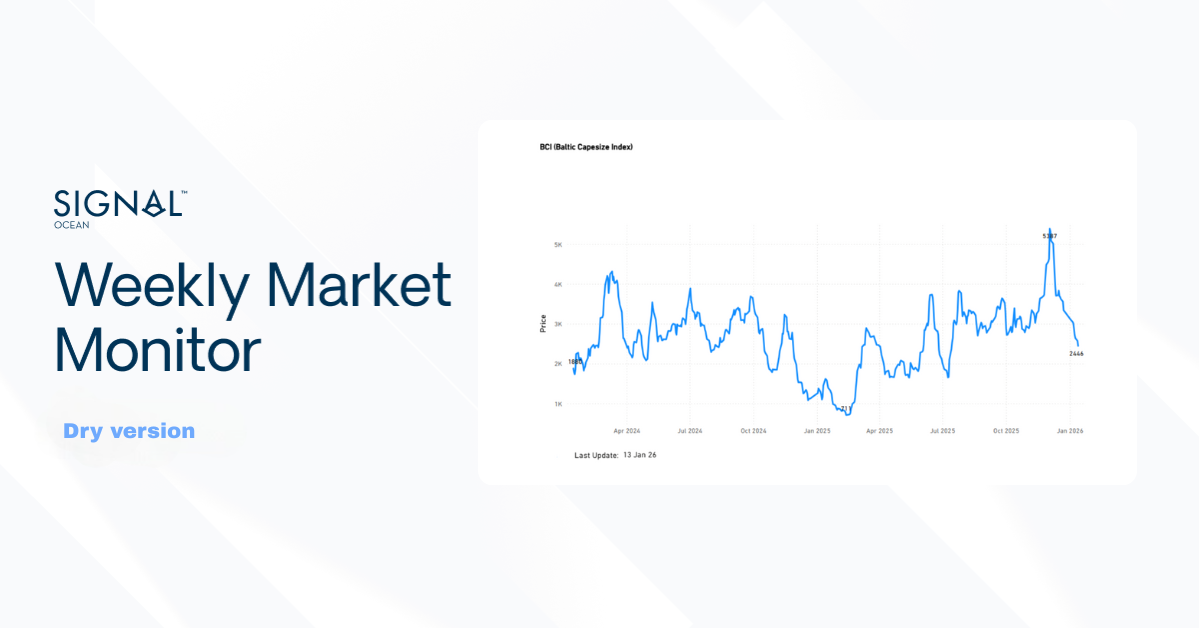
The Baltic Dry Index is approaching the 3,000-point threshold, supported by sustained gains across all major vessel segments, with the Capesize market continuing to lead the rally at +149% year-on-year. Current index levels represent the strongest performance recorded since 2023, reflecting a marked improvement in freight market sentiment, particularly in the Capesize sector, which has driven consistent upward momentum since the end of the first quarter of this year.
The Panamax segment is also demonstrating robust annual growth, with index levels up +57% year-on-year. Meanwhile, positive market fundamentals continue to support the smaller vessel categories, with the Supramax index increasing by +58% year-on-year and the Handysize index by +47% year-on-year.
Source: Signal Ocean Platform | Market Prices Data (last update: May 7, 2026)
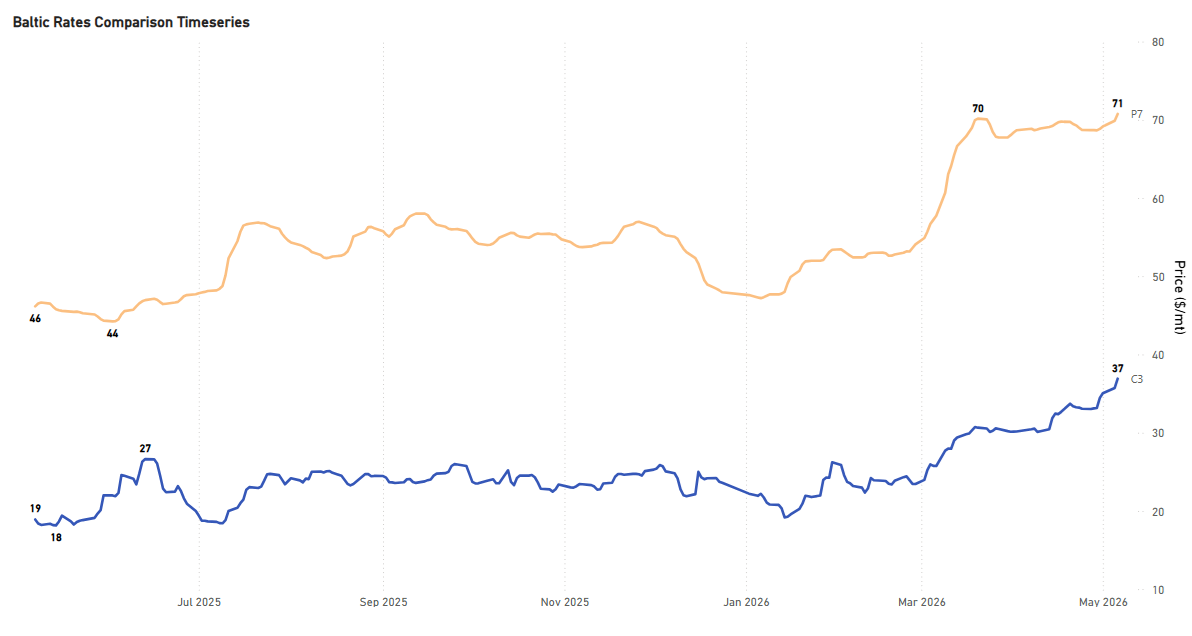
P7 | US Gulf to Qingdao grain | 70.75 $/MT | Day: +0.87 | Week: +2.10 | Year: +24.75
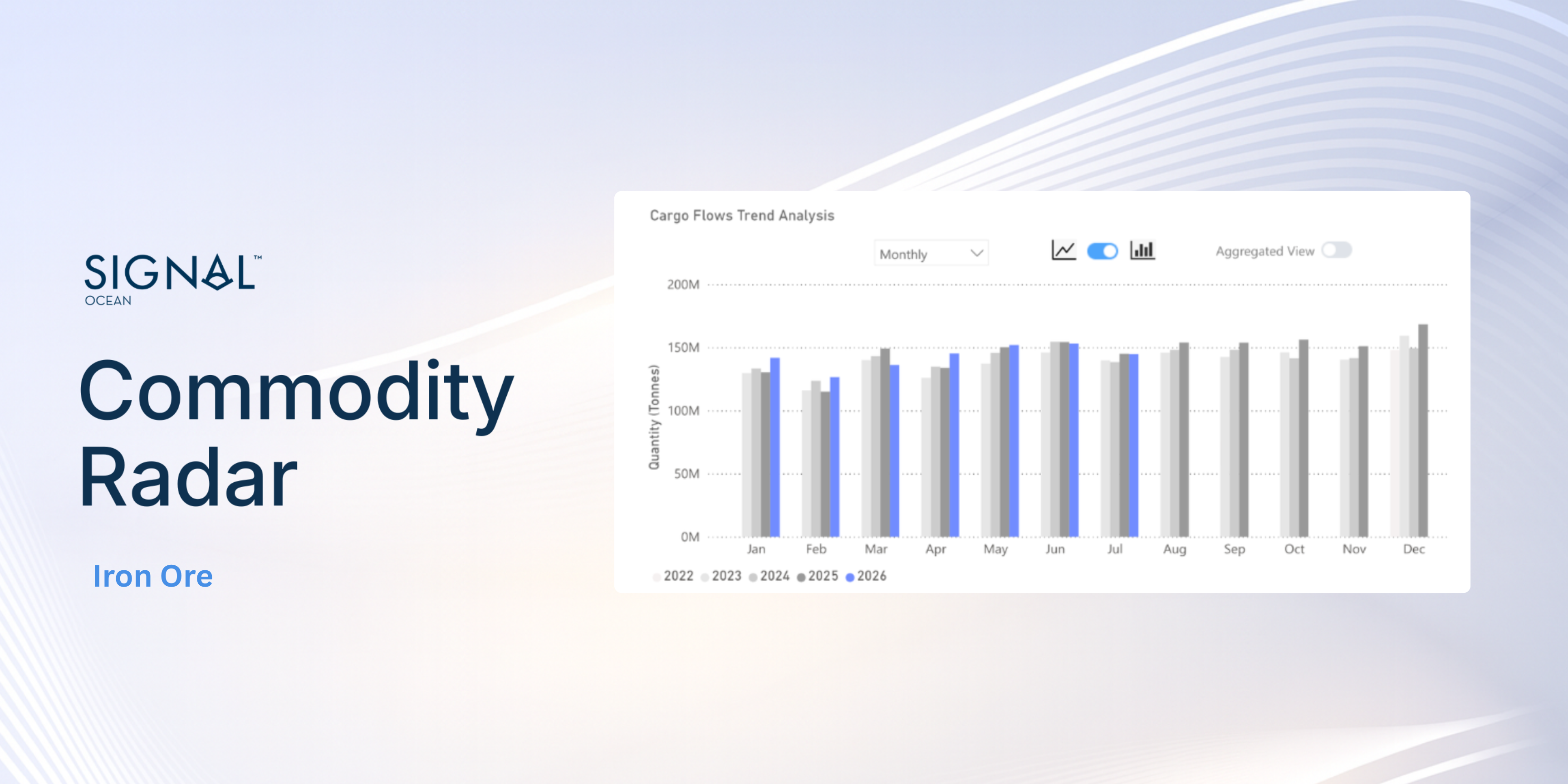
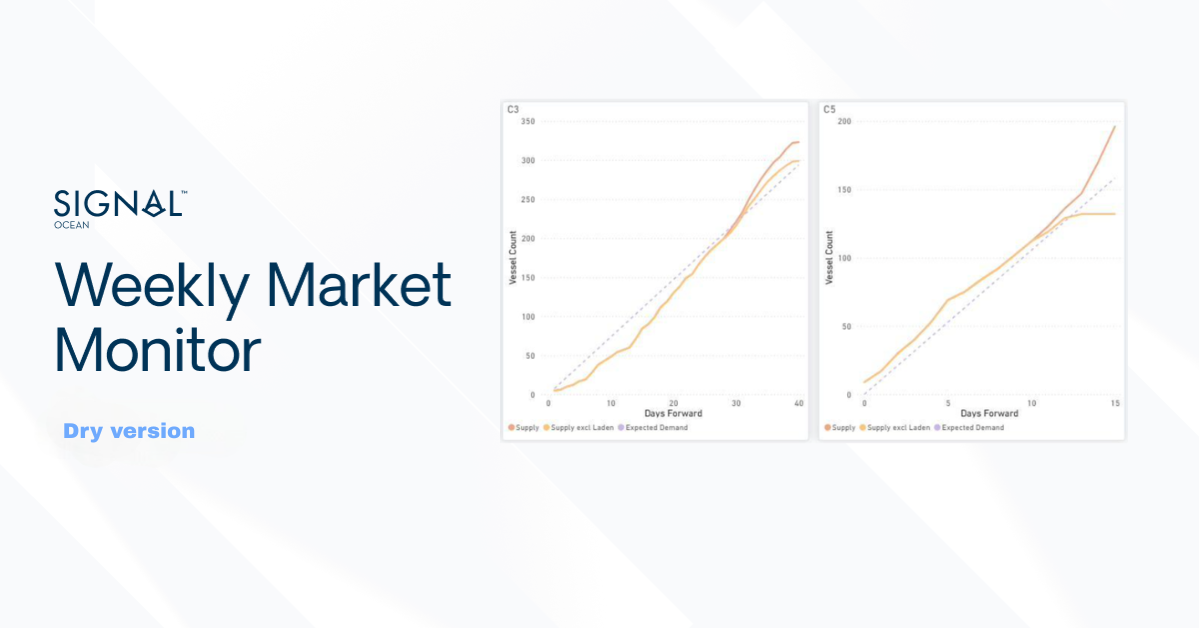
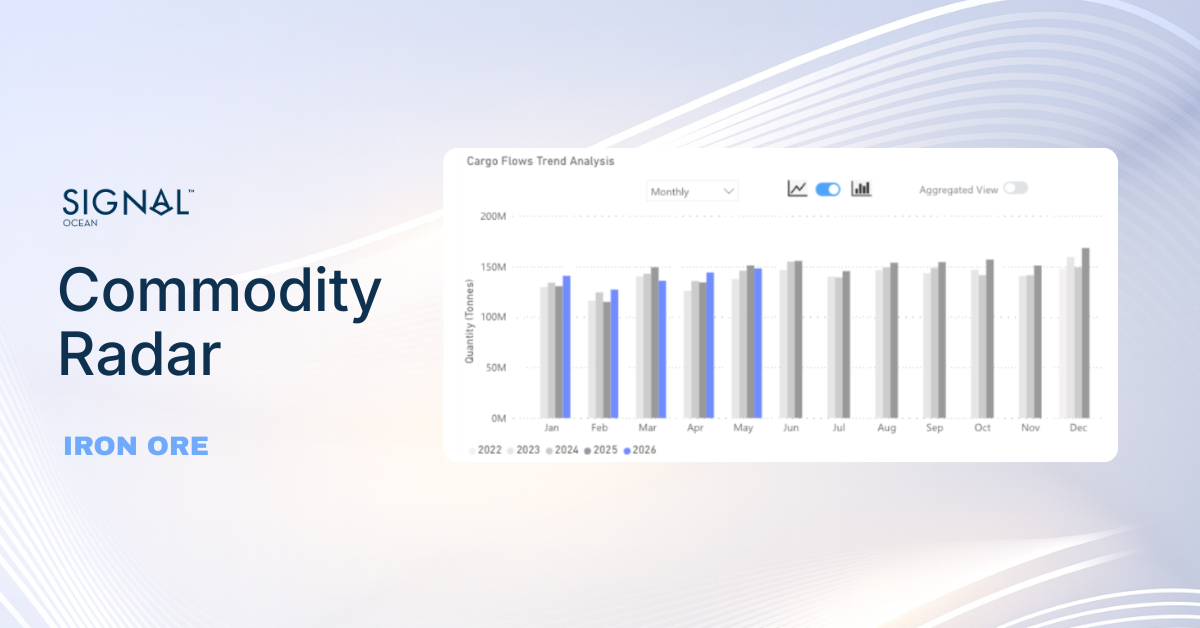
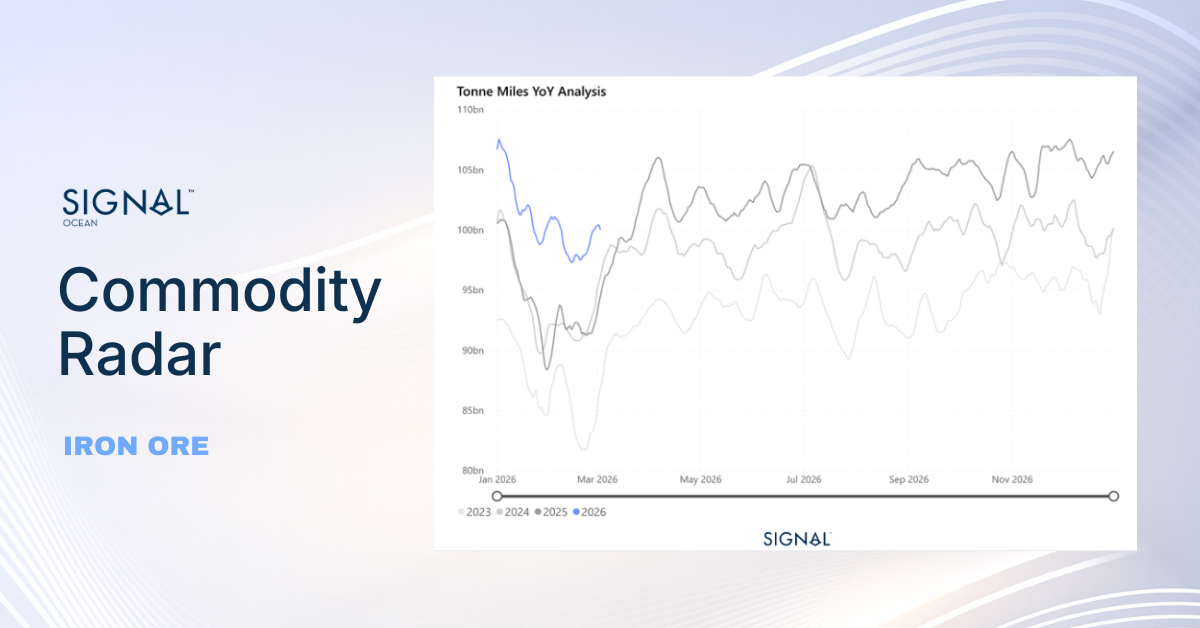
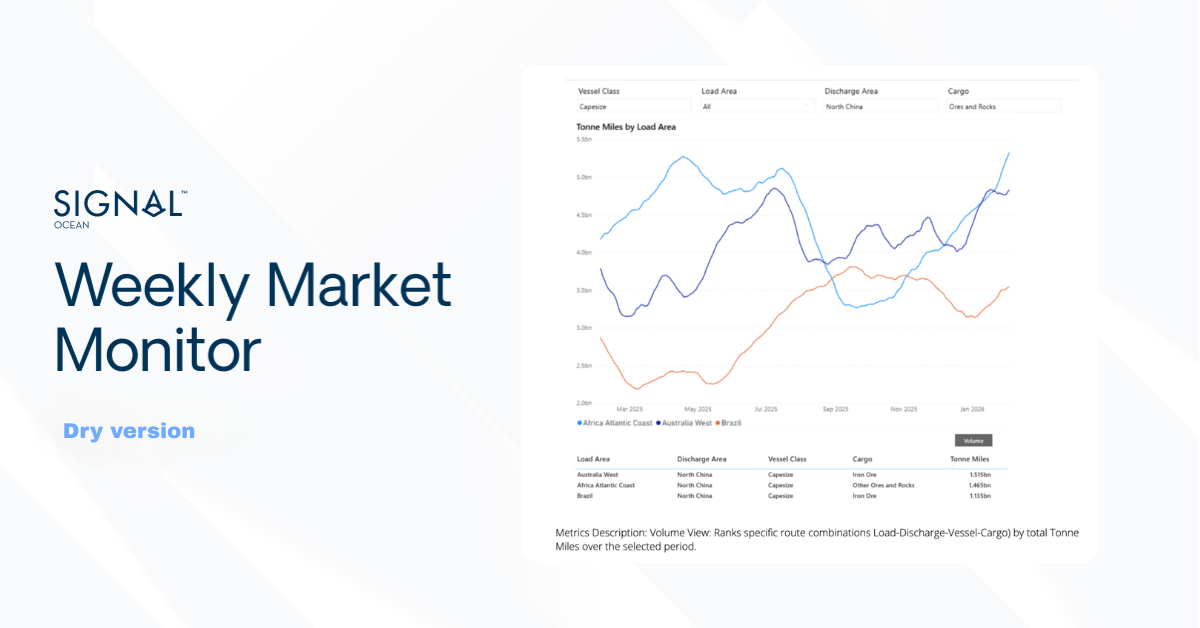
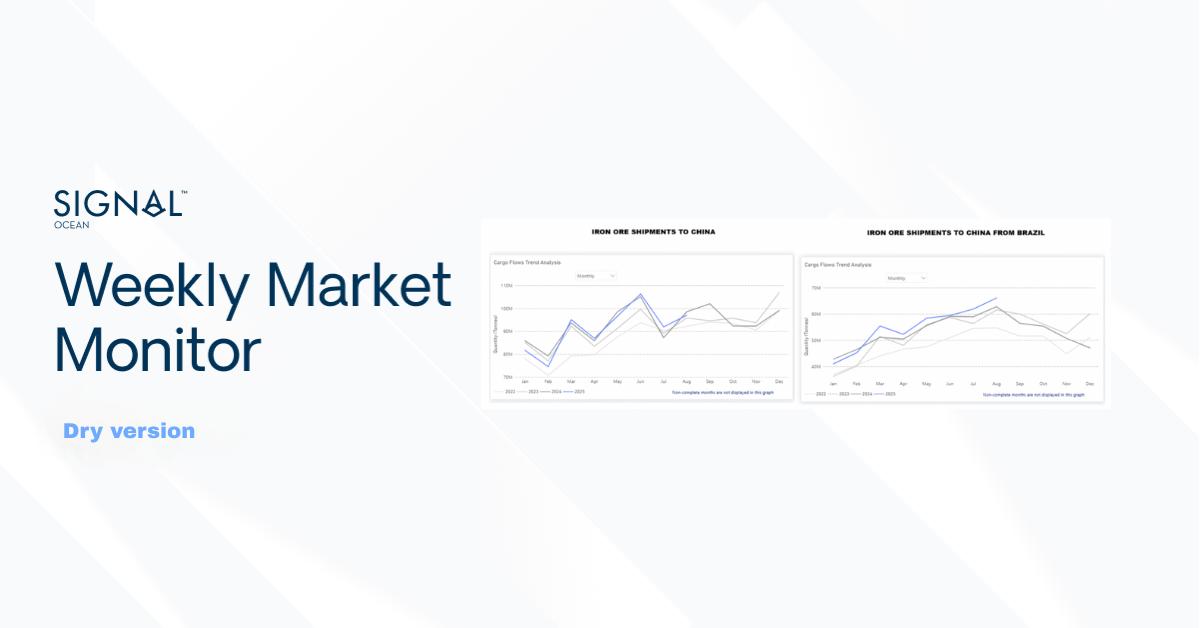
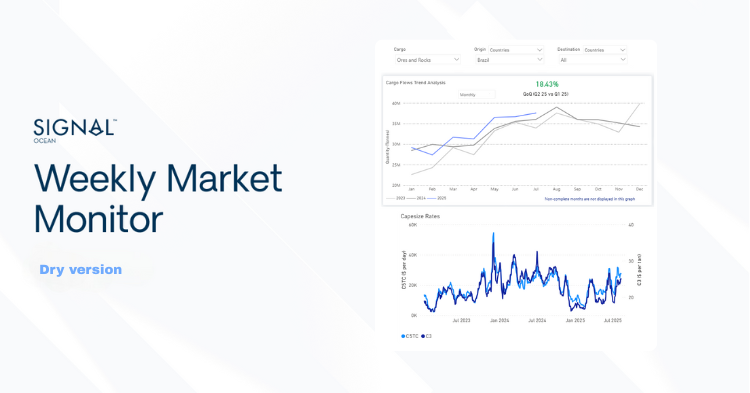
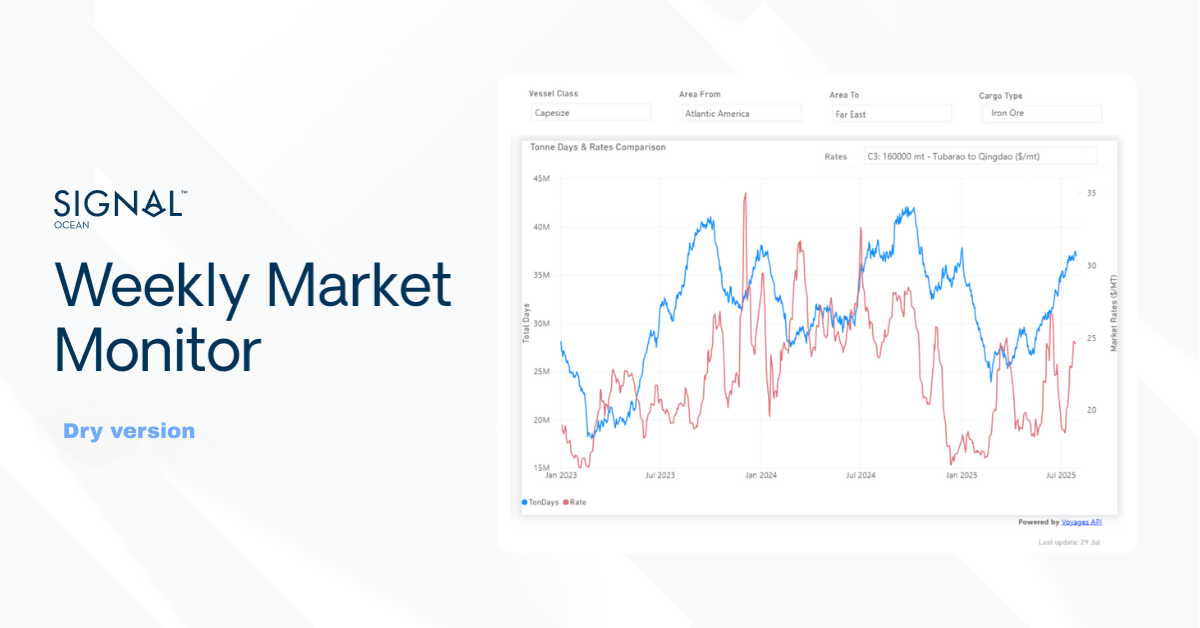
The first week of May has confirmed the bullish momentum in the Atlantic Capesize freight market that emerged during April, with freight rates now exceeding $35/ton and reaching an annual peak of $37/ton. The continued upward trajectory in rates has been closely supported by sustained iron ore export activity from both Australia and Brazil throughout April.
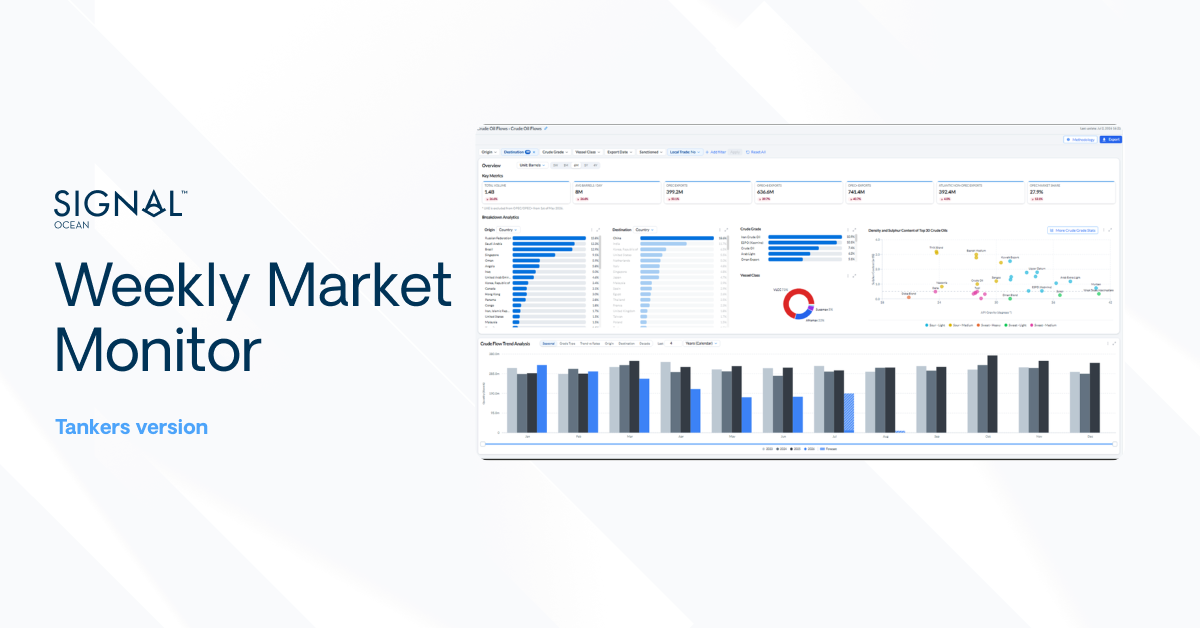
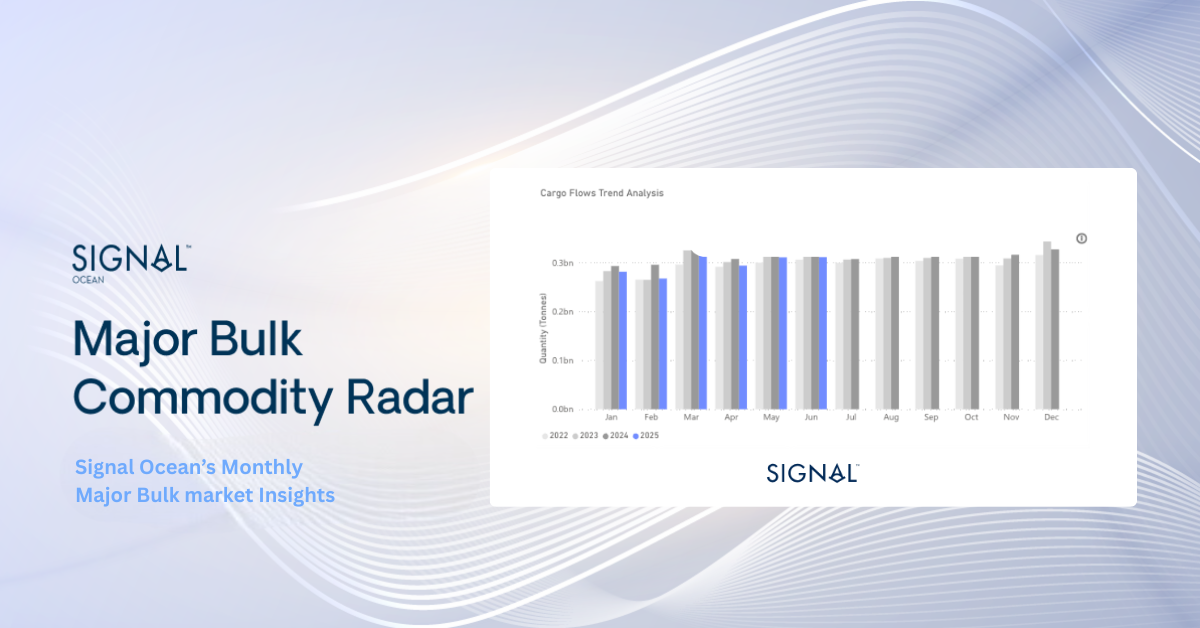
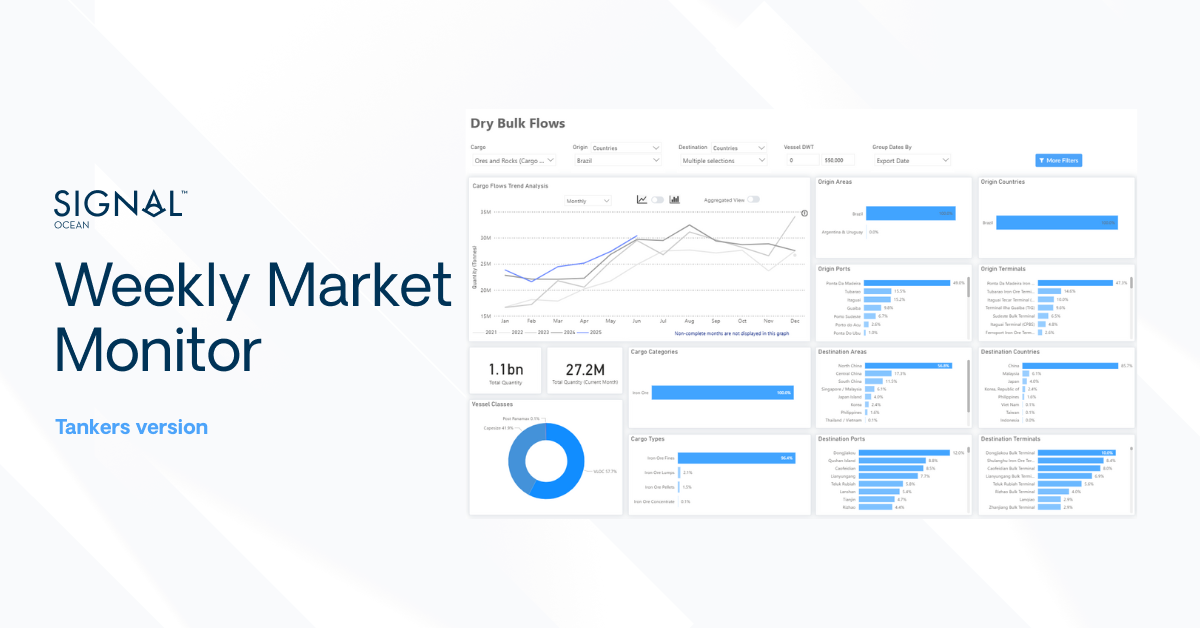
Australian iron ore exports recorded a monthly increase of 5%, while Brazilian volumes showed a more pronounced rise of 11% month-on-month, reaching nearly 33 million metric tons. This marks one of the highest export levels recorded since the previous peak observed in August 2025, when shipments climbed to 41 million metric tons. The strong export performance from both major suppliers continues to provide firm underlying support to Capesize market fundamentals and freight sentiment in the Atlantic basin.
Supramax S4A / Handysize HS4_38 Mixed
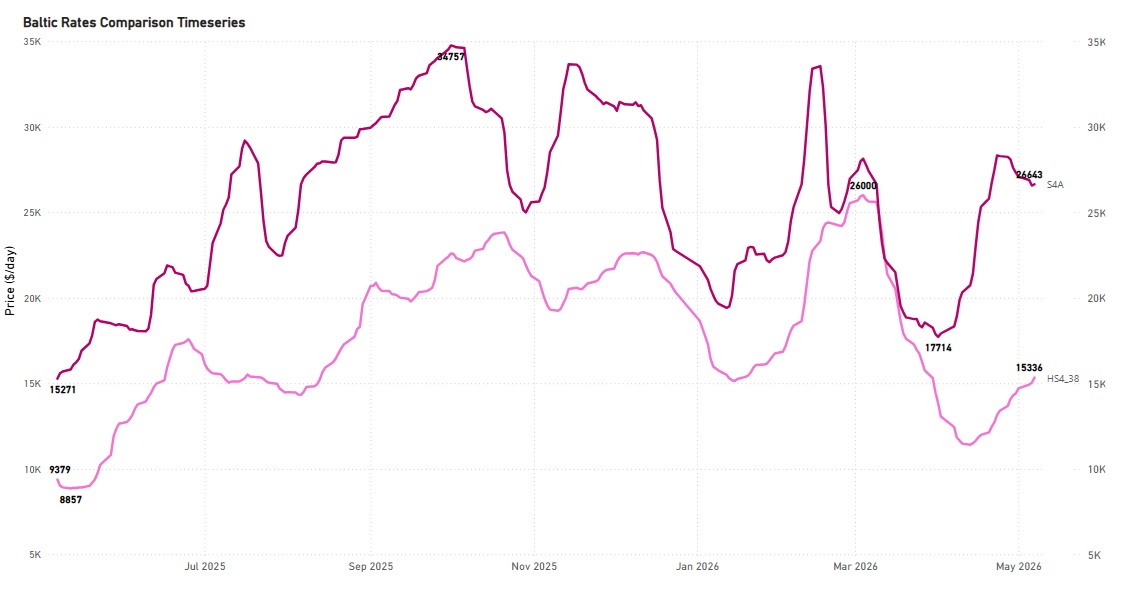
S4A | US Gulf trip to Skaw-Passero | 26,643 $/day | Day: -678 | Week: +8,307 | Year: +11,372
HS4_38 | US Gulf trip via US Gulf or North Coast South America | 15,336 $/day | Day: +929 | Week: +2,893 | Year: +5,957
FREIGHT PACIFIC
Capesize | C5 Firmer
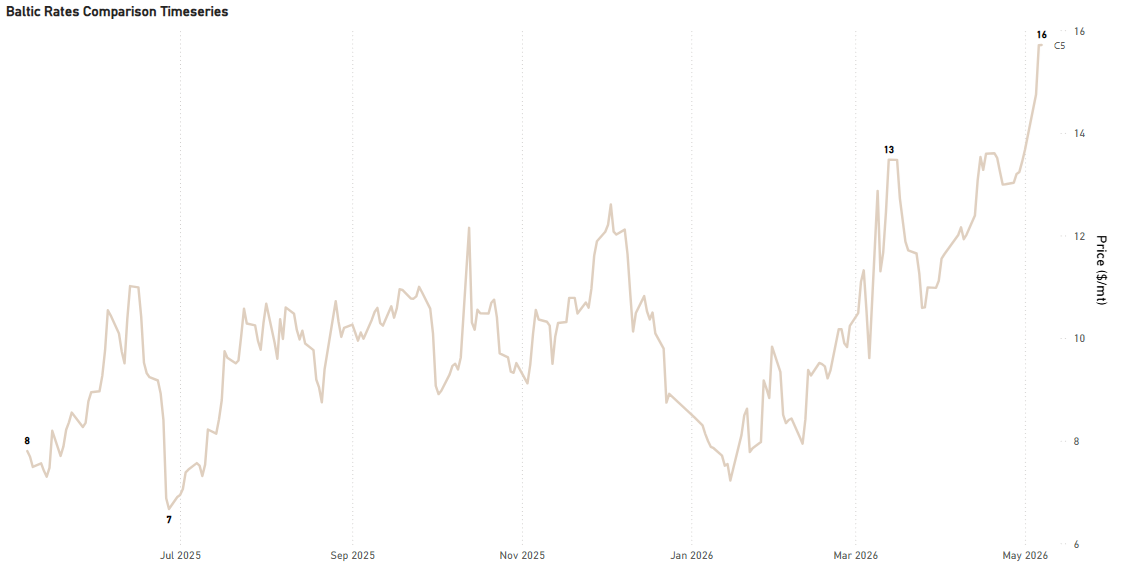
C5 West Australia–Qingdao
C5 | West Australia to Qingdao | 15.72 $/MT | Day: +0.0 | Week: +2.28 | Year: +7.92
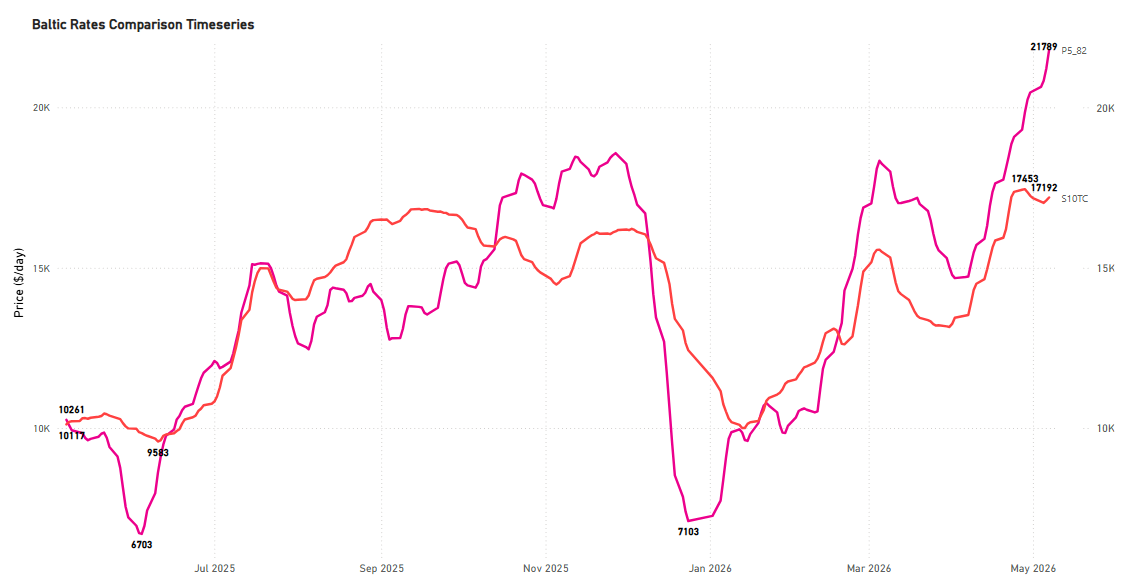
Panamax P5_82 / Supramax S10 Firmer
P5_82 | South China, Indonesian round voyage | 21,789 $/day | Day: +564 | Week: +1,322 | Year: +11,528
S10 | South China trip via Indonesia to South China | 17,191 $/day | Day: +95 | Week: -247 | Year: +6,228
BALLASTERS OVERVIEW
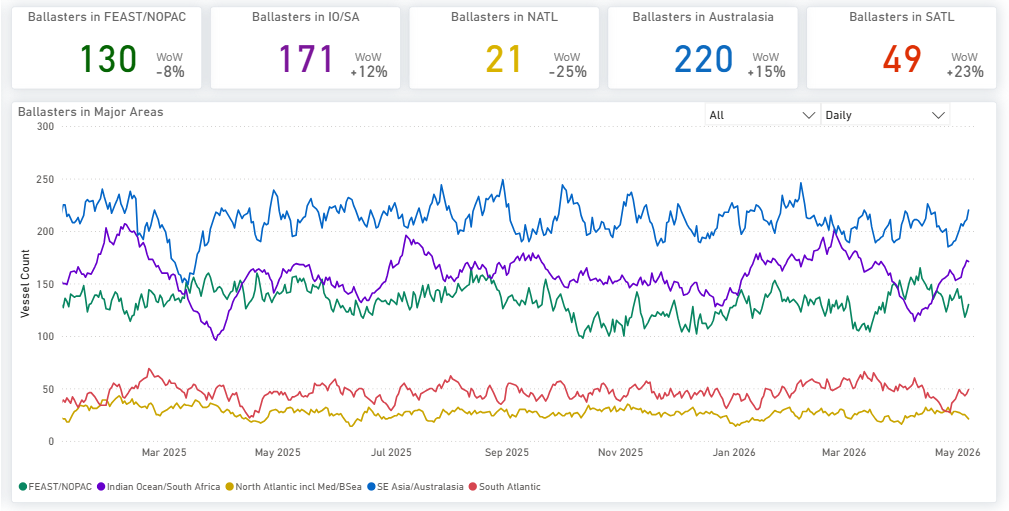
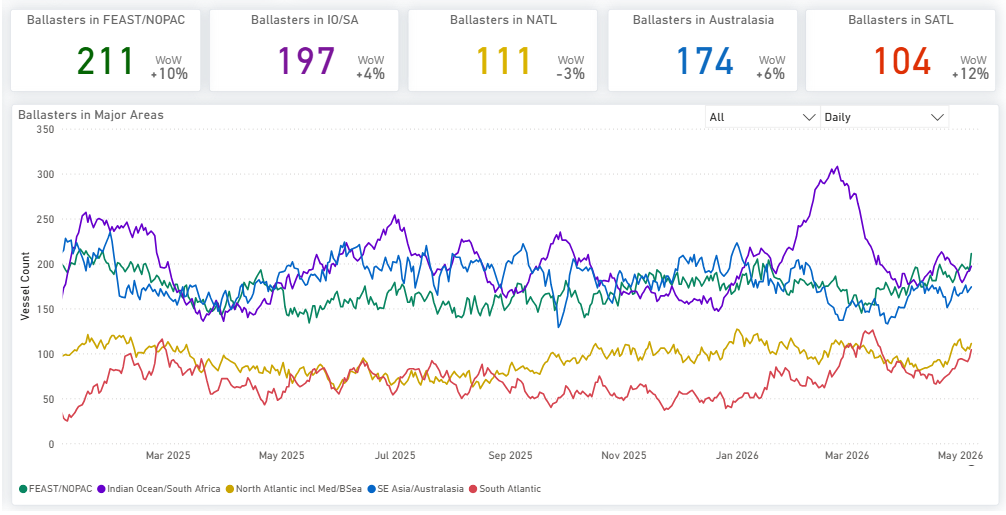
We take a closer look at the basins of ballast count increases per vessel size segment.
Capesize:Ballasters are rising in the Indian Ocean/SA to 170 (+12% WoW), while in Australasia the count has now reached 220 (+15% WoW).
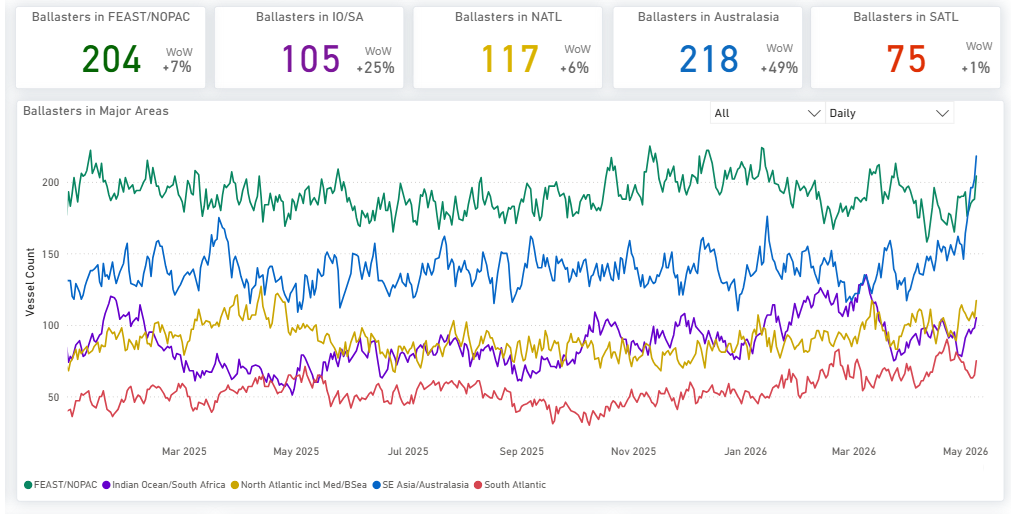
Panamax: The upward trend in Atlantic basins persisted from the prior week. In the South Atlantic, the ship tally surpassed 100, while the North Atlantic count held at over 110 vessels, reflecting a slight 3% weekly dip. Concurrently, Pacific market pressure intensified in the Far East/NOPAC region, where the vessel count climbed above 200, marking a 10% WoW rise.
Supramax: For the current week, the Pacific basin is exhibiting a sharp upward trajectory in contrast to the Atlantic. In Australasia, the number of ballasting vessels has surged past 200 (+49% WoW), while the Indian Ocean maintained its previous momentum with a vessel count exceeding 100.
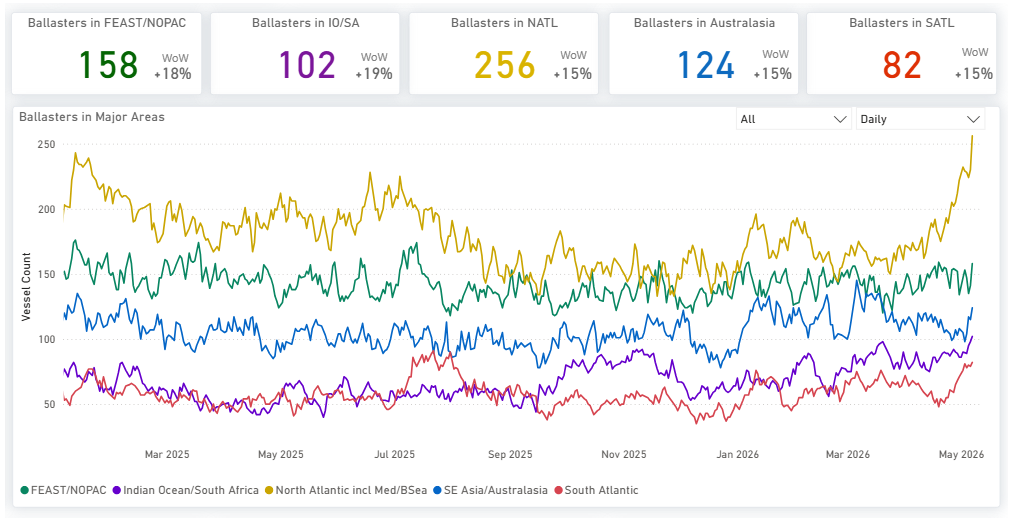
Handysize: The number of ballasters in the Atlantic continues to climb, with the North Atlantic tally exceeding 250 (+15% WoW) and the South Atlantic reaching over 80 (+15% WoW). Simultaneously, the Pacific is experiencing broad upward pressure; vessel counts are approaching 160 in Far East/NOPAC (+18% WoW), topping 100 in the Indian Ocean/South Africa (+19% WoW), and surpassing 120 in Australasia (+15% WoW).
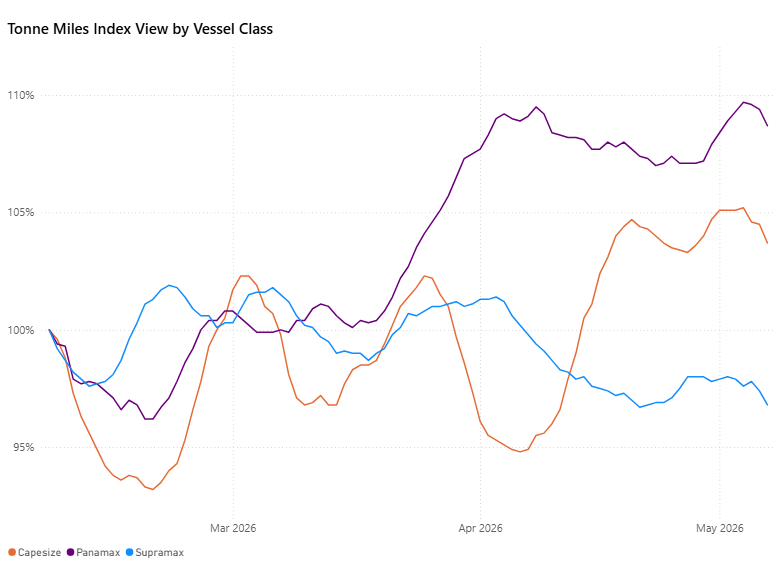
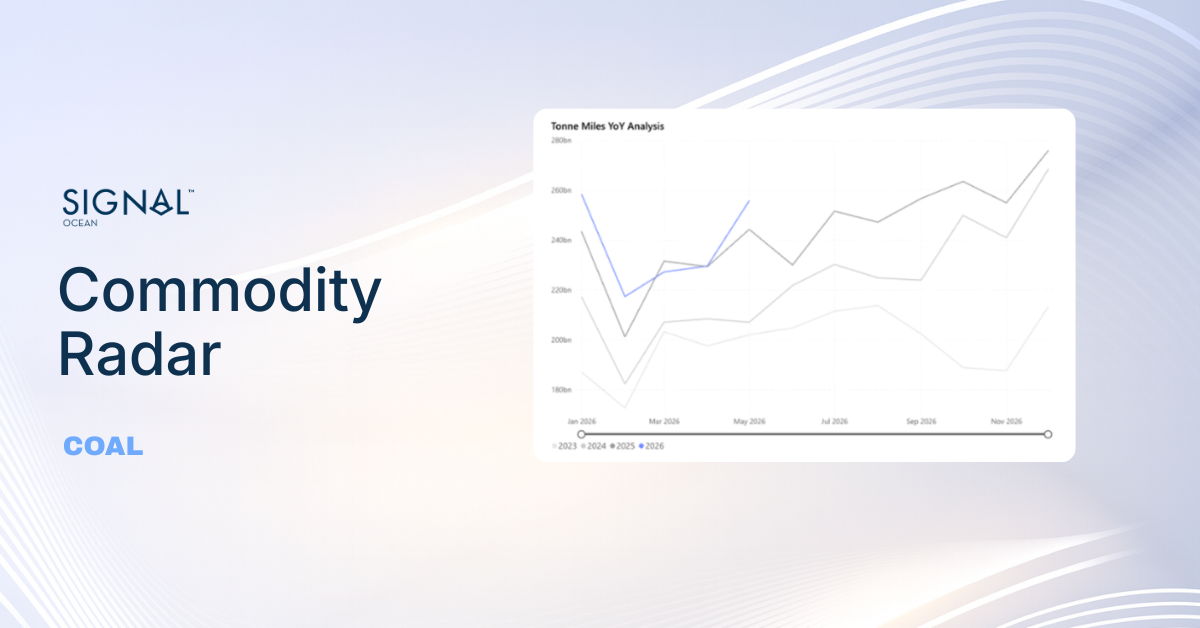
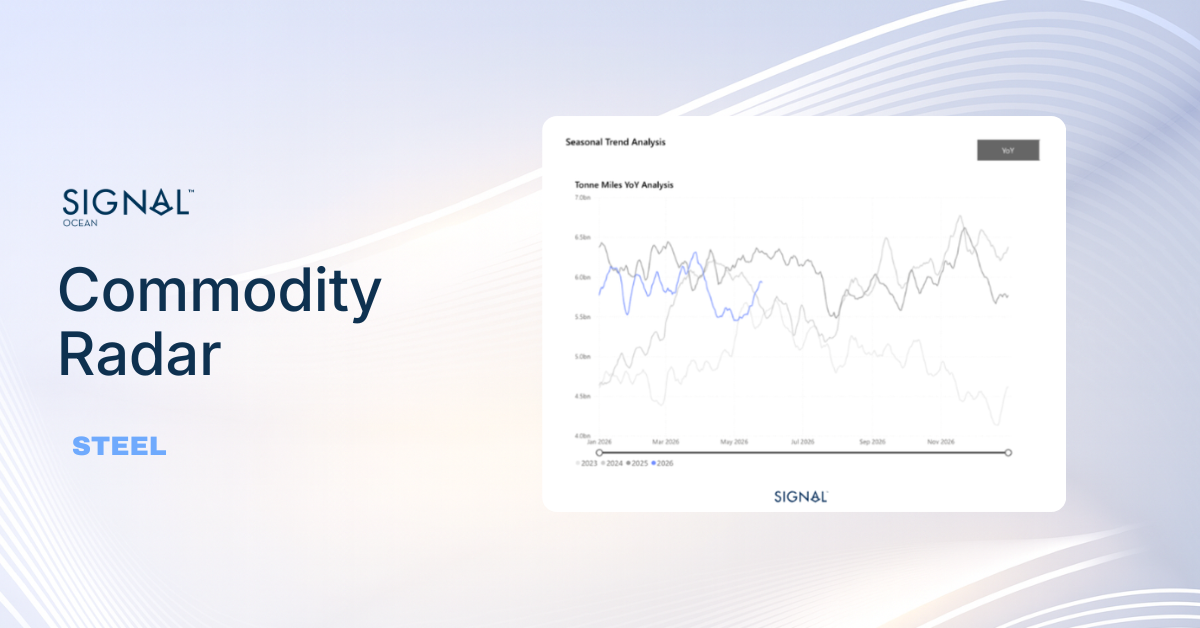
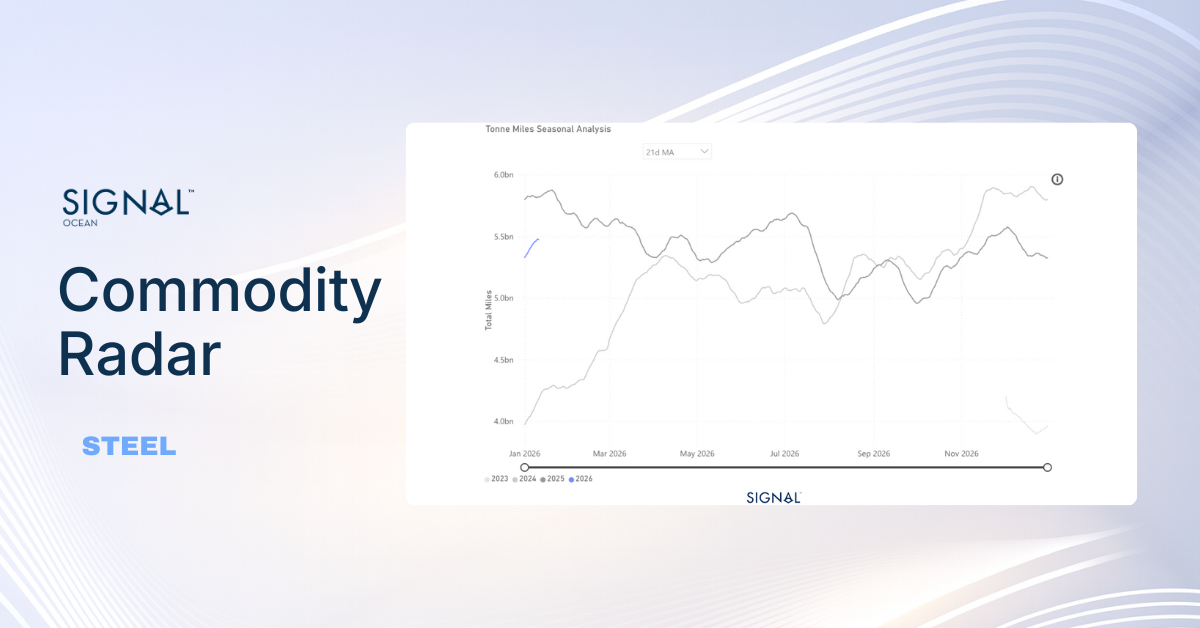
Panamax continues to trade above the 100% threshold, supported by firm tonne-mile demand. Capesize has strengthened in recent weeks and is now above 103%. Supramax remains below 100% at around 97%, reflecting lagging demand and upward pressure on the ballasters' side.
Metrics Description: Index View (Base 100) by total Tonne Miles over the selected period. This facilitates relative performance comparisons between segments of different sizes (e.g., comparing the growth rate of Supramax vs Capesize)
Maria holds a M.Sc. in Shipping, Trade and Finance from the Bayes Business School at the City University in London and a B.Sc. in Shipping Economics from the University of Piraeus.
Creating a sustainable world requires us to embark on a journey towards a zero emission future, where every step is a commitment to preserve our planet for future generations.
Albert Greenway
Environmental Scientist, Sustainability Expert
No items found.
Increased Use of Renewable Energy:
Shipping companies are embracing renewable energy sources to power onboard systems and reduce emissions during port operations. Solar panels and wind turbines are being installed on vessels to generate clean energy, reducing reliance on auxiliary engines, and cutting down emissions. Shore power facilities in ports allow ships to connect to the electrical grid, eliminating the need for onboard generators while docked.
Collaboration and Industry Partnerships:
Recognizing that addressing emissions requires collective action, shipping companies, governments, and organizations have formed partnerships and collaborations. These initiatives focus on research and development, sharing best practices, and promoting knowledge transfer. Joint projects aim to develop and deploy innovative technologies, improve infrastructure, and create a supportive regulatory framework to accelerate the industry's transition towards a greener future. The Zero Emission Shipping - Mission Innovation.
To pave the way for a greener future in shipping, the availability of alternative fuels plays a vital role in their widespread adoption. However, this availability is influenced by factors such as port infrastructure, local regulations, and government policies. As the demand for cleaner fuels in shipping rises and environmental regulations become more stringent, efforts are underway to improve the accessibility of these fuels through infrastructure development, collaborations, and investments in production facilities.
Liquefied Natural Gas (LNG) infrastructure has seen significant growth in recent years, resulting in more LNG bunkering facilities and LNG-powered vessels. Nonetheless, the availability of LNG as a marine fuel can still vary depending on the region. To ensure consistent availability worldwide, there is a need for further development of LNG supply chains and infrastructure. For biofuels, their availability hinges on production capacity and the availability of feedstock. Although biofuels are being produced and utilized in various sectors, their availability as a marine fuel remains limited. Scaling up biofuel production and establishing robust supply chains are imperative to ensure wider availability within the shipping industry.Hydrogen, as a fuel for maritime applications, is still in the early stages of infrastructure development. While some hydrogen vessels have been tested or introduced in the first quarter of last year, the infrastructure required for hydrogen production and distribution needs further advancement.
Ammonia, as a marine fuel, currently faces limitations in availability. The production, storage, and handling infrastructure for ammonia need further development to support its widespread use in the shipping industry.Methanol, on the other hand, is already a commercially available fuel and has been used as a blend with conventional fuels in some ships. However, its availability as a standalone marine fuel can still be limited in certain regions. Bureau Veritas in October 2022 published a White Paper for the Alternative Fuels Outlook. This white paper provides a comprehensive overview of alternative fuels for the shipping industry, taking into account key factors such as technological maturity, availability, safety, emissions, and regulations.
Creating a sustainable world requires us to embark on a journey towards a zero emission future, where every step is a commitment to preserve our planet for future generations.
Albert Greenway
Environmental Scientist, Sustainability Expert
Increased Use of Renewable Energy:
Shipping companies are embracing renewable energy sources to power onboard systems and reduce emissions during port operations. Solar panels and wind turbines are being installed on vessels to generate clean energy, reducing reliance on auxiliary engines, and cutting down emissions. Shore power facilities in ports allow ships to connect to the electrical grid, eliminating the need for onboard generators while docked.
Collaboration and Industry Partnerships:
Recognizing that addressing emissions requires collective action, shipping companies, governments, and organizations have formed partnerships and collaborations. These initiatives focus on research and development, sharing best practices, and promoting knowledge transfer. Joint projects aim to develop and deploy innovative technologies, improve infrastructure, and create a supportive regulatory framework to accelerate the industry's transition towards a greener future. The Zero Emission Shipping - Mission Innovation.
To pave the way for a greener future in shipping, the availability of alternative fuels plays a vital role in their widespread adoption. However, this availability is influenced by factors such as port infrastructure, local regulations, and government policies. As the demand for cleaner fuels in shipping rises and environmental regulations become more stringent, efforts are underway to improve the accessibility of these fuels through infrastructure development, collaborations, and investments in production facilities.
Liquefied Natural Gas (LNG) infrastructure has seen significant growth in recent years, resulting in more LNG bunkering facilities and LNG-powered vessels. Nonetheless, the availability of LNG as a marine fuel can still vary depending on the region. To ensure consistent availability worldwide, there is a need for further development of LNG supply chains and infrastructure. For biofuels, their availability hinges on production capacity and the availability of feedstock. Although biofuels are being produced and utilized in various sectors, their availability as a marine fuel remains limited. Scaling up biofuel production and establishing robust supply chains are imperative to ensure wider availability within the shipping industry.Hydrogen, as a fuel for maritime applications, is still in the early stages of infrastructure development. While some hydrogen vessels have been tested or introduced in the first quarter of last year, the infrastructure required for hydrogen production and distribution needs further advancement.
Ammonia, as a marine fuel, currently faces limitations in availability. The production, storage, and handling infrastructure for ammonia need further development to support its widespread use in the shipping industry.Methanol, on the other hand, is already a commercially available fuel and has been used as a blend with conventional fuels in some ships. However, its availability as a standalone marine fuel can still be limited in certain regions. Bureau Veritas in October 2022 published a White Paper for the Alternative Fuels Outlook. This white paper provides a comprehensive overview of alternative fuels for the shipping industry, taking into account key factors such as technological maturity, availability, safety, emissions, and regulations.

.webp)





.png)










.png)






.png)
.png)


.png)
.png)
.png)

.png)
.png)
.png)