Subscribe for our latest news, straight to your inbox:
Thank you! Your submission has been received!
Oops! Something went wrong while submitting the form.
Share this post
Iran's bottleneck is Hormuz, not the buyer.
The Iranian crude that reached Asia is being taken. The crude that has not reached it is standing at the strait and behind it, and there is nearly twice as much of that.
AXSMarine · Data to 15 August 2026 · All volumes million barrels
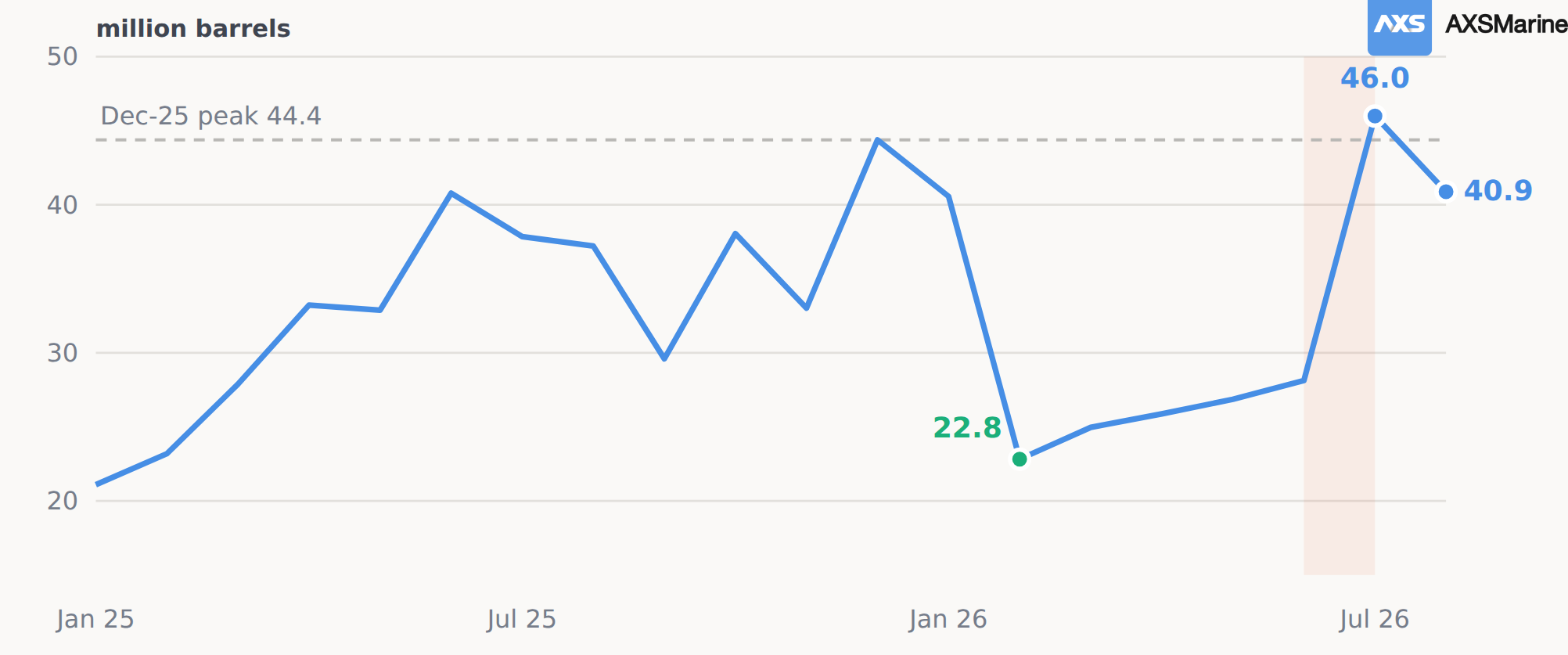
Iranian crude sitting in Asian waters peaked at 44.4 million barrels in December. By February it was 22.8, a fall of nearly half in two months.
The pile did not stay down. From February it rose every single month. Slowly, but in one direction. By the time the US sanctions waiver opened on 22 June the refill was already four months old.
The window ran three weeks. By the end of July, the pile stood at 46.0 million barrels, above its December peak. So, the waiver finished a refill that was already under way and did in one month what the previous four had managed between them.
Figure 1: Iranian-linked crude in floating storage in Asian waters, monthly. Shaded band: the June to July policy window.
The region emptied around it
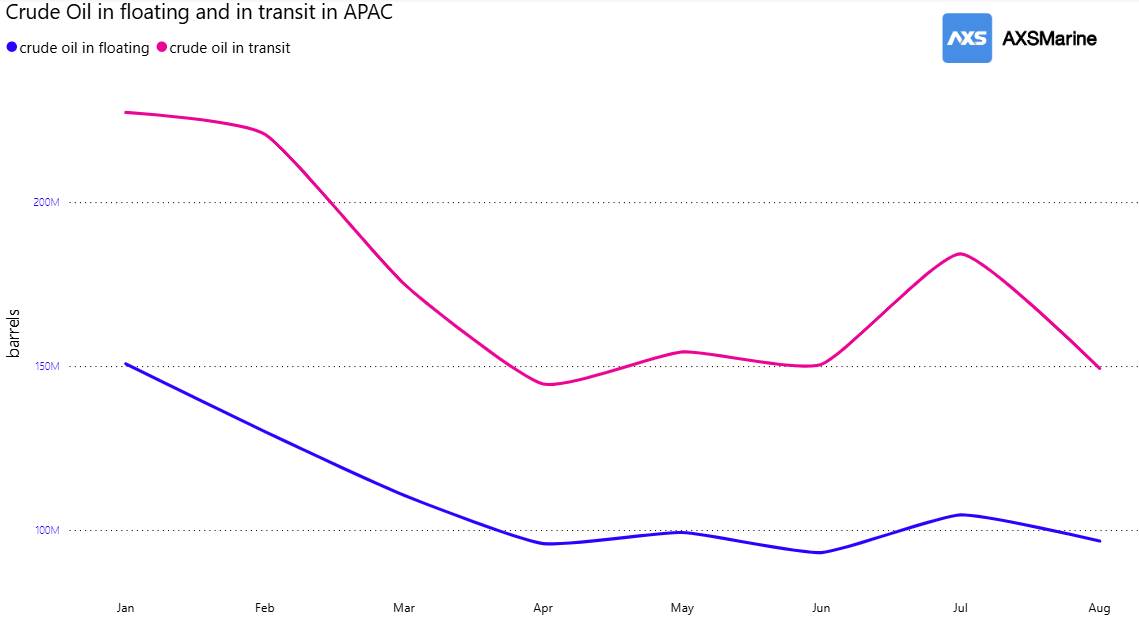
What makes the Iranian build stand out is that it ran against the tide. Asia's total crude on water fell 23.6% between January and July. Both halves fell together, floating storage by 30.6% and crude in transit by 19.0%, which is the detail that matters: had one fallen while the other rose, barrels would simply have been changing state.
Figure 2: Crude oil in transit & crude oil floating in APAC region
Two months break the pattern and they belong together. July is a surge in cargo moving, up 22.4% on June and the busiest month since February. August gives all of it back. Barrels moved, then they stopped moving.
More of what stays is standing still
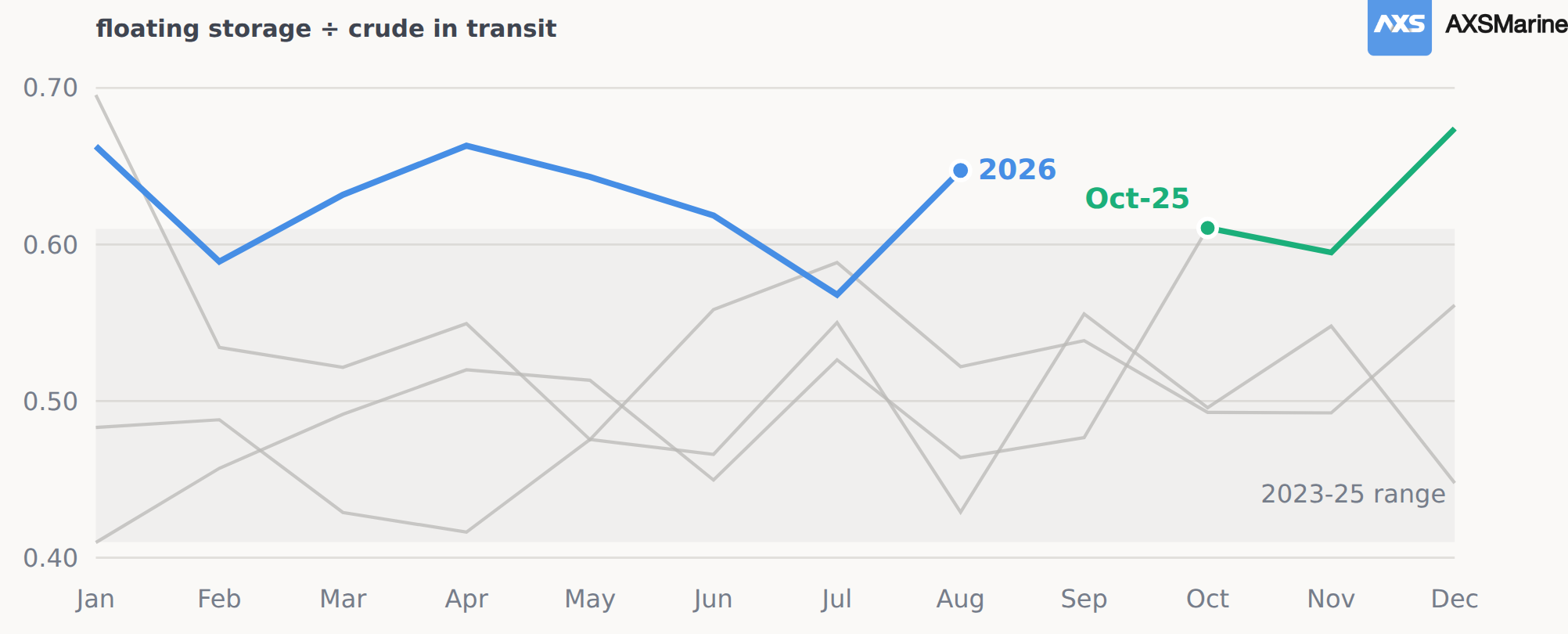
Divide crude into floating storage and in transit and you get a rough measure of how long a barrel floats before someone takes it. For three years that ratio sat around 0.50. Since October 2025 it has averaged 0.63.
Figure 3 : Ratio of crude in floating storage to crude in transit, by month, in APAC.
The number itself is not unprecedented. January 2023 printed higher than any month of 2026 and reverted within weeks. What is new is that it took longer to revert. Eight of the eleven months since October 2025 have printed at or above 0.61; one month in the previous thirty-three did. And the fourth quarter of 2025 averaged 0.63 the same as for the eight months of 2026.
July was relocation, and the queue starts at the strait
The measured part is the split at Hormuz. 39.8 million barrels stand east of the strait in the Gulf of Oman and 37.1 million remain west of it, 76.9 million of Iranian crude across the Gulf region on 47 hulls, seven in ten of them VLCCs. Asian waters held 40.9 million in August.
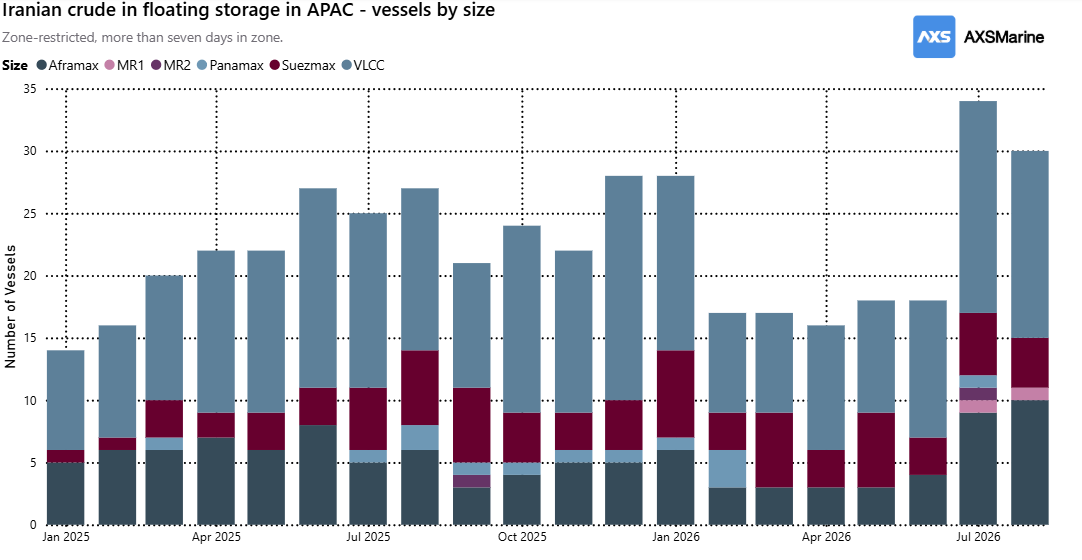
The fleet tells the same story as the volumes, and it tells it the whole way along. West of Hormuz the cargo sits in big parcels waiting for the door: 21 hulls, 17 of them VLCCs, averaging 1.77 million barrels each. East of the strait the mix breaks up, 26 hulls averaging 1.53. Inside Asia the fleet went from eighteen hulls to thirty-four across the window, the growth all in the smaller sizes, and the average parcel fell to 1.35. Parcel size declines at every step from MEG to a Chinese berth, which is what ship-to-ship redistribution looks like rather than bulk storage.
Figure 4 : Iranian crude in floating storage in APAC by vessel size.
August looks like a stoppage. It is not one.
The floating to transit ratio (Figure 3) jumped again in August, and the intuitive reading is exactly wrong. Crude in floating storage fell 7.6% that month. Crude in transit fell 18.9%. The ratio rose because the denominator collapsed. Had refiners shut the door, floating storage would have climbed. It did the opposite.
So, the same indicator has now risen twice for opposite reasons. In October 2025 the numerator did the work: crude in floating storage jumped 24% in a single month while crude in transit barely moved, which is cargo arriving faster than it could be taken away. In August 2026 the denominator did the work: crude in transit fell 18.9% while floating storage fell too, just more slowly. Less crude heading for the region at all.
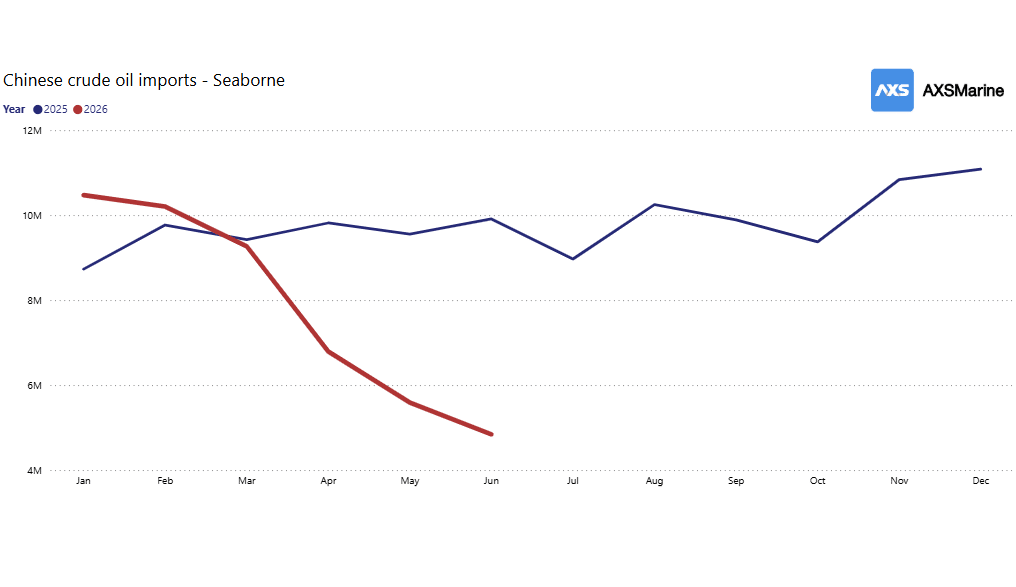
Chinese refinery runs were cut hard, from 14.6 million barrels a day in March to 12.7 in May. But China built crude stocks through the disruption and drew only marginally afterwards. Throughput fell from 14.6mbpd to 13.4 to 12.7 across March, April and May, a drop of 1.9mbpd. Over the same three months crude imports fell from 11.8mpbd to 9.4 to 7.8. Both fell, but not by the same amount, and the gap between them is the whole story.
It is not one pile. It is a queue with two stages.
Which points to the reading that ties the year together. Iranian crude floating off Malacca is best understood as Chinese inventory that has not yet crossed customs. Drawing it down never shows up in import statistics, which is precisely what makes it useful.
Singapore Chinese coastal zones
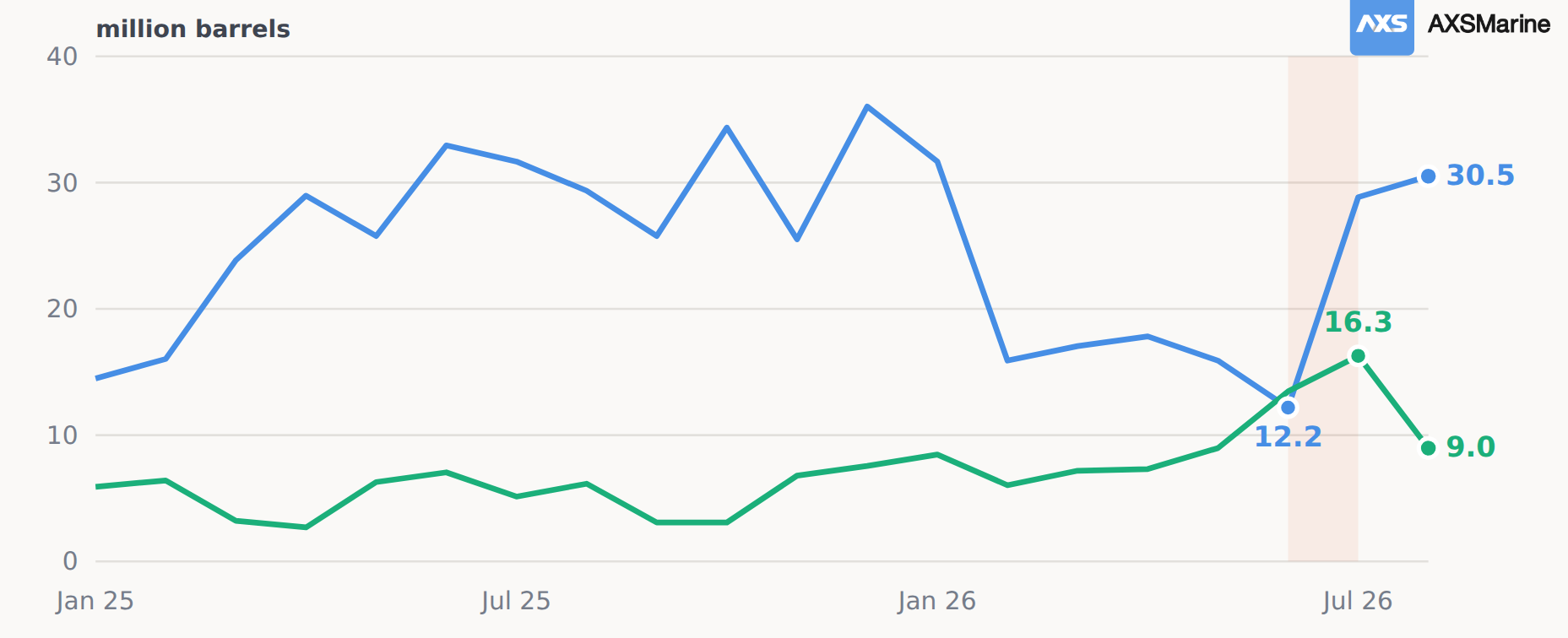
Figure 5 : Iranian crude in floating storage in APAC by region.
August is the part worth stopping on. Chinese-zone holdings fell 45%, from 16.3 million barrels to 9.0, while the Malacca hub grew 6%. That is what discharge looks like in this dataset, and it is the first clear instance of it all year.
What to watch
Whether the Chinese leg keeps drawing. This pile has only fallen substantially once this year, from 44.4 million barrels in December 2025 to 22.8 in February, and it rose every month after that. August's fall was the first decline since. The Chinese-zone portion alone fell 7.3 million barrels in the month, while Singapore rose by a far smaller 1.7 million. Refiners are expected to accelerate their commercial inventory drawdown over the next two to three months to bridge the feedstock gap. And on market-circulated information most of the floating barrels have already been sold, even if that has yet to show through in the regional total, so the demand is there. And the pile is now the nearest crude in the region: Malacca to a Chinese berth is about a week, against three weeks from the Gulf and rather more than that from a Saudi cargo going the long way round Africa.
Fundamental data from AXSMarine. Chinese production, throughput and customs data are official.
Creating a sustainable world requires us to embark on a journey towards a zero emission future, where every step is a commitment to preserve our planet for future generations.
Albert Greenway
Environmental Scientist, Sustainability Expert
No items found.
Increased Use of Renewable Energy:
Shipping companies are embracing renewable energy sources to power onboard systems and reduce emissions during port operations. Solar panels and wind turbines are being installed on vessels to generate clean energy, reducing reliance on auxiliary engines, and cutting down emissions. Shore power facilities in ports allow ships to connect to the electrical grid, eliminating the need for onboard generators while docked.
Collaboration and Industry Partnerships:
Recognizing that addressing emissions requires collective action, shipping companies, governments, and organizations have formed partnerships and collaborations. These initiatives focus on research and development, sharing best practices, and promoting knowledge transfer. Joint projects aim to develop and deploy innovative technologies, improve infrastructure, and create a supportive regulatory framework to accelerate the industry's transition towards a greener future. The Zero Emission Shipping - Mission Innovation.
To pave the way for a greener future in shipping, the availability of alternative fuels plays a vital role in their widespread adoption. However, this availability is influenced by factors such as port infrastructure, local regulations, and government policies. As the demand for cleaner fuels in shipping rises and environmental regulations become more stringent, efforts are underway to improve the accessibility of these fuels through infrastructure development, collaborations, and investments in production facilities.
Liquefied Natural Gas (LNG) infrastructure has seen significant growth in recent years, resulting in more LNG bunkering facilities and LNG-powered vessels. Nonetheless, the availability of LNG as a marine fuel can still vary depending on the region. To ensure consistent availability worldwide, there is a need for further development of LNG supply chains and infrastructure. For biofuels, their availability hinges on production capacity and the availability of feedstock. Although biofuels are being produced and utilized in various sectors, their availability as a marine fuel remains limited. Scaling up biofuel production and establishing robust supply chains are imperative to ensure wider availability within the shipping industry.Hydrogen, as a fuel for maritime applications, is still in the early stages of infrastructure development. While some hydrogen vessels have been tested or introduced in the first quarter of last year, the infrastructure required for hydrogen production and distribution needs further advancement.
Ammonia, as a marine fuel, currently faces limitations in availability. The production, storage, and handling infrastructure for ammonia need further development to support its widespread use in the shipping industry.Methanol, on the other hand, is already a commercially available fuel and has been used as a blend with conventional fuels in some ships. However, its availability as a standalone marine fuel can still be limited in certain regions. Bureau Veritas in October 2022 published a White Paper for the Alternative Fuels Outlook. This white paper provides a comprehensive overview of alternative fuels for the shipping industry, taking into account key factors such as technological maturity, availability, safety, emissions, and regulations.
Creating a sustainable world requires us to embark on a journey towards a zero emission future, where every step is a commitment to preserve our planet for future generations.
Albert Greenway
Environmental Scientist, Sustainability Expert
Increased Use of Renewable Energy:
Shipping companies are embracing renewable energy sources to power onboard systems and reduce emissions during port operations. Solar panels and wind turbines are being installed on vessels to generate clean energy, reducing reliance on auxiliary engines, and cutting down emissions. Shore power facilities in ports allow ships to connect to the electrical grid, eliminating the need for onboard generators while docked.
Collaboration and Industry Partnerships:
Recognizing that addressing emissions requires collective action, shipping companies, governments, and organizations have formed partnerships and collaborations. These initiatives focus on research and development, sharing best practices, and promoting knowledge transfer. Joint projects aim to develop and deploy innovative technologies, improve infrastructure, and create a supportive regulatory framework to accelerate the industry's transition towards a greener future. The Zero Emission Shipping - Mission Innovation.
To pave the way for a greener future in shipping, the availability of alternative fuels plays a vital role in their widespread adoption. However, this availability is influenced by factors such as port infrastructure, local regulations, and government policies. As the demand for cleaner fuels in shipping rises and environmental regulations become more stringent, efforts are underway to improve the accessibility of these fuels through infrastructure development, collaborations, and investments in production facilities.
Liquefied Natural Gas (LNG) infrastructure has seen significant growth in recent years, resulting in more LNG bunkering facilities and LNG-powered vessels. Nonetheless, the availability of LNG as a marine fuel can still vary depending on the region. To ensure consistent availability worldwide, there is a need for further development of LNG supply chains and infrastructure. For biofuels, their availability hinges on production capacity and the availability of feedstock. Although biofuels are being produced and utilized in various sectors, their availability as a marine fuel remains limited. Scaling up biofuel production and establishing robust supply chains are imperative to ensure wider availability within the shipping industry.Hydrogen, as a fuel for maritime applications, is still in the early stages of infrastructure development. While some hydrogen vessels have been tested or introduced in the first quarter of last year, the infrastructure required for hydrogen production and distribution needs further advancement.
Ammonia, as a marine fuel, currently faces limitations in availability. The production, storage, and handling infrastructure for ammonia need further development to support its widespread use in the shipping industry.Methanol, on the other hand, is already a commercially available fuel and has been used as a blend with conventional fuels in some ships. However, its availability as a standalone marine fuel can still be limited in certain regions. Bureau Veritas in October 2022 published a White Paper for the Alternative Fuels Outlook. This white paper provides a comprehensive overview of alternative fuels for the shipping industry, taking into account key factors such as technological maturity, availability, safety, emissions, and regulations.

.webp)











.png)










.png)


.png)

.png)

.png)


.png)


.avif)



.avif)