Subscribe for our latest news, straight to your inbox:
Thank you! Your submission has been received!
Oops! Something went wrong while submitting the form.
Share this post
Market Insights: CRUDE OIL
Energy Realignment: India Drops Russian Crude, Secures US Tariff Relief
On Monday, 2nd February 2026, U.S. President Donald Trump announced a new trade deal with India. The deal laid out how India will stop purchasing Russian crude oil and import more from the U.S., and possibly Venezuela.
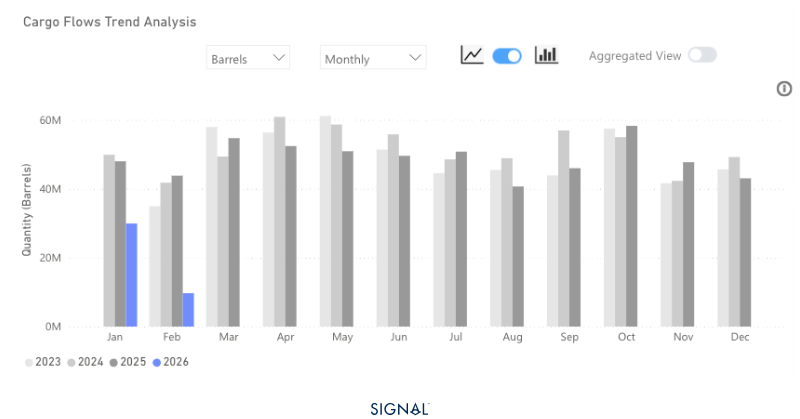
India has taken a third of all Russian crude exports since February 2023. This equates to over 1.8bn barrels of oil.
Steep discounts on Russian oil have been the driving factor for India's sourcing from Russia in recent years.
No confirmation yet from India around if domestic refiners will be told to completely halt Russian imports. If they do, oil prices could jump as replacement barrels are sought despite a well-supplied market.
The U.S. will cut tariffs on Indian goods to 18% from the current 50% if India stops buying Russian crude.
Source: Crude oil flows from Russia to India from Signal Ocean
India’s continued buying of Russian crude oil despite pressure from the West has been a source of strain between the two regions. The latest deal announced by President Trump on Monday looks set to ease the tensions.
Since February 2023, TSOP recorded that India has been the destination for a third of all Russian crude flows, accounting for around 1.8bn barrels. This highlights how crucial the Russia-India relationship has been for Russia. The deal would turn this on its head and see India replacing the Russian crude oil with shipments of crude from the U.S. or even Venezuela.
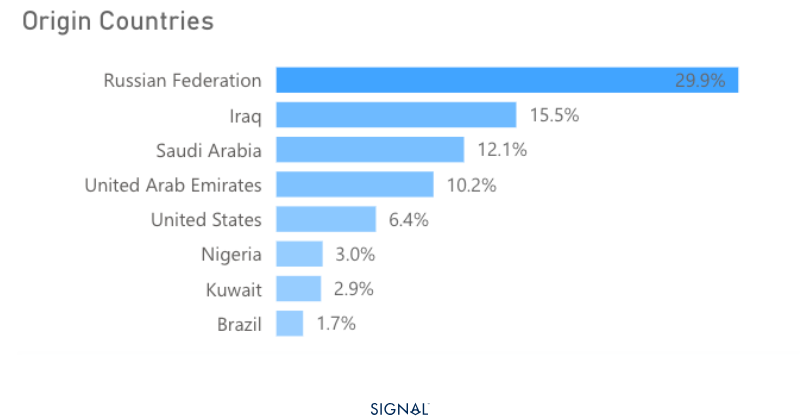
India imported a total of 2.1bn barrels of oil in 2025, with only 6% coming from the U.S. and 30% from Russia. The large discounts on Russian crude have been the driving factor for this. Displacing the entirety of this Russian crude would be a lucrative trade for the U.S. and would see an extra 640m barrels of U.S. oil sent to India. Yet this move would heap pressure on those covering the freight costs, given the much-increased distance between the U.S. Gulf and Indian ports. Historically, prices have needed to be competitive enough that freight costs do not significantly alter the economics.
TSOP has already started to see India taking less Russian oil, though, and has reported on it here. It would be logical that India’s imports of Russian crude trend down rather than drop off instantly, given there has been no confirmation from India yet that refiners will completely halt Russian imports. Despite the market being well supplied, a sudden shift in buying like this from India would inevitably drive oil prices higher, even for a short period of time.
The tariff reductions do, though, offer significant upside for India if it can manage the replacement of Russian crude. The 50% tariff on Indian goods has remained a strong barrier to finished goods entering the U.S. market. These tariffs falling to 18% boost the price competitiveness of Indian origin good and open up the largest consumer market.
Source: Indian crude oil sources in 2025 from Signal Ocean
Takeaways
India looks deeply incentivised to replace the majority, if not the entirety, of its Russian crude oil imports, with a greater proportion of them coming from the U.S. or Venezuela. Indian refiners have not confirmed if they will completely halt Russian oil imports, and doing so would likely push oil prices up higher. This is driving our view that the imports will see a steep decline rather than an abrupt stop. This is also supported by the fact that cargoes have already been booked for February and March, with Reliance Industries confirming it is doing so in sanction-compliant deals.
The benefit of reduced tariffs on Indian goods, from 50% down to 18%, could be a huge win for India as its goods become more price-competitive instantly and open more possibilities in the largest consumer market.
Creating a sustainable world requires us to embark on a journey towards a zero emission future, where every step is a commitment to preserve our planet for future generations.
Albert Greenway
Environmental Scientist, Sustainability Expert
No items found.
Increased Use of Renewable Energy:
Shipping companies are embracing renewable energy sources to power onboard systems and reduce emissions during port operations. Solar panels and wind turbines are being installed on vessels to generate clean energy, reducing reliance on auxiliary engines, and cutting down emissions. Shore power facilities in ports allow ships to connect to the electrical grid, eliminating the need for onboard generators while docked.
Collaboration and Industry Partnerships:
Recognizing that addressing emissions requires collective action, shipping companies, governments, and organizations have formed partnerships and collaborations. These initiatives focus on research and development, sharing best practices, and promoting knowledge transfer. Joint projects aim to develop and deploy innovative technologies, improve infrastructure, and create a supportive regulatory framework to accelerate the industry's transition towards a greener future. The Zero Emission Shipping - Mission Innovation.
To pave the way for a greener future in shipping, the availability of alternative fuels plays a vital role in their widespread adoption. However, this availability is influenced by factors such as port infrastructure, local regulations, and government policies. As the demand for cleaner fuels in shipping rises and environmental regulations become more stringent, efforts are underway to improve the accessibility of these fuels through infrastructure development, collaborations, and investments in production facilities.
Liquefied Natural Gas (LNG) infrastructure has seen significant growth in recent years, resulting in more LNG bunkering facilities and LNG-powered vessels. Nonetheless, the availability of LNG as a marine fuel can still vary depending on the region. To ensure consistent availability worldwide, there is a need for further development of LNG supply chains and infrastructure. For biofuels, their availability hinges on production capacity and the availability of feedstock. Although biofuels are being produced and utilized in various sectors, their availability as a marine fuel remains limited. Scaling up biofuel production and establishing robust supply chains are imperative to ensure wider availability within the shipping industry.Hydrogen, as a fuel for maritime applications, is still in the early stages of infrastructure development. While some hydrogen vessels have been tested or introduced in the first quarter of last year, the infrastructure required for hydrogen production and distribution needs further advancement.
Ammonia, as a marine fuel, currently faces limitations in availability. The production, storage, and handling infrastructure for ammonia need further development to support its widespread use in the shipping industry.Methanol, on the other hand, is already a commercially available fuel and has been used as a blend with conventional fuels in some ships. However, its availability as a standalone marine fuel can still be limited in certain regions. Bureau Veritas in October 2022 published a White Paper for the Alternative Fuels Outlook. This white paper provides a comprehensive overview of alternative fuels for the shipping industry, taking into account key factors such as technological maturity, availability, safety, emissions, and regulations.
Creating a sustainable world requires us to embark on a journey towards a zero emission future, where every step is a commitment to preserve our planet for future generations.
Albert Greenway
Environmental Scientist, Sustainability Expert
Increased Use of Renewable Energy:
Shipping companies are embracing renewable energy sources to power onboard systems and reduce emissions during port operations. Solar panels and wind turbines are being installed on vessels to generate clean energy, reducing reliance on auxiliary engines, and cutting down emissions. Shore power facilities in ports allow ships to connect to the electrical grid, eliminating the need for onboard generators while docked.
Collaboration and Industry Partnerships:
Recognizing that addressing emissions requires collective action, shipping companies, governments, and organizations have formed partnerships and collaborations. These initiatives focus on research and development, sharing best practices, and promoting knowledge transfer. Joint projects aim to develop and deploy innovative technologies, improve infrastructure, and create a supportive regulatory framework to accelerate the industry's transition towards a greener future. The Zero Emission Shipping - Mission Innovation.
To pave the way for a greener future in shipping, the availability of alternative fuels plays a vital role in their widespread adoption. However, this availability is influenced by factors such as port infrastructure, local regulations, and government policies. As the demand for cleaner fuels in shipping rises and environmental regulations become more stringent, efforts are underway to improve the accessibility of these fuels through infrastructure development, collaborations, and investments in production facilities.
Liquefied Natural Gas (LNG) infrastructure has seen significant growth in recent years, resulting in more LNG bunkering facilities and LNG-powered vessels. Nonetheless, the availability of LNG as a marine fuel can still vary depending on the region. To ensure consistent availability worldwide, there is a need for further development of LNG supply chains and infrastructure. For biofuels, their availability hinges on production capacity and the availability of feedstock. Although biofuels are being produced and utilized in various sectors, their availability as a marine fuel remains limited. Scaling up biofuel production and establishing robust supply chains are imperative to ensure wider availability within the shipping industry.Hydrogen, as a fuel for maritime applications, is still in the early stages of infrastructure development. While some hydrogen vessels have been tested or introduced in the first quarter of last year, the infrastructure required for hydrogen production and distribution needs further advancement.
Ammonia, as a marine fuel, currently faces limitations in availability. The production, storage, and handling infrastructure for ammonia need further development to support its widespread use in the shipping industry.Methanol, on the other hand, is already a commercially available fuel and has been used as a blend with conventional fuels in some ships. However, its availability as a standalone marine fuel can still be limited in certain regions. Bureau Veritas in October 2022 published a White Paper for the Alternative Fuels Outlook. This white paper provides a comprehensive overview of alternative fuels for the shipping industry, taking into account key factors such as technological maturity, availability, safety, emissions, and regulations.

.webp)













.png)










.png)



.png)

.png)

.png)


.png)


.avif)



.avif)