.webp)


drives these stories

Shipping technology and freight markets: a review of 2025 and signals for 2026
How AI Shipping Technology Helps Decode Freight Developments
Understanding freight markets has always required piecing together information from multiple and often fragmented sources. From rates, vessel supply, availability, to cargo demand and port congestion, you can rarely find these sources in a single, structured dataset. Instead, most of the sources and data about such valuable commercial intelligence lie scattered across thousands of emails, WhatsApp and Teams conversations, that by themselves, offer but little value. But, when combined in a structured form, all pieced together and analyzed, you see that it can be the most valuable database, one that will bring you much closer to decoding the market.
This is how AI in shipping technology begins to change how freight developments are interpreted. Modern machine learning and language-processing techniques allow for large volumes of unstructured communication to be analyzed systematically for the first time, whether it is formal emails, or informal conversations. So, instead of treating communication as isolated fragments of the market, technology helps us find patterns and uncover underlying market dynamics.
Shipping conversations follow a unique language of their own, from abbreviated words or whole sentences to implied meanings, and the industry-specific phrasing that can signal actual commercial activities, vessel availability, or market sentiment, long before they appear in reports or any form of formal data. By learning these conversation patterns, AI can help structure scattered information into coherent insights, revealing how the supply and demand balance across regions and vessel classes.
When combined with traditional datasets, such as vessel movement and port activity, this structured view of communication adds an important layer of context. It allows market participants to have a deep understanding of not only events in freight markets, but how and why conditions are changing. In an environment that is being shaped by rapid information flow and information complexity, the ability to organize and interpret fragmented signals is becoming central to understanding freight developments in real time.
From Structured Insight to Smarter Decisions
Once data and shipping intelligence has been structured and contextualized, a real opportunity arises, and it is based on how this intelligence is delivered and used by shipping professionals in their day-to-day work. Historically, analyzing data to support decision making required time, experience and manual effort. Analysts prepared reports, brokers mentally compared multiple scenarios, and commercial teams relied heavily on intuition built over years in the market. While this expertise and experience-based intuition remains irreplaceable, the growing volume and speed of information make it increasingly difficult to process everything effectively.
This is where shipping technology is now entering a more evolutionary phase. With freight signals already structured and analyzed in the background, technology can begin to surface insights in ways that are more intuitive, timely, and aligned with how people actually make decisions. The focus swifts more into answering commercial questions directly, helping users to export alternatives, compare scenarios, and understand trade-offs in each case.
As this evolution is taking place, there is a noticeable shift happening. The use of AI in shipping is moving from being purely analytical to steering increasingly towards user-facing solutions. This potentially means that instead of requiring the time and effort to extract information from complex datasets and systems, users will be able to utilize the intelligence available to them to extract what they need in a more direct, conversational and contextual way.
This swift is paving the way for the emergence of AI agents designed specifically to support commercial decision making. These systems are going to enhance human judgement and capabilities and by combining structured market data, private commercial intelligence and real-time analytics, they will be able to evaluate scenarios, highlight risks, and uncover opportunities in seconds. The real breakthrough here is not a system that will be making decisions for us, but a system that will help us understand the consequences of our decisions faster. In practice, this means that professionals can spend less time on assembling information and more on interpreting outcomes, negotiating and focusing on what really matters.
Importantly, the rise of user-facing AI tools also reflects a deeper understanding of the shipping industry itself. Shipping markets are driven by nuance, relationships, and judgement, and any technology that ignores these realities will struggle to gain trust. The most effective AI systems are therefore those that enhance human expertise and not just attempt to automate it.
Looking ahead to 2026, it appears increasingly likely to mark a big step forward in this transition, and with foundational data challenges largely addressed, AI agents are moving from experimental concepts to practical tools that will support everyday commercial workflows. In that sense, the next day for shipping technology is less about prediction and more about interpretation, enabling professionals to engage with the market more confidently and with clearer insight that ever before.
Reviewing 2025 and What the Signals Suggest for 2026
With freight intelligence being increasingly structured and decision-support tools becoming more accessible, we can now focus on what technology reveals about the market itself. Looking back at 2025, we see that the dry bulk market was shaped less by a single dominant trend, and more by the interaction of several powerful forces unfolding simultaneously. Commodity trade patterns evolved unevenly, and fleet positioning became more sensitive to marginal shifts, as well as the geopolitical tensions that introduced friction across global trade routes.
Together, these dynamics created a market that appeared volatile, and in this backdrop, we will focus on interpreting the three forces that emerged as central in shaping freight outcomes during 2025 and are likely to remain critical in shaping the market in 2026.
Coal: Structural Pressure, Shifting Trade Routes
Coal markets in 2025 highlighted how long-term transition does not equate to immediate freight irrelevance. The global coal demand plateaued after reaching record levels in 2024, reflecting a slowed growth dynamic, rather than a sharp decline. In China, modest demand contraction and rapid renewable expansion softened imports early in the year, yet coal remained critical for system stability during periods of high demand and hydropower shortfalls. India followed a different path, where domestic production expanded rapidly but continued reliance on imported coking coal to support its steel output.
For freight, the key development was not volume alone but changing trade patterns. Indonesian exports, long dominating the short-haul Asian trades, came under pressure from pricing policies and weaker demand from China. At the same time, suppliers of longer-haul routes such as Australia, Russia and South Africa regained relevance, particularly in the Indian market. This shift toward longer voyages helped sustain vessel employment, despite a flatter or declining aggregate demand.
Heading into 2026, coal’s signal for freight is increasingly about distance and regional resourcing rather than growth, reinforcing the importance of ton-mile dynamics over headline consumption figures.
Iron Ore: Expanding Supply Meets Uneven Demand
Iron ore markets in 2025 were defined by strong supply momentum while facing uncertain demand. Seaborne shipments increased sharply, driven mostly by stable output from Australia, a strong Brazilian market recovery, and the approaching launch of Guinea’s Simandou project. Together, these developments made long-haul trade flows stronger and provided support to a significant tonne-day demand, underpinning improved Capesize utilization.
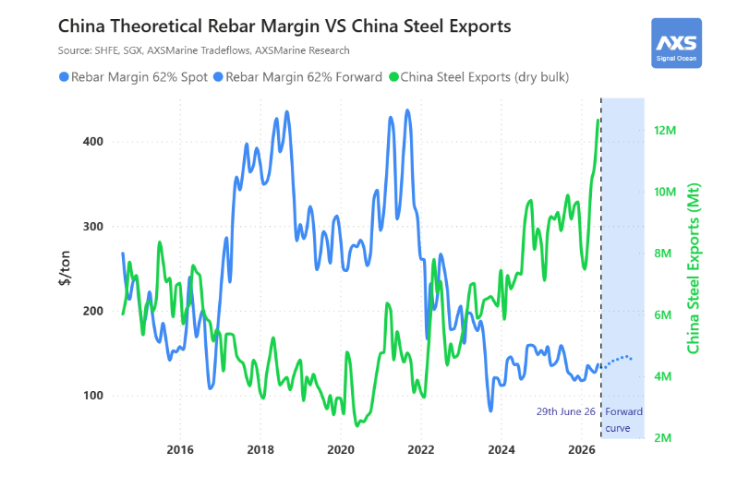
However, this supply expansion coincided with a weaker demand backdrop in China. Sluggish steel margins and a limited policy stimulus constrained restocking appetite, even as monthly imports reached multi-year highs. The seasonal production cuts and rising port inventories kept prices under pressure and reinforced volatility in the market, rather than providing directional clarity.
For freight markets, the signals remain mixed. Expanding long-haul supply supports ton-mile demand, but uneven consumption suggests continued sensitivity to timing, routing and fleet positioning. Iron ore is therefore likely to remain a driver of freight volatility into 2026, rewarding those who can interpret shifts early.
Geopolitical Tensions: Persistent Friction, Not a Return to Normal
Geopolitics was a defining feature of 2025, introducing inefficiencies that reshaped trade flows and absorbed vessel capacity. Re-routing, longer voyages, port disruptions, and heightened operational risk distorted the previously established patterns and amplified ton-mile demand in unexpected ways.
While some easing of tensions is anticipated in 2026, data suggests that a full return to pre-disruption trading patterns is unlikely. Even incremental geopolitical developments continue to influence routing decisions, insurance costs, and operational behavior, embedding additional friction into the market. As a result, freight outcomes remain highly sensitive to events beyond the traditional supply-demand fundamentals.
A Market That Rewards Insight
Taken together, these forces suggest the dry bulk market will enter 2026 with fewer certainties but clearer signals. Rather than a year of decisive directional moves, the period ahead is more likely to reward disciplined positioning and careful interpretation. With demand uneven, supply expanding, and geopolitical risk persistent, the ability to connect market signals is becoming a core strategy for navigating uncertainty and managing exposure to volatility itself.
- Authored by Alex Ledovas
The above analysis leveraged the advanced freight analytics of The Signal Ocean Platform, offering a comprehensive summary of annual trends across key market indicators, including Fleet, Demand, Ship Prices, and Voyages. As we step into the New Year, we invite you to explore these trends further through our weekly monitors, which provide in-depth analyses of Freight, Supply, and Demand metrics. Stay tuned for more enhancements to our platform, including new features that will deepen your understanding of market behaviour and improve operational planning.


Ready to get started and outrun your competition?








.png)









.png)


.png)

.png)

.png)


.png)


.avif)



.avif)