Subscribe for our latest news, straight to your inbox:
Thank you! Your submission has been received!
Oops! Something went wrong while submitting the form.
Share this post
New Super Typhoon Could Disrupt Taiwan & China Ports Again
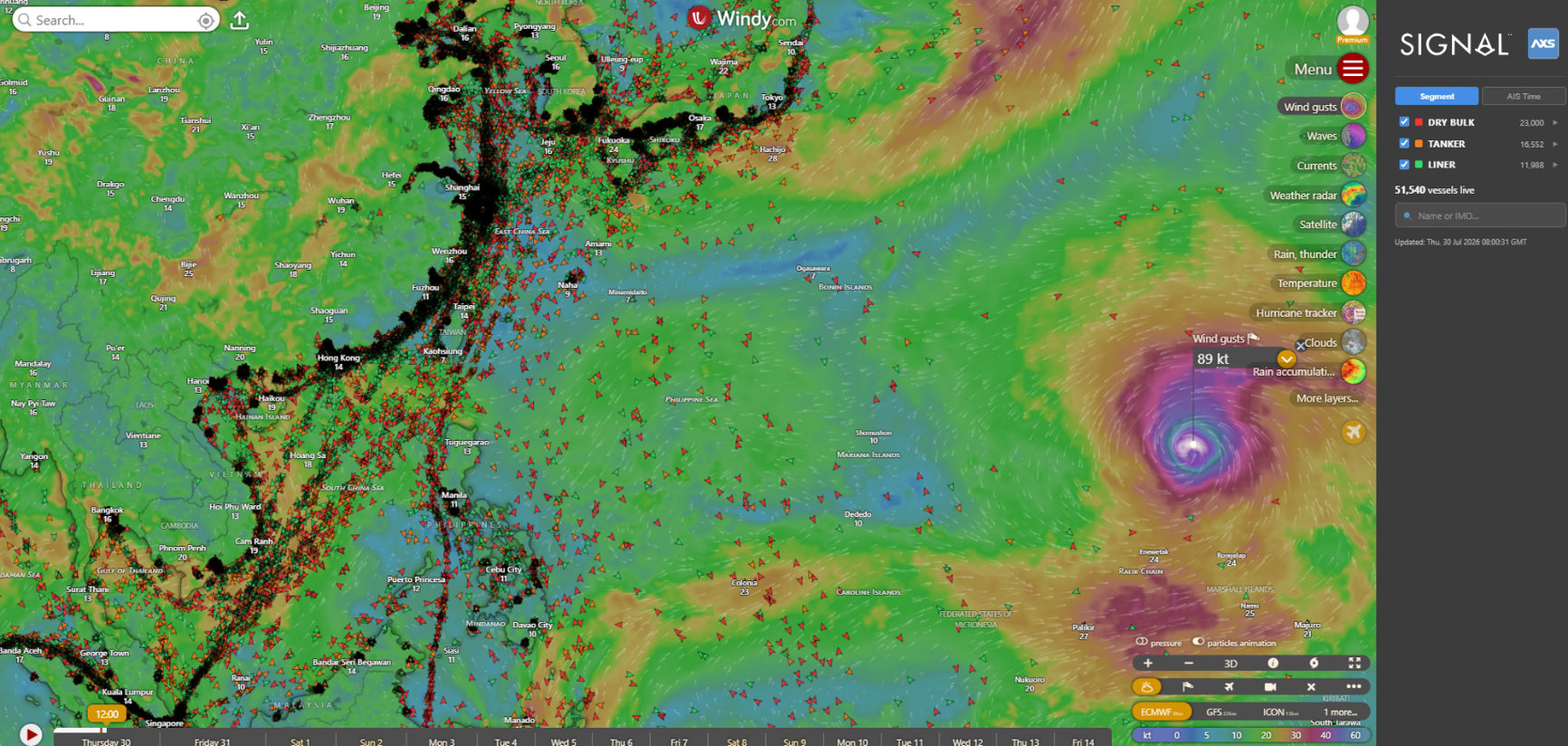
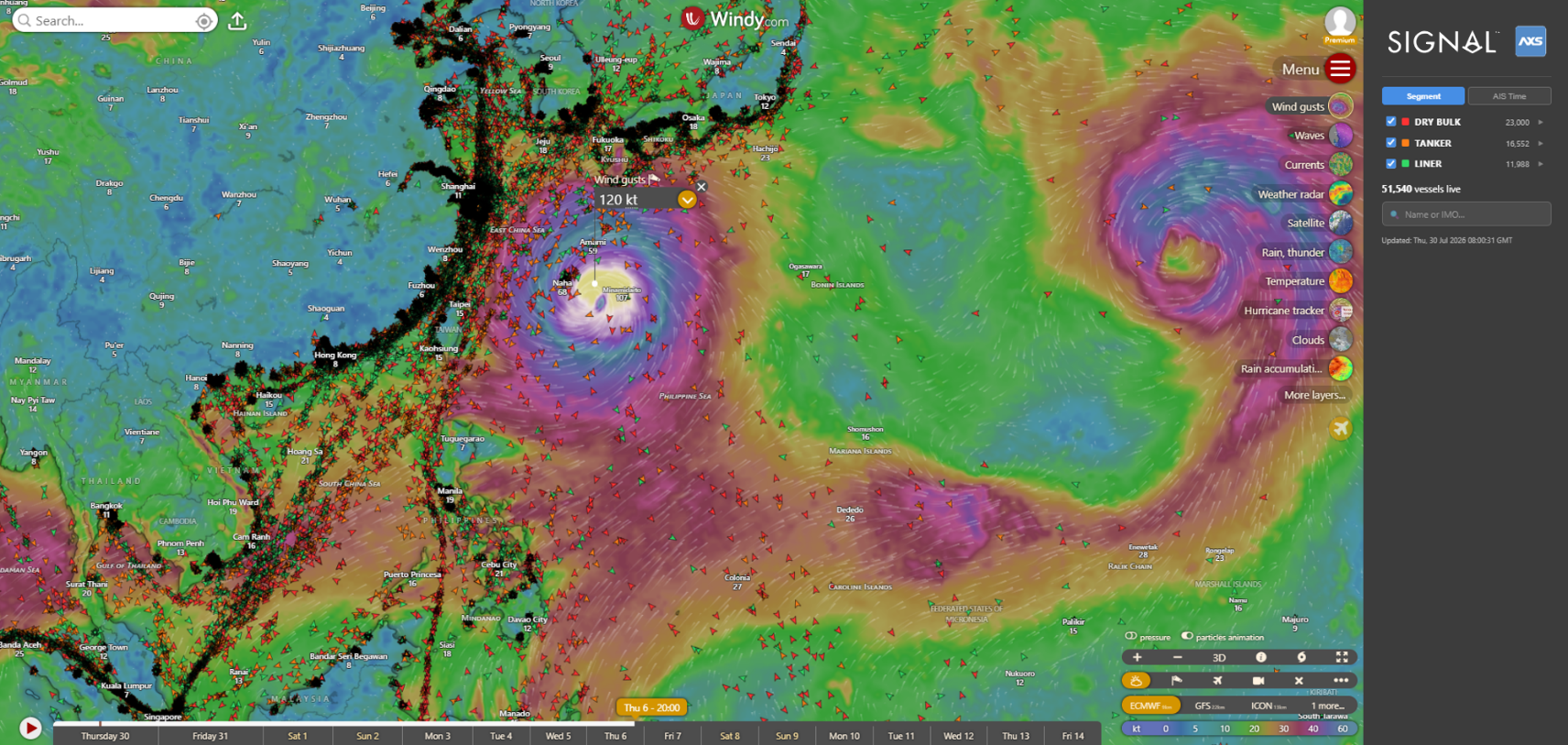
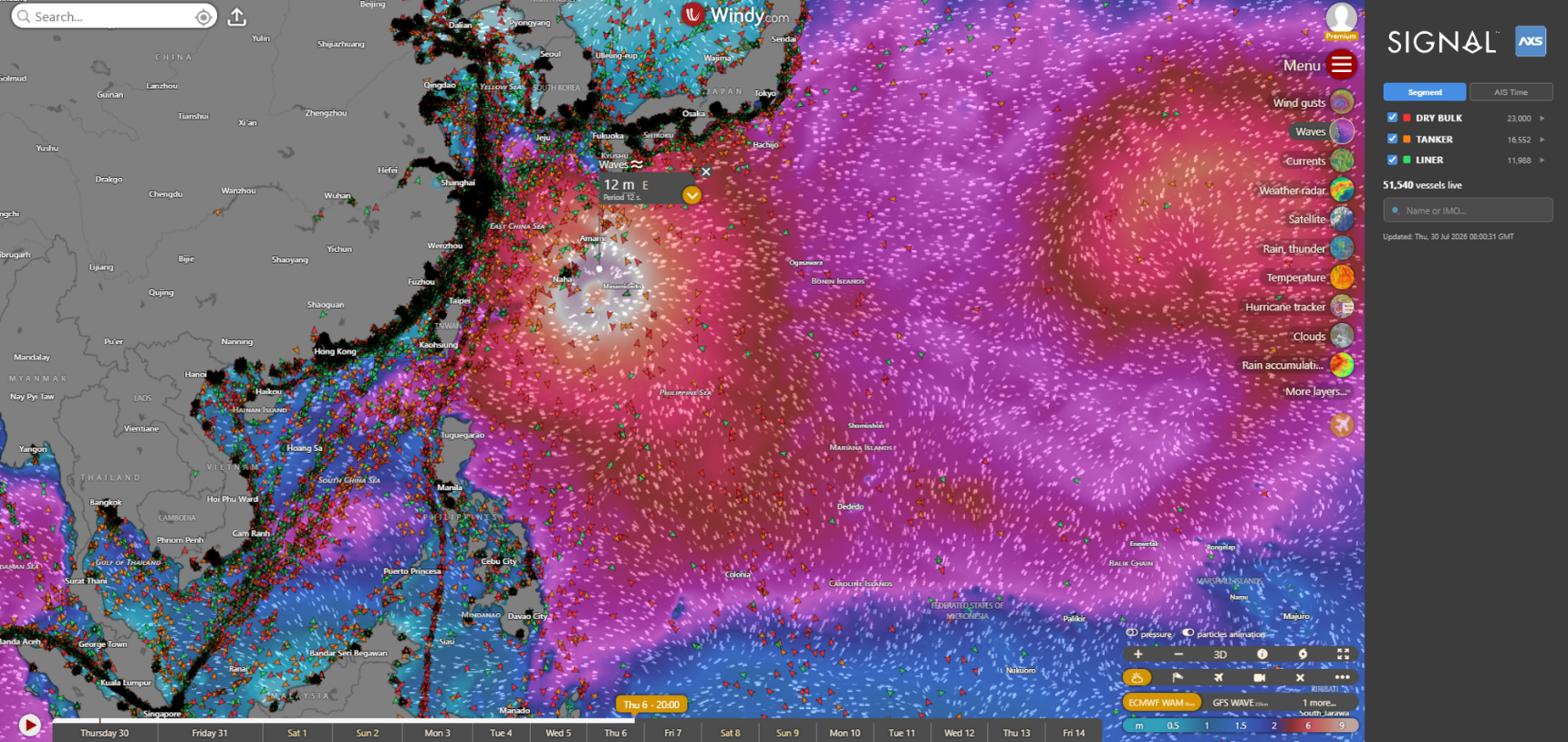
Super Typhoon Dolphin is currently rated Category 5 by ECMWF, and Windy tracking shows it heading toward Taiwan and China, following Typhoon Bavi which impacted the Chinese supply chain mid-July. The system could approach the coast on Thursday, 6 August, with gusts reaching approximately 100 knots and waves of up to 12 meters with a 12-second period.
The precise track and intensity may still change, but the projected conditions would be sufficient to disrupt navigation and port operations across the region.
Potential impact across vessel segments
As a result, all vessel segments — dry bulk, container, tanker, and gas — face potential disruption. Container services could see congestion rise again as some Chinese ports close or scale back operations for safety reasons. Dry bulk terminals may also slow down, adding to congestion and tightening vessel supply across the Pacific. Tankers and gas carriers face similar exposure, with reduced manoeuvring capacity and possible delays to loading and discharge; even a brief port suspension can leave effects lasting well beyond the storm itself, as vessels bunch and compete for terminal availability once operations resume.
Existing congestion could amplify the impact
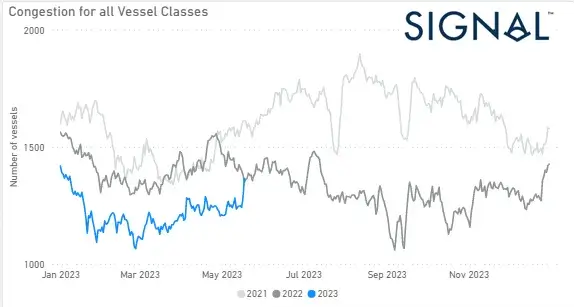
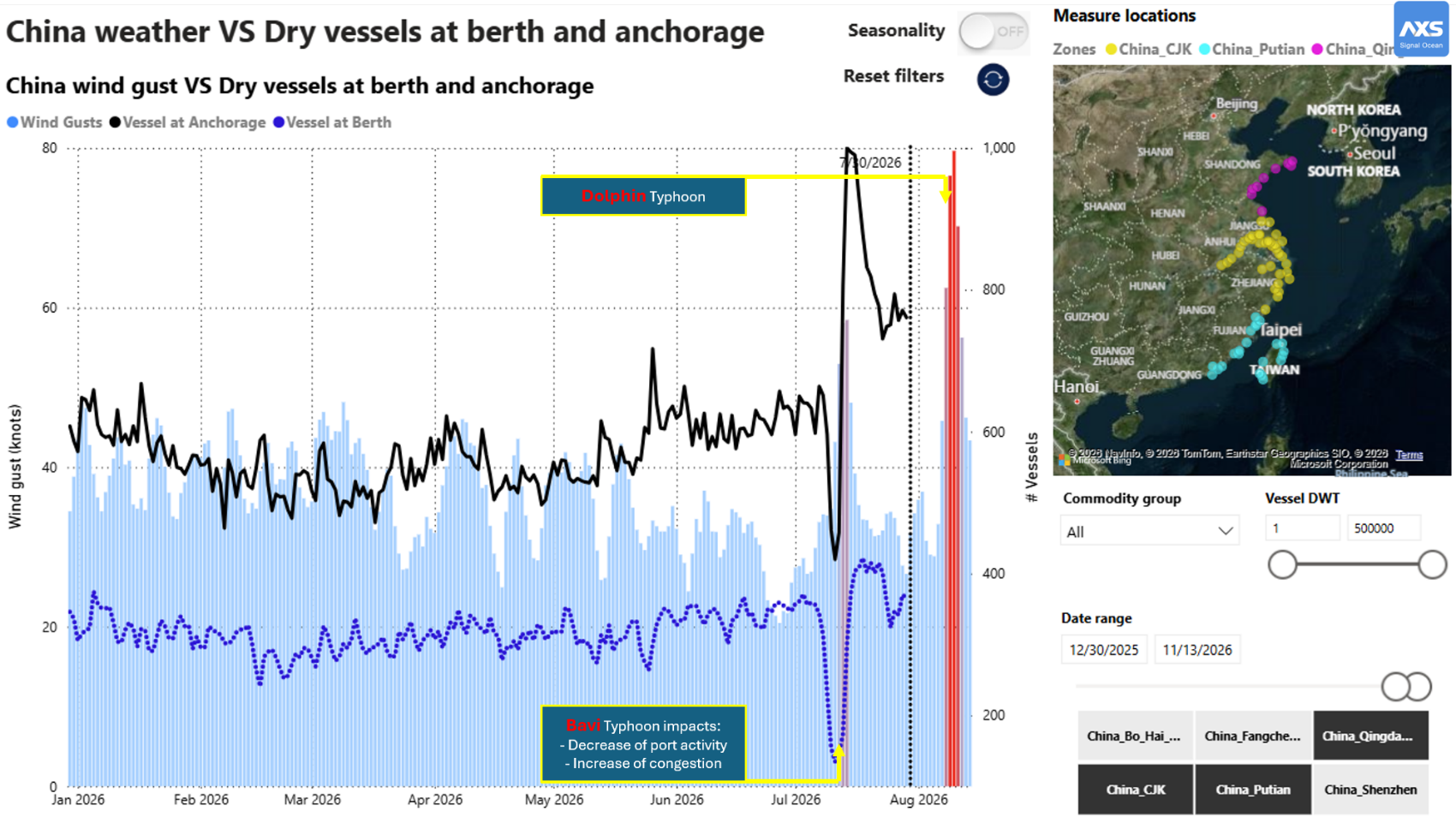
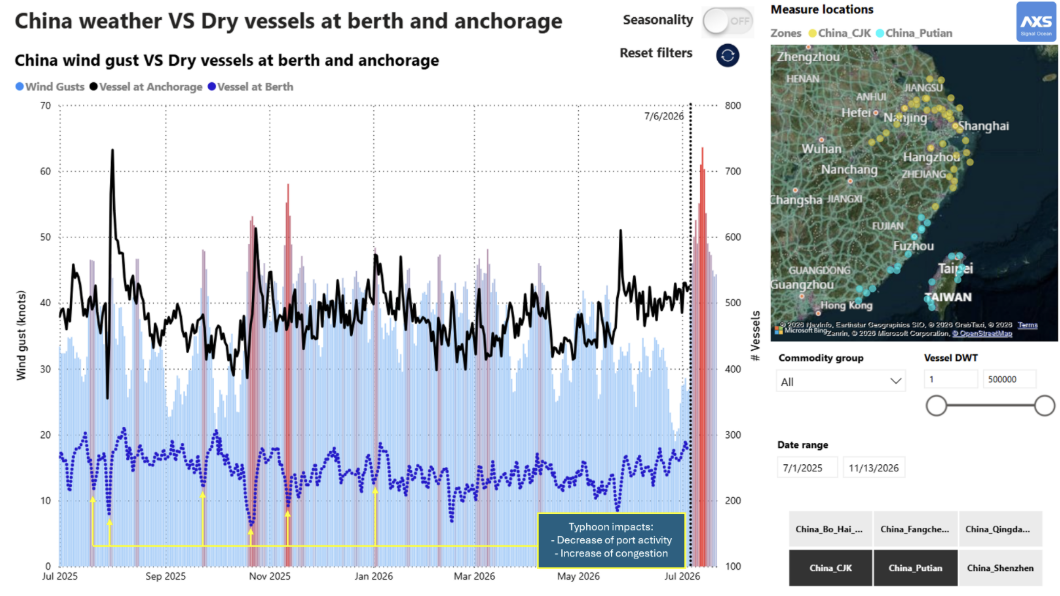
Bavi’s impact remains visible in Chinese dry bulk vessel activity. Around the storm period, port activity declined while the number of vessels waiting at anchorage increased. Although operations have gradually resumed, congestion remains elevated, as shown in the graph below.
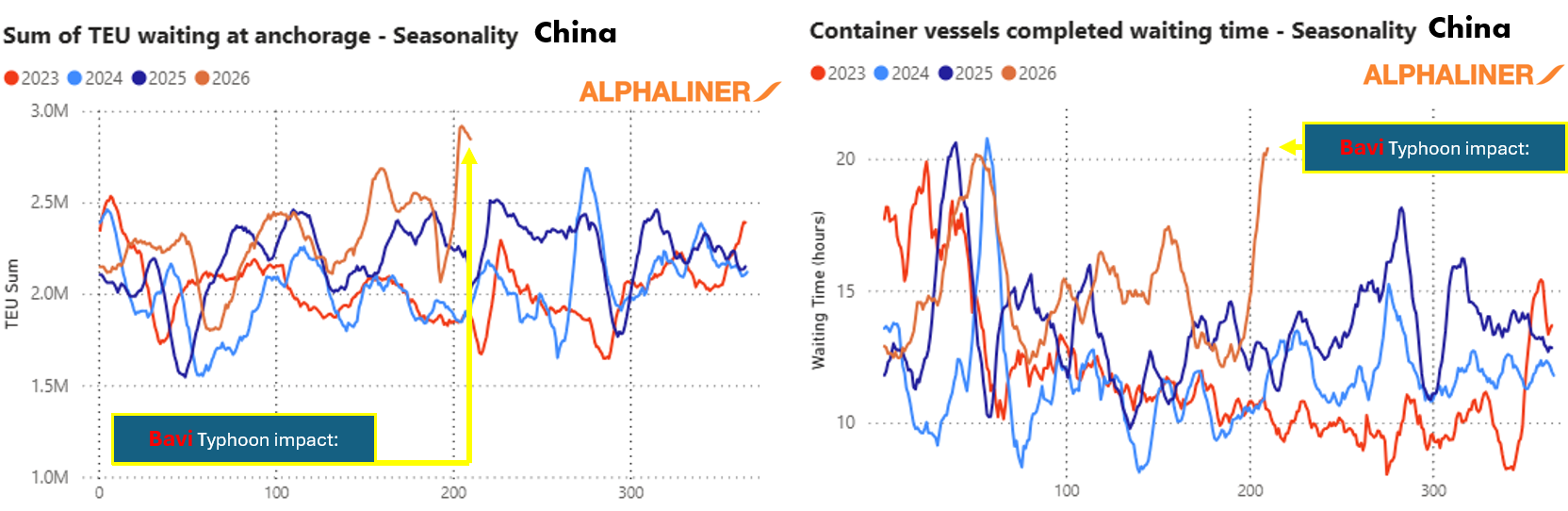
Alphaliner reports that Bavi also caused a noticeable increase in container vessel congestion in China. Both the amount of container capacity waiting at anchorage and completed vessel waiting times rose following the storm. While conditions have started to improve, the disruption has not yet been fully absorbed, leaving the market more exposed to another round of port restrictions or vessel bunching if Dolphin follows its current projected path.
More than 66 million tonnes scheduled for discharge
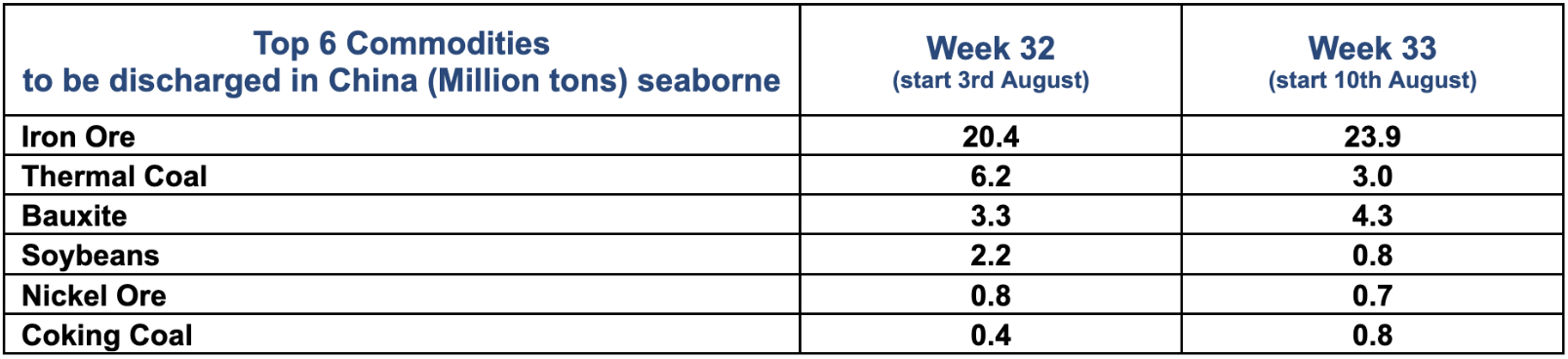
Iron ore, thermal and coking coal, bauxite, soybeans, and nickel ore are the commodities most exposed by volume should Dolphin hit Chinese ports hard. Across these six commodities, approximately 33.3 million tonnes are scheduled to be discharged in China during Week 32, followed by another 33.5 million tonnes in Week 33 — together more than 66 million tonnes. Iron ore represents the largest share, with 20.4 million tonnes expected in Week 32 and 23.9 million tonnes in Week 33.
Top 6 Commodities to be discharged in China (Million tons) seaborne
The immediate risk is a potential delay in discharge activity, which could extend anchorage congestion and tighten available vessel supply across the Pacific. With Bavi's backlog still clearing and a second storm now approaching the same corridor within a month, the key indicators to watch over the coming days will be changes to Dolphin's projected track, port suspension notices, vessel accumulation at Chinese anchorages, and the pace at which congestion clears once the storm passes. We will continue tracking crossing volumes and discharge data across all vessel segments as the picture develops.
Creating a sustainable world requires us to embark on a journey towards a zero emission future, where every step is a commitment to preserve our planet for future generations.
Albert Greenway
Environmental Scientist, Sustainability Expert
No items found.
Increased Use of Renewable Energy:
Shipping companies are embracing renewable energy sources to power onboard systems and reduce emissions during port operations. Solar panels and wind turbines are being installed on vessels to generate clean energy, reducing reliance on auxiliary engines, and cutting down emissions. Shore power facilities in ports allow ships to connect to the electrical grid, eliminating the need for onboard generators while docked.
Collaboration and Industry Partnerships:
Recognizing that addressing emissions requires collective action, shipping companies, governments, and organizations have formed partnerships and collaborations. These initiatives focus on research and development, sharing best practices, and promoting knowledge transfer. Joint projects aim to develop and deploy innovative technologies, improve infrastructure, and create a supportive regulatory framework to accelerate the industry's transition towards a greener future. The Zero Emission Shipping - Mission Innovation.
To pave the way for a greener future in shipping, the availability of alternative fuels plays a vital role in their widespread adoption. However, this availability is influenced by factors such as port infrastructure, local regulations, and government policies. As the demand for cleaner fuels in shipping rises and environmental regulations become more stringent, efforts are underway to improve the accessibility of these fuels through infrastructure development, collaborations, and investments in production facilities.
Liquefied Natural Gas (LNG) infrastructure has seen significant growth in recent years, resulting in more LNG bunkering facilities and LNG-powered vessels. Nonetheless, the availability of LNG as a marine fuel can still vary depending on the region. To ensure consistent availability worldwide, there is a need for further development of LNG supply chains and infrastructure. For biofuels, their availability hinges on production capacity and the availability of feedstock. Although biofuels are being produced and utilized in various sectors, their availability as a marine fuel remains limited. Scaling up biofuel production and establishing robust supply chains are imperative to ensure wider availability within the shipping industry.Hydrogen, as a fuel for maritime applications, is still in the early stages of infrastructure development. While some hydrogen vessels have been tested or introduced in the first quarter of last year, the infrastructure required for hydrogen production and distribution needs further advancement.
Ammonia, as a marine fuel, currently faces limitations in availability. The production, storage, and handling infrastructure for ammonia need further development to support its widespread use in the shipping industry.Methanol, on the other hand, is already a commercially available fuel and has been used as a blend with conventional fuels in some ships. However, its availability as a standalone marine fuel can still be limited in certain regions. Bureau Veritas in October 2022 published a White Paper for the Alternative Fuels Outlook. This white paper provides a comprehensive overview of alternative fuels for the shipping industry, taking into account key factors such as technological maturity, availability, safety, emissions, and regulations.
Creating a sustainable world requires us to embark on a journey towards a zero emission future, where every step is a commitment to preserve our planet for future generations.
Albert Greenway
Environmental Scientist, Sustainability Expert
Increased Use of Renewable Energy:
Shipping companies are embracing renewable energy sources to power onboard systems and reduce emissions during port operations. Solar panels and wind turbines are being installed on vessels to generate clean energy, reducing reliance on auxiliary engines, and cutting down emissions. Shore power facilities in ports allow ships to connect to the electrical grid, eliminating the need for onboard generators while docked.
Collaboration and Industry Partnerships:
Recognizing that addressing emissions requires collective action, shipping companies, governments, and organizations have formed partnerships and collaborations. These initiatives focus on research and development, sharing best practices, and promoting knowledge transfer. Joint projects aim to develop and deploy innovative technologies, improve infrastructure, and create a supportive regulatory framework to accelerate the industry's transition towards a greener future. The Zero Emission Shipping - Mission Innovation.
To pave the way for a greener future in shipping, the availability of alternative fuels plays a vital role in their widespread adoption. However, this availability is influenced by factors such as port infrastructure, local regulations, and government policies. As the demand for cleaner fuels in shipping rises and environmental regulations become more stringent, efforts are underway to improve the accessibility of these fuels through infrastructure development, collaborations, and investments in production facilities.
Liquefied Natural Gas (LNG) infrastructure has seen significant growth in recent years, resulting in more LNG bunkering facilities and LNG-powered vessels. Nonetheless, the availability of LNG as a marine fuel can still vary depending on the region. To ensure consistent availability worldwide, there is a need for further development of LNG supply chains and infrastructure. For biofuels, their availability hinges on production capacity and the availability of feedstock. Although biofuels are being produced and utilized in various sectors, their availability as a marine fuel remains limited. Scaling up biofuel production and establishing robust supply chains are imperative to ensure wider availability within the shipping industry.Hydrogen, as a fuel for maritime applications, is still in the early stages of infrastructure development. While some hydrogen vessels have been tested or introduced in the first quarter of last year, the infrastructure required for hydrogen production and distribution needs further advancement.
Ammonia, as a marine fuel, currently faces limitations in availability. The production, storage, and handling infrastructure for ammonia need further development to support its widespread use in the shipping industry.Methanol, on the other hand, is already a commercially available fuel and has been used as a blend with conventional fuels in some ships. However, its availability as a standalone marine fuel can still be limited in certain regions. Bureau Veritas in October 2022 published a White Paper for the Alternative Fuels Outlook. This white paper provides a comprehensive overview of alternative fuels for the shipping industry, taking into account key factors such as technological maturity, availability, safety, emissions, and regulations.

.webp)











.png)









.png)


.png)

.png)

.png)


.png)


.avif)



.avif)