Subscribe for our latest news, straight to your inbox:
Thank you! Your submission has been received!
Oops! Something went wrong while submitting the form.
Share this post
Syria's tanker trade: what the data shows
AXSMarine TradeFlows, load and discharge sides · Wet cargo only · January–July 2025 against January–July 2026 · Extract dated 17 August 2026.Barrels, converted record by record at 7.3 bbl a tonne for crude, 7.9 for clean products, 6.353 for fuel oil and 11.6 for LPG
The short answer
Both are up, for quite different reasons. Seaborne imports of oil, products and gas into the three ports went from 3.75m bbl in the first seven months of 2025 to 17.03m bbl this year, +354%, on 25 discharge records rising to 65. Exports are a different case. They barely existed in 2025: one cargo, 0.23m bbl. This year they are 15.42m bbl on 28 records. Syria has gone from importing something like 17 barrels for every one it shipped out to roughly 1.1:1.
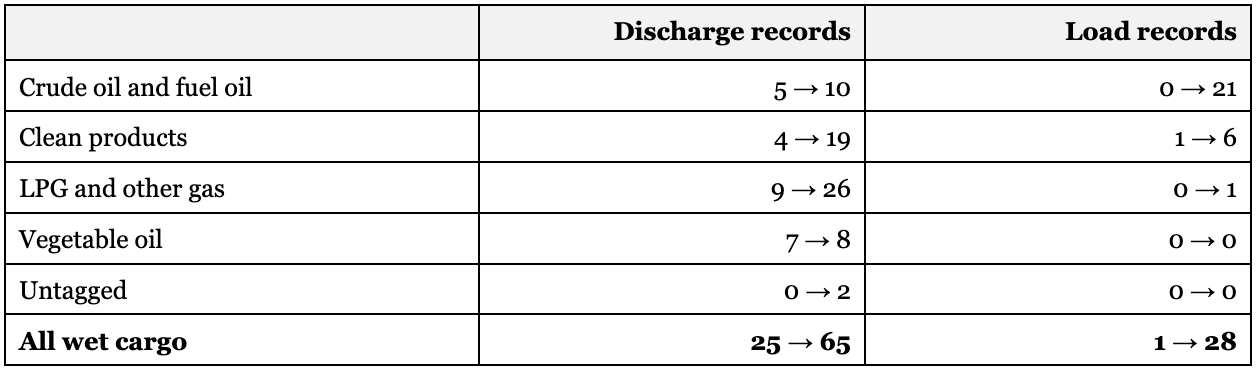
Imports rose in every segment. On the export side, crude and fuel oil recorded nothing whatever in 2025 and now account for four fifths of everything that leaves. So one trade multiplied and the other started from scratch.
Where the movement is
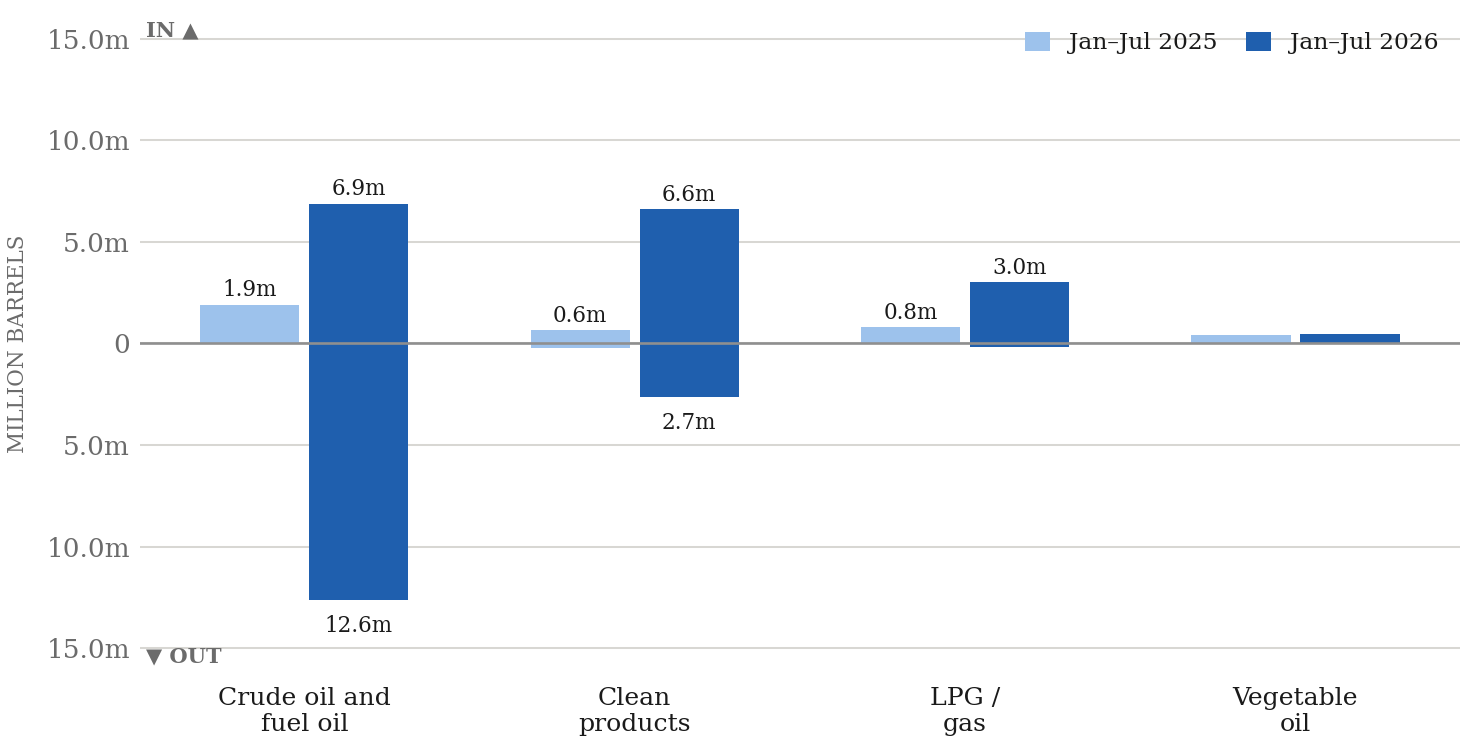
Seaborne wet cargo at Banias, Tartous and Latakia, millions of barrels, January to July. Bars above the line are imports, below the line exports. Crude and fuel oil are shown as one line for the reason set out below. Untagged records are excluded from the chart and appear in the table.
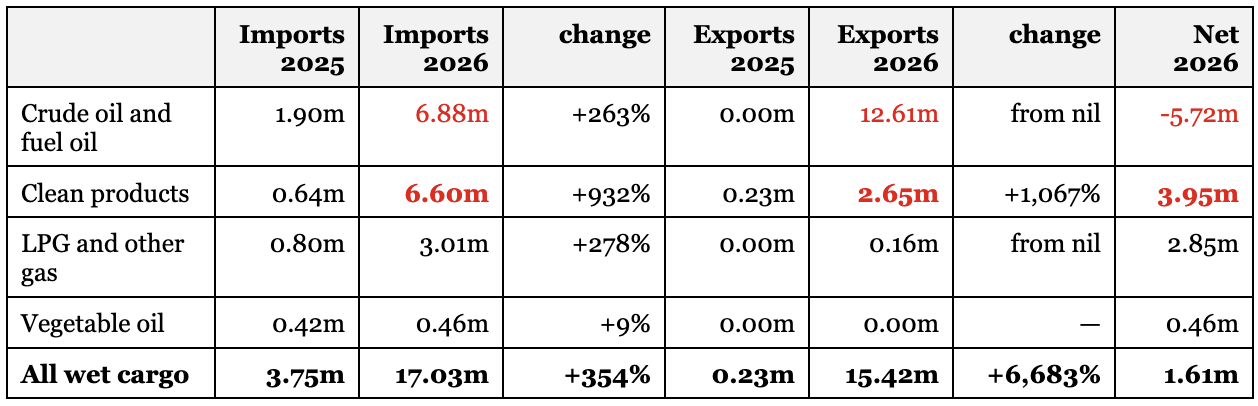
Barrels, January to July. "Net 2026" is imports minus exports for the current year, so a positive number means the country took in more than it sent out.
Most of the movement sits in two lines. Clean products are the largest inbound stream at 6.60m bbl. After the 2.65m bbl that left again, Syria was 3.95m barrels short over the seven months. Crude and fuel oil go the other way: 6.88m bbl in against 12.61m bbl out, a net outflow of 5.72m barrels. That single line is the whole of the export story.
Some context for the clean deficit. Syria’s energy minister has put domestic demand at 120,000 to 150,000 barrels a day. The same official gave production as 100,000 b/d in one statement and 40,000 in another, and the Syrian Petroleum Company put combined refinery capacity at about 130,000 b/d, with Banias running at 95,000: Enab Baladi, 7 March 2026. Against those numbers a heavy clean import bill is roughly what you would expect.
The three ports do different jobs
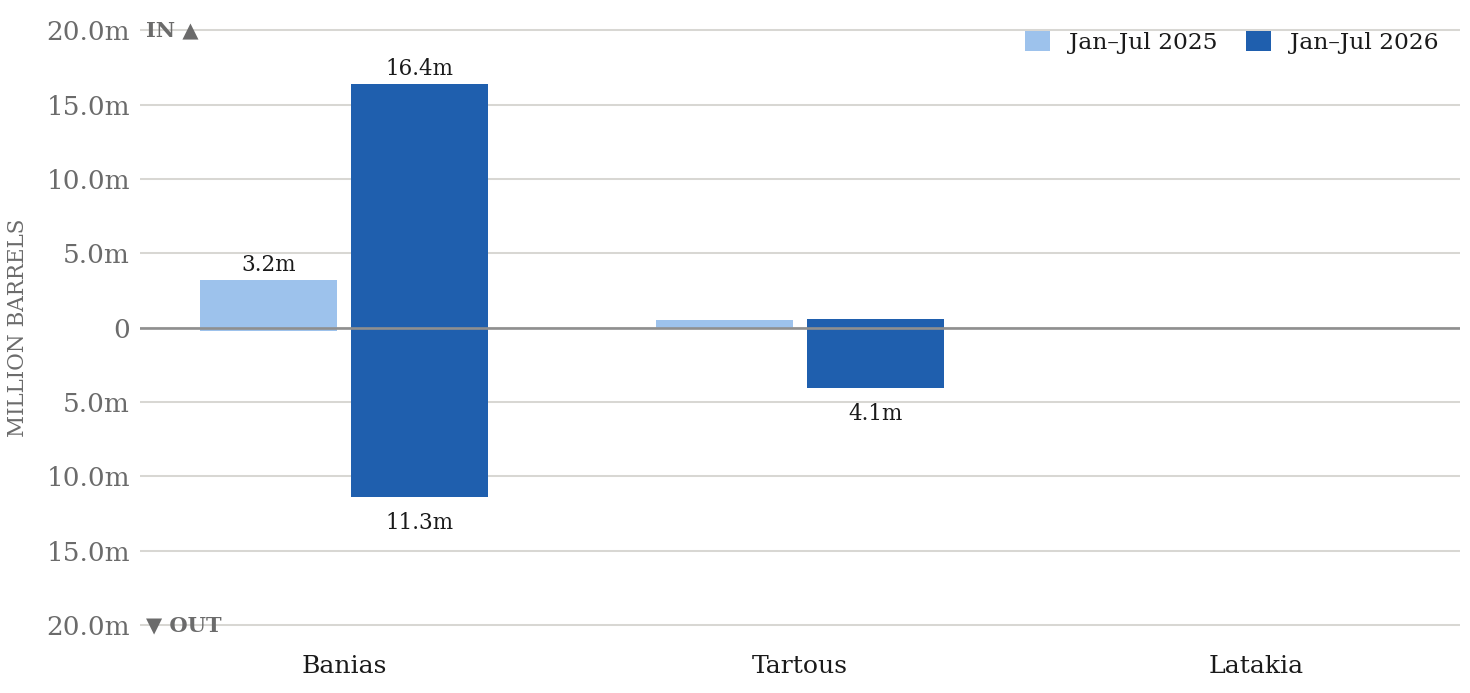
Wet cargo by port, millions of barrels, January to July.
Barrels, January to July.
Banias is the oil port, and very nearly the whole of it: 16.41m bbl in and 11.35m bbl out, or 96% of wet imports and 74% of wet exports. Tartous runs a smaller crude and products business alongside its dry trade, 0.62m bbl in and 4.07m bbl out. Latakia records no tanker cargo at all, in either year or either direction.
Voyages and port calls
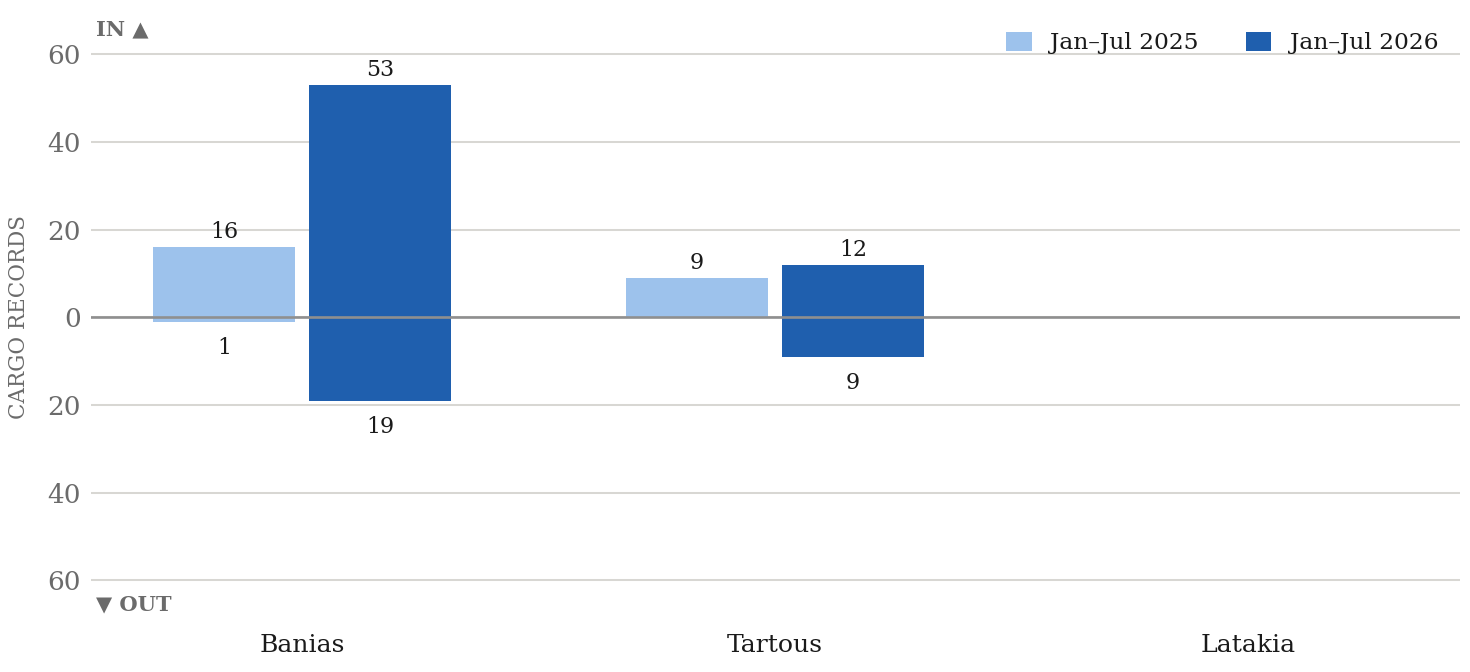
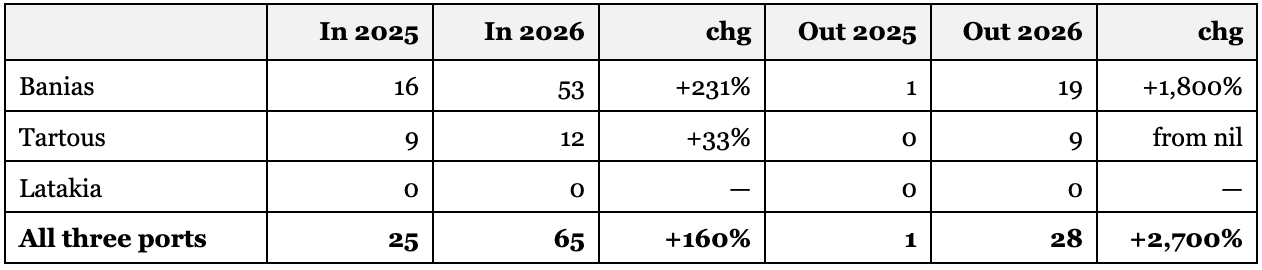
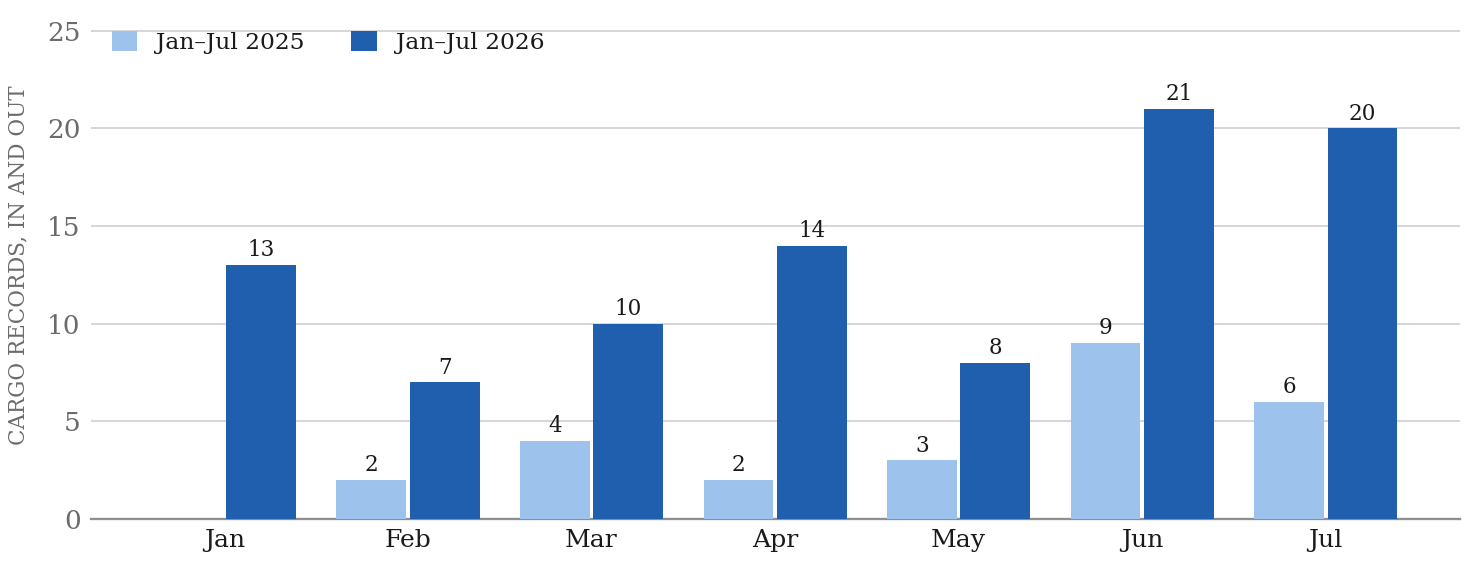
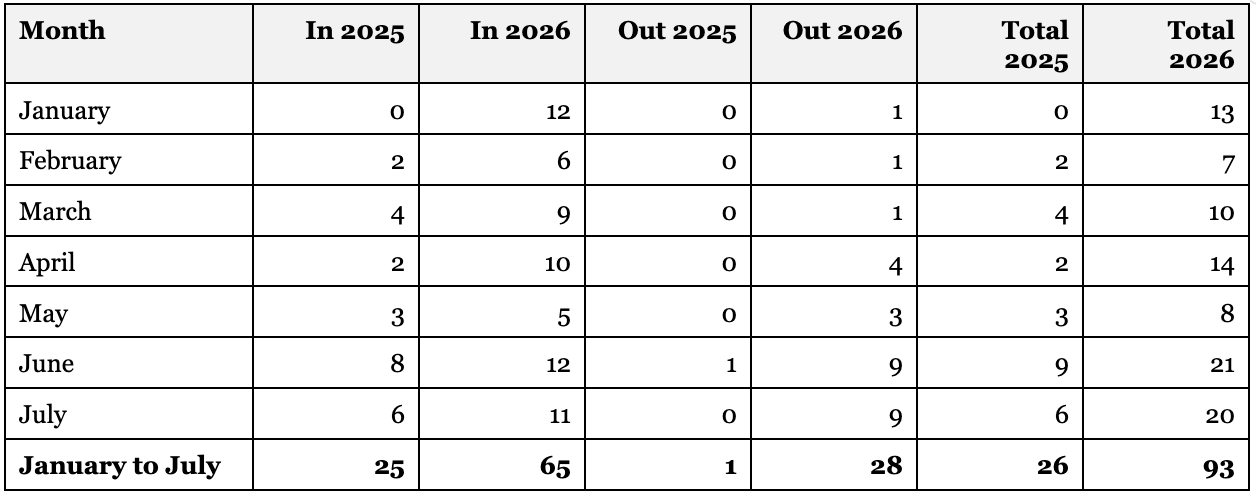
Tonnage is only half of it, and the vessel count moves differently. Wet cargo records across the three ports went from 25 inbound and 1 outbound in January–July 2025 to 65 and 28 in 2026, so total 26 became 93, or +258%. That is a smaller multiple than the tonnage rise, which means average cargo size went up as well. Some of the extra volume came from more ships and some from bigger ones.
Wet cargo records by port, January to July. Latakia records none in either year.
Cargo records, January to July.
Wet cargo records per month, both directions combined, January to July.
Cargo records by month of discharge for imports and month of loading for exports.
Cargo records, 2025 → 2026, January to July.
Banias month by month
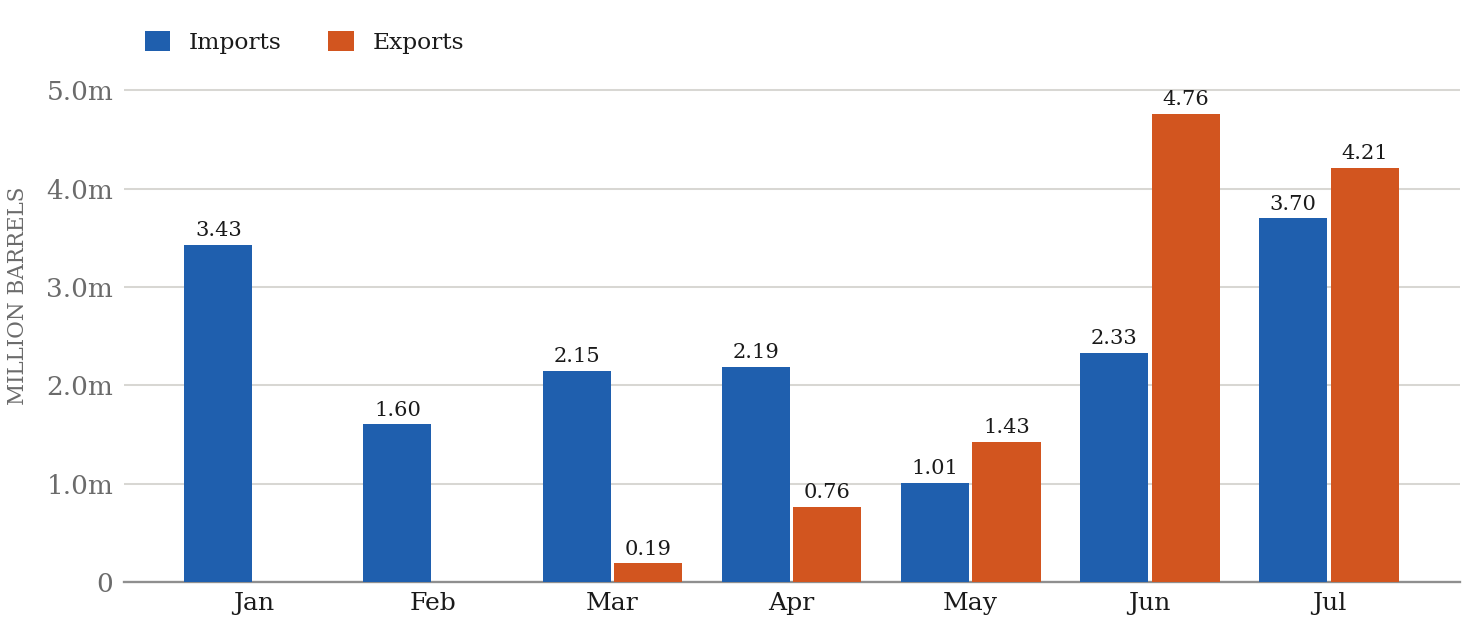
Banias wet cargo by month, millions of barrels, 2026. Imports run through the whole period; exports do not appear until March.
Banias imports in every month of the year. It ships nothing out in January or February, sends a first 0.19m barrels in March, then climbs sharply from May to a June peak of 4.76m barrels. The change is abrupt rather than gradual.
The timing is worth noting, carefully. The Al-Tanf–Al-Waleed crossing between Iraq and Syria reopened on 2 April 2026 after more than a decade shut, and Iraqi fuel tanker convoys "had begun crossing through the Tanf border towards the Banias refinery": Qatar News Agency, 2 April 2026. The export ramp in the extract sits either side of that date. It is a coincidence of timing, not a causal link this data can prove, and in any case the first cargo leaves in March, before the crossing opened.
Where the imported oil loads
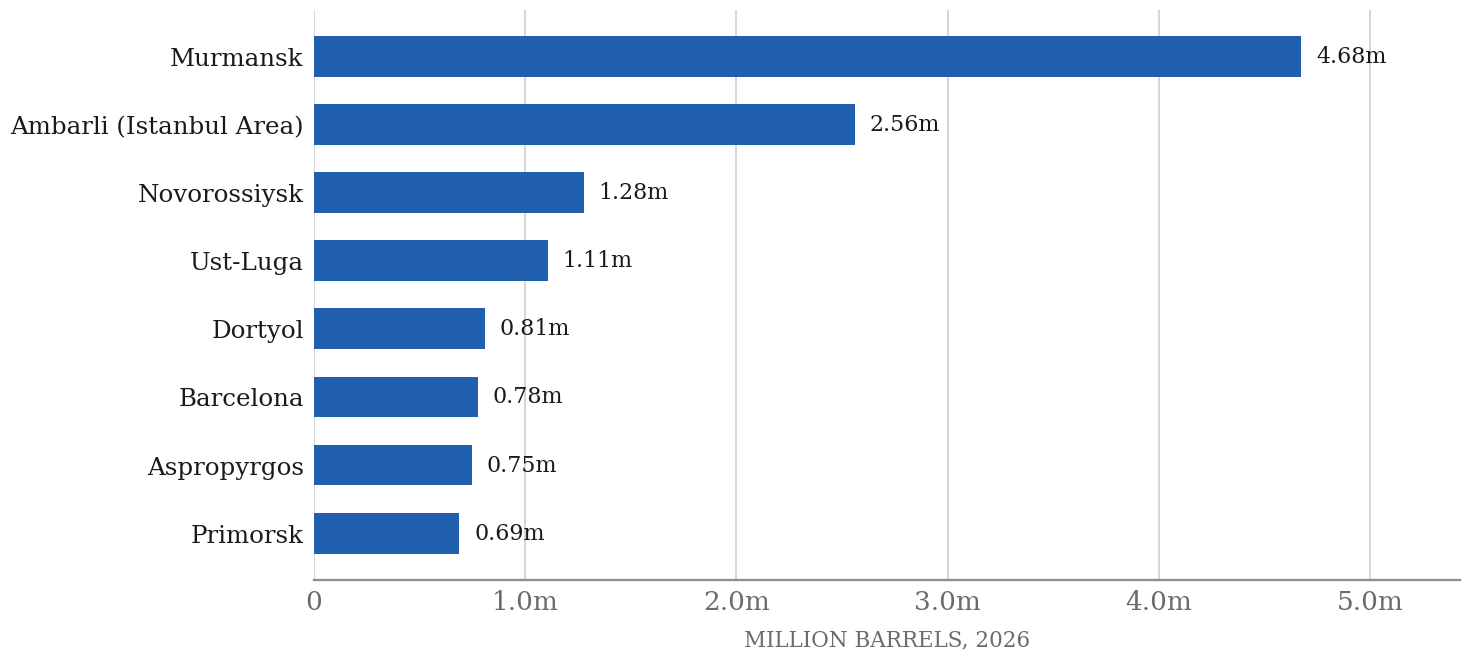
Top eight load ports for 2026 wet arrivals, millions of barrels, January to July, from the extract.
Murmansk on its own accounts for 4.68m bbl. Add Ust-Luga, Novorossiysk, Primorsk and Tuapse and the Russian load ports come to 8.00m barrels, 47% of 2026 wet arrivals.
How much of the flow we actually see
Worth knowing what all of the above is a share of. Where there is a published benchmark, this is how our numbers compare.
The reported figures come from the Syrian General Authority for Land and Sea Border Crossings, which describes Banias since the start of 2026 as "receiving 108 tankers carrying about 3.23 million tons of various petroleum products" and handling the outbound flow on "30 tankers carrying fuel oil and petroleum distillates" (SANA, 7 August 2026, Shafaq News, 7 August 2026), plus 551 vessels and about 5m tonnes at Tartous in the first half (SANA, 6 August 2026).
Creating a sustainable world requires us to embark on a journey towards a zero emission future, where every step is a commitment to preserve our planet for future generations.
Albert Greenway
Environmental Scientist, Sustainability Expert
No items found.
Increased Use of Renewable Energy:
Shipping companies are embracing renewable energy sources to power onboard systems and reduce emissions during port operations. Solar panels and wind turbines are being installed on vessels to generate clean energy, reducing reliance on auxiliary engines, and cutting down emissions. Shore power facilities in ports allow ships to connect to the electrical grid, eliminating the need for onboard generators while docked.
Collaboration and Industry Partnerships:
Recognizing that addressing emissions requires collective action, shipping companies, governments, and organizations have formed partnerships and collaborations. These initiatives focus on research and development, sharing best practices, and promoting knowledge transfer. Joint projects aim to develop and deploy innovative technologies, improve infrastructure, and create a supportive regulatory framework to accelerate the industry's transition towards a greener future. The Zero Emission Shipping - Mission Innovation.
To pave the way for a greener future in shipping, the availability of alternative fuels plays a vital role in their widespread adoption. However, this availability is influenced by factors such as port infrastructure, local regulations, and government policies. As the demand for cleaner fuels in shipping rises and environmental regulations become more stringent, efforts are underway to improve the accessibility of these fuels through infrastructure development, collaborations, and investments in production facilities.
Liquefied Natural Gas (LNG) infrastructure has seen significant growth in recent years, resulting in more LNG bunkering facilities and LNG-powered vessels. Nonetheless, the availability of LNG as a marine fuel can still vary depending on the region. To ensure consistent availability worldwide, there is a need for further development of LNG supply chains and infrastructure. For biofuels, their availability hinges on production capacity and the availability of feedstock. Although biofuels are being produced and utilized in various sectors, their availability as a marine fuel remains limited. Scaling up biofuel production and establishing robust supply chains are imperative to ensure wider availability within the shipping industry.Hydrogen, as a fuel for maritime applications, is still in the early stages of infrastructure development. While some hydrogen vessels have been tested or introduced in the first quarter of last year, the infrastructure required for hydrogen production and distribution needs further advancement.
Ammonia, as a marine fuel, currently faces limitations in availability. The production, storage, and handling infrastructure for ammonia need further development to support its widespread use in the shipping industry.Methanol, on the other hand, is already a commercially available fuel and has been used as a blend with conventional fuels in some ships. However, its availability as a standalone marine fuel can still be limited in certain regions. Bureau Veritas in October 2022 published a White Paper for the Alternative Fuels Outlook. This white paper provides a comprehensive overview of alternative fuels for the shipping industry, taking into account key factors such as technological maturity, availability, safety, emissions, and regulations.
Creating a sustainable world requires us to embark on a journey towards a zero emission future, where every step is a commitment to preserve our planet for future generations.
Albert Greenway
Environmental Scientist, Sustainability Expert
Increased Use of Renewable Energy:
Shipping companies are embracing renewable energy sources to power onboard systems and reduce emissions during port operations. Solar panels and wind turbines are being installed on vessels to generate clean energy, reducing reliance on auxiliary engines, and cutting down emissions. Shore power facilities in ports allow ships to connect to the electrical grid, eliminating the need for onboard generators while docked.
Collaboration and Industry Partnerships:
Recognizing that addressing emissions requires collective action, shipping companies, governments, and organizations have formed partnerships and collaborations. These initiatives focus on research and development, sharing best practices, and promoting knowledge transfer. Joint projects aim to develop and deploy innovative technologies, improve infrastructure, and create a supportive regulatory framework to accelerate the industry's transition towards a greener future. The Zero Emission Shipping - Mission Innovation.
To pave the way for a greener future in shipping, the availability of alternative fuels plays a vital role in their widespread adoption. However, this availability is influenced by factors such as port infrastructure, local regulations, and government policies. As the demand for cleaner fuels in shipping rises and environmental regulations become more stringent, efforts are underway to improve the accessibility of these fuels through infrastructure development, collaborations, and investments in production facilities.
Liquefied Natural Gas (LNG) infrastructure has seen significant growth in recent years, resulting in more LNG bunkering facilities and LNG-powered vessels. Nonetheless, the availability of LNG as a marine fuel can still vary depending on the region. To ensure consistent availability worldwide, there is a need for further development of LNG supply chains and infrastructure. For biofuels, their availability hinges on production capacity and the availability of feedstock. Although biofuels are being produced and utilized in various sectors, their availability as a marine fuel remains limited. Scaling up biofuel production and establishing robust supply chains are imperative to ensure wider availability within the shipping industry.Hydrogen, as a fuel for maritime applications, is still in the early stages of infrastructure development. While some hydrogen vessels have been tested or introduced in the first quarter of last year, the infrastructure required for hydrogen production and distribution needs further advancement.
Ammonia, as a marine fuel, currently faces limitations in availability. The production, storage, and handling infrastructure for ammonia need further development to support its widespread use in the shipping industry.Methanol, on the other hand, is already a commercially available fuel and has been used as a blend with conventional fuels in some ships. However, its availability as a standalone marine fuel can still be limited in certain regions. Bureau Veritas in October 2022 published a White Paper for the Alternative Fuels Outlook. This white paper provides a comprehensive overview of alternative fuels for the shipping industry, taking into account key factors such as technological maturity, availability, safety, emissions, and regulations.

.webp)













.png)










.png)



.png)

.png)

.png)


.png)


.avif)



.avif)